A Stroll Along the Boardwalk – Torres del Paine – Without the W or the O Part 3

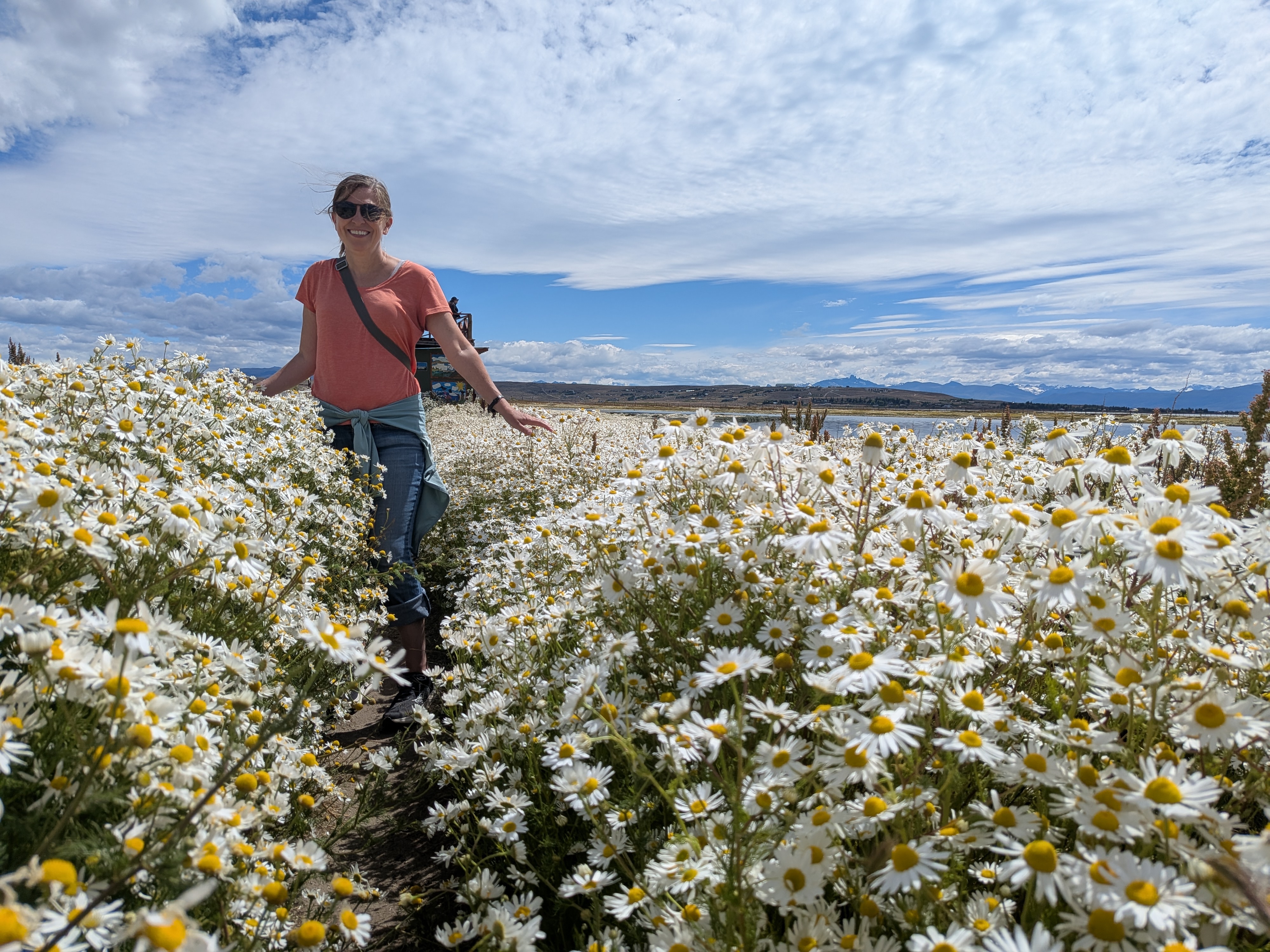
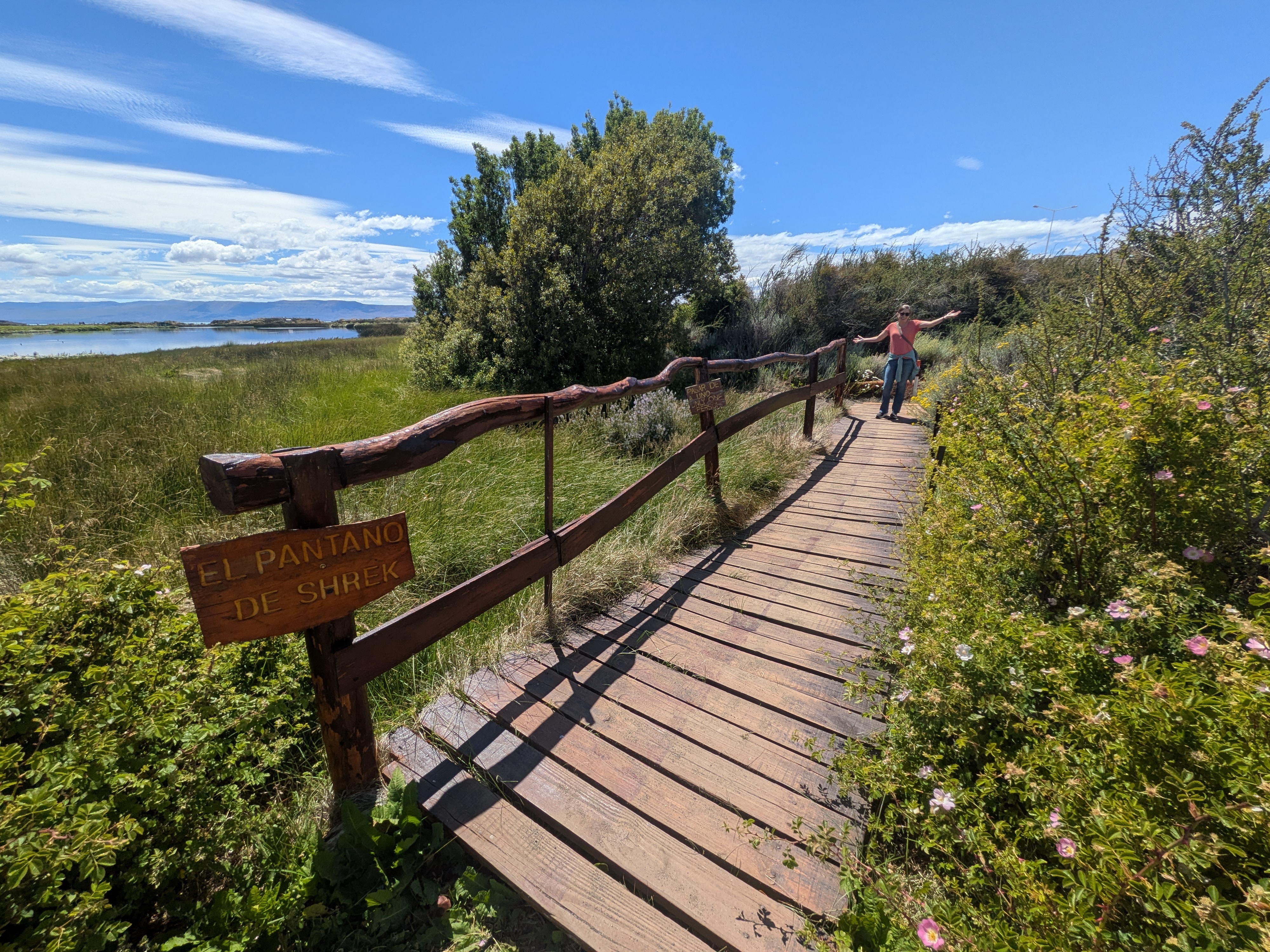
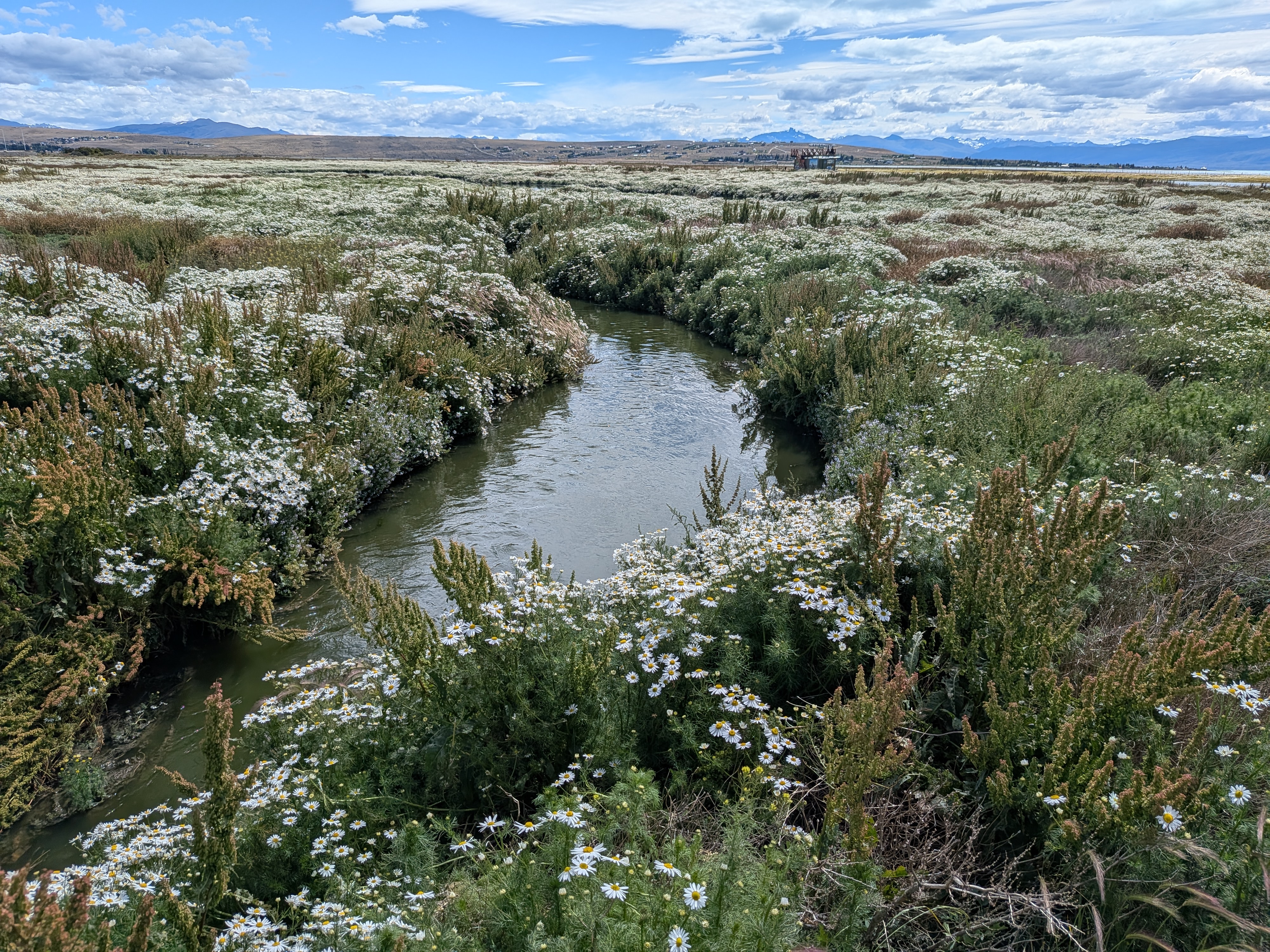
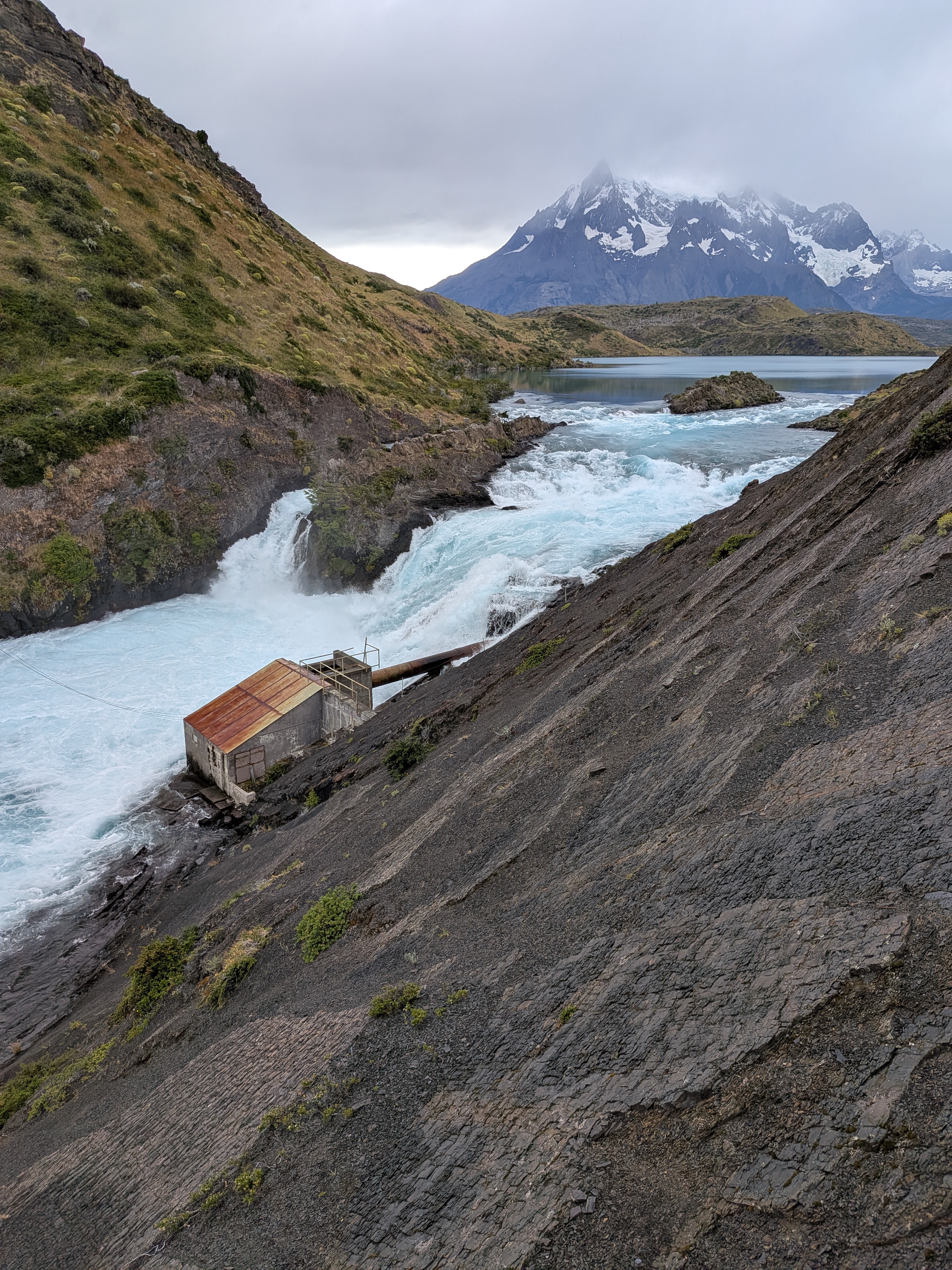
We had an hour to kill in the afternoon and the weather was beautiful so we decided to take a leisurely stroll down the road to the Explora Hotel where we heard that there was an easy boardwalk stroll to see a waterfall next to the hotel. What we did not realize was that the boardwalk was actually a maze of paths set up by the hotel that did not always go directly to the viewpoint of the waterfall. In fact, what we thought would be a twenty minute stroll to see a waterfall turned into an hour and half of wandering over old wooden paths, always hearing the waterfall, but taking a long time to finally get to the spot that we had heard about.
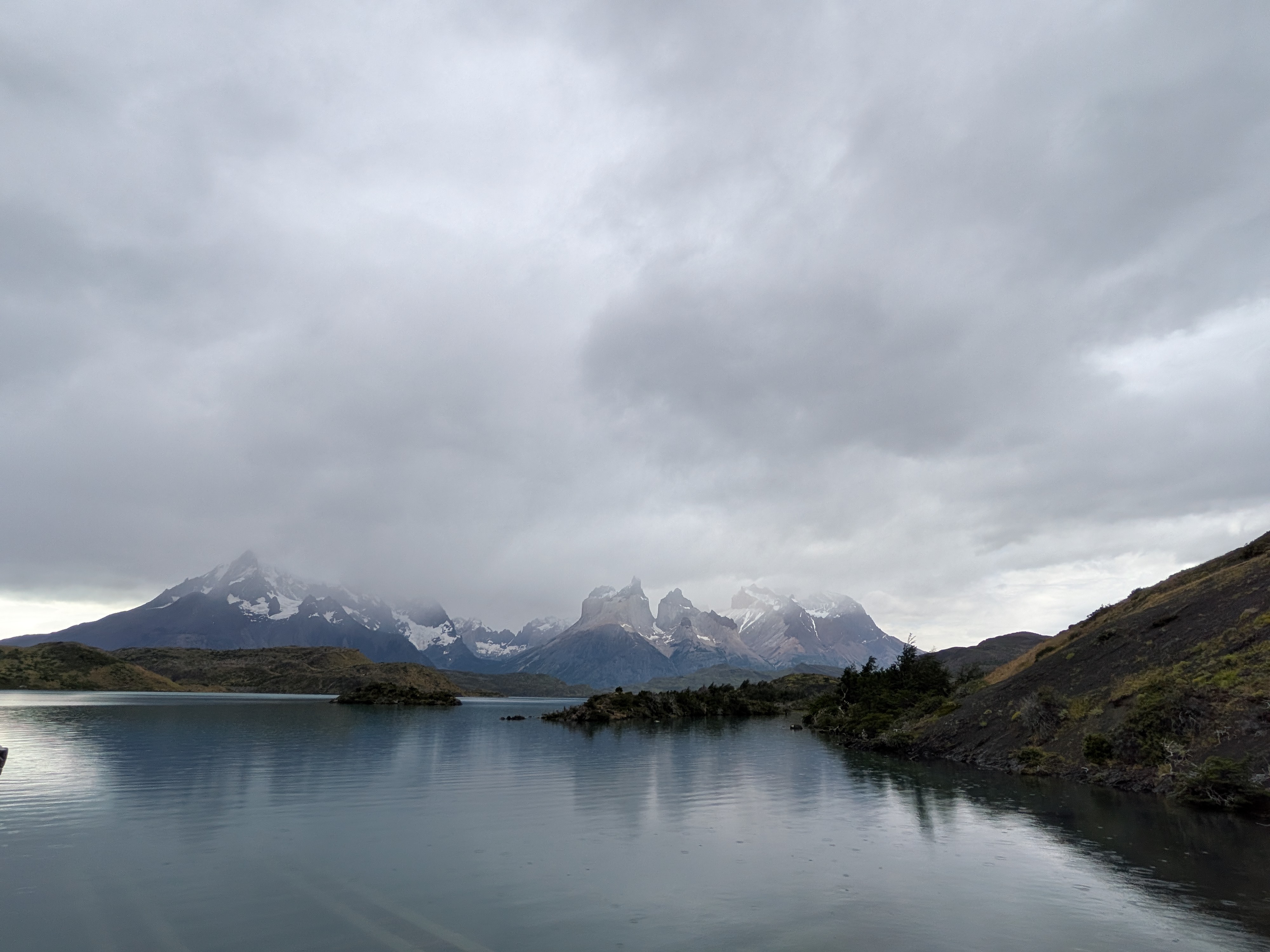
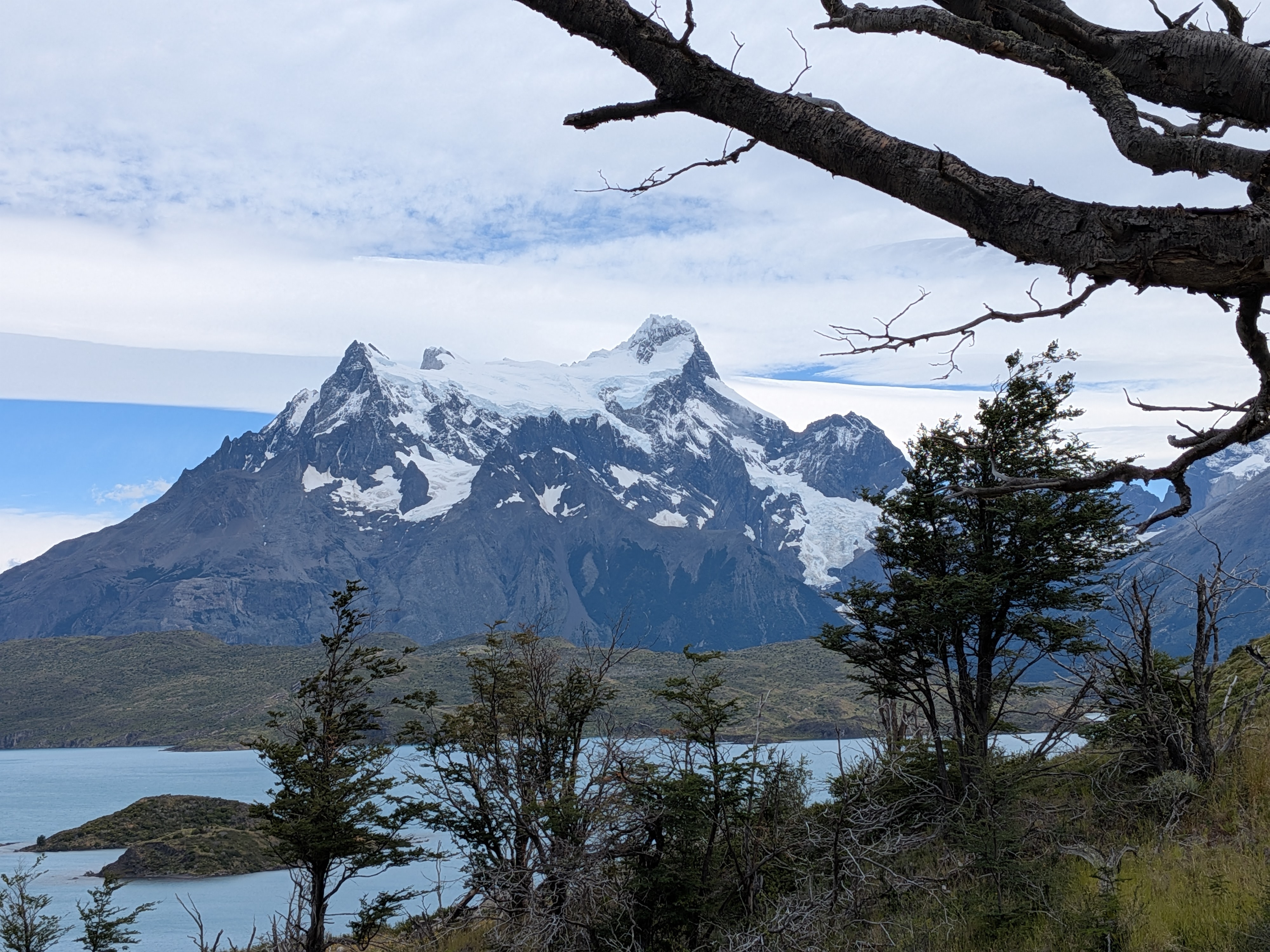
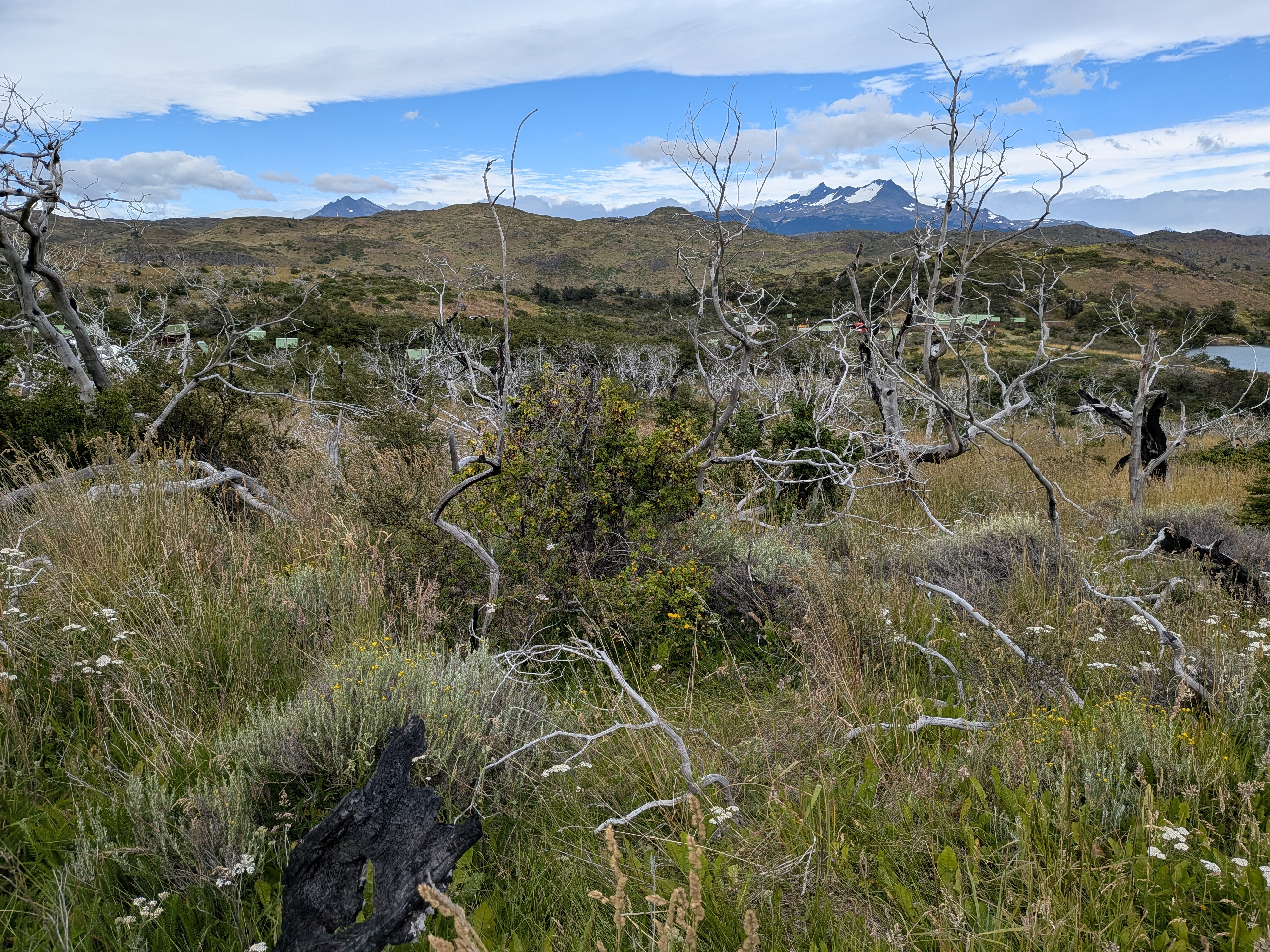
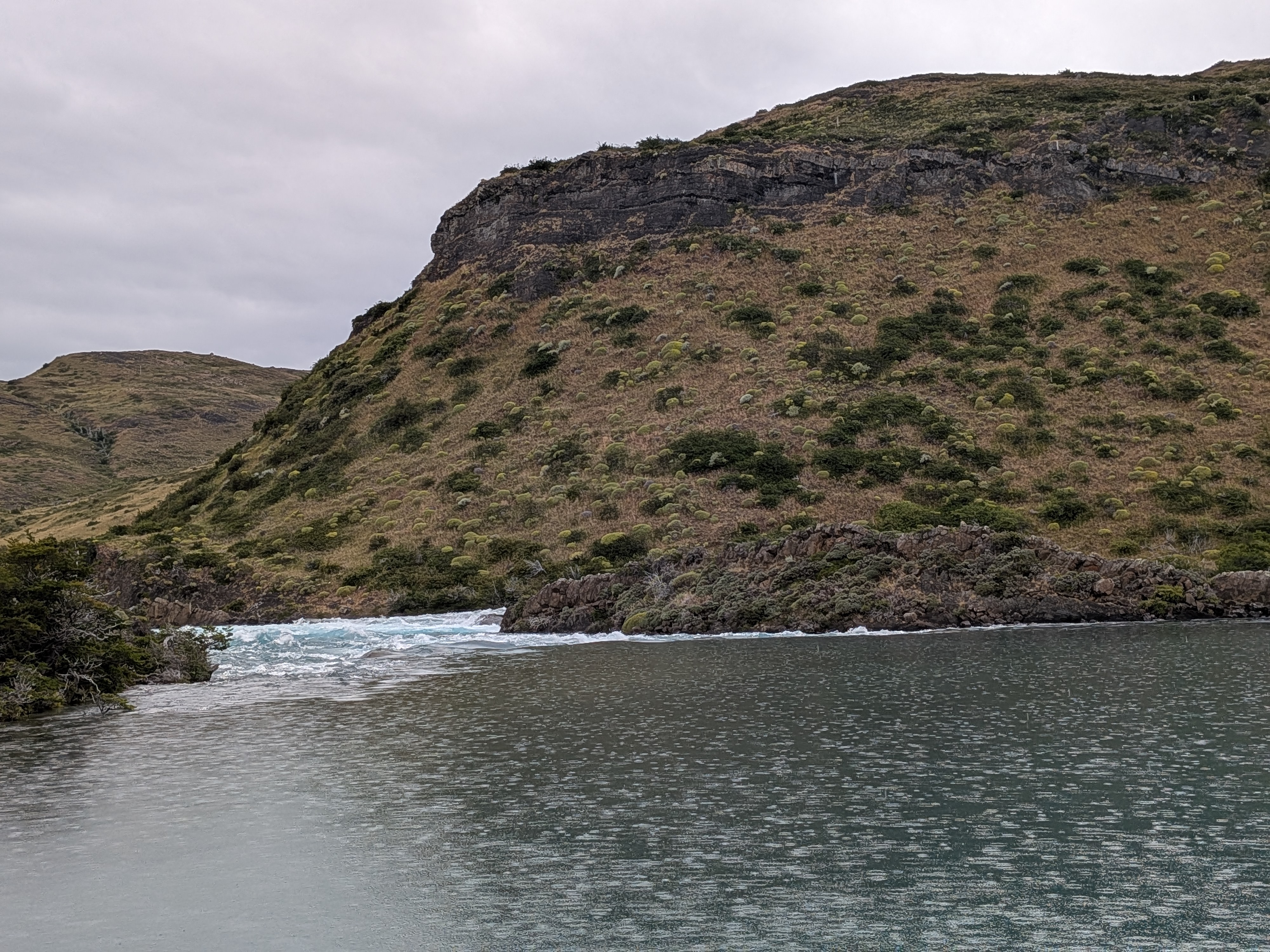
We traveled from Campground Pehoe by turning right out of the parking lot from the restaurant and walking fifteen minutes to the Explora Hotel. The boardwalk was hard to miss when looking from the right side of the road, but this was the back part of the boardwalk, and we made a few mistakes from this point. When wer got to our first four-way intersection on the boardwalk, we thought taking a right would be the logical choice because this led to the lake and we could hear the waterfall coming from this direction. But this was incorrect. This took down to a dock where a large boat was parked, and we could see the rapids that were formed at the top of the waterfall, but could not see the waterfall itself. It was still okay because we had some beautiful views of the mountains in the distance and the whole lake, but we knew there was a better view, and we just needed to find it. 
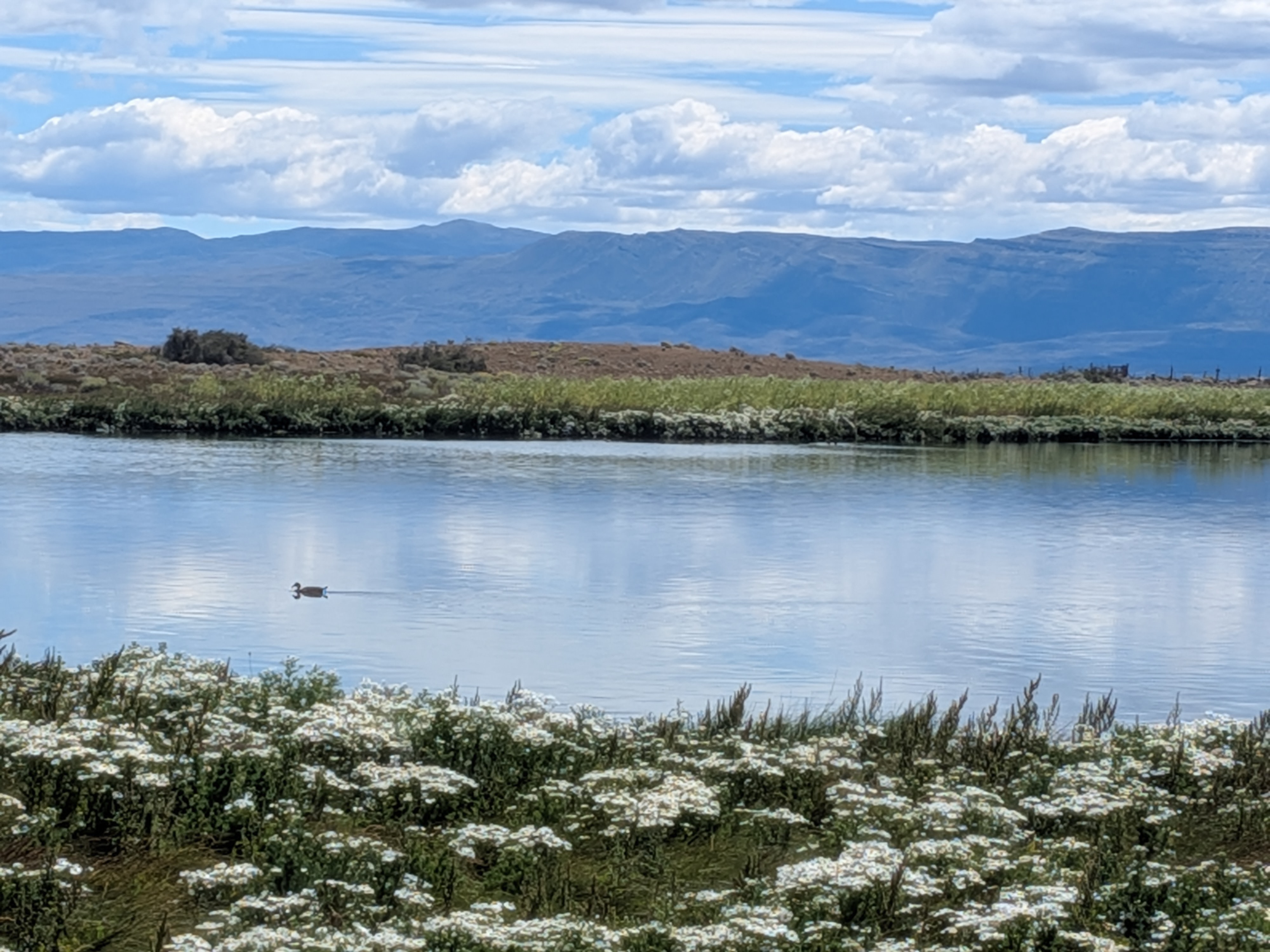
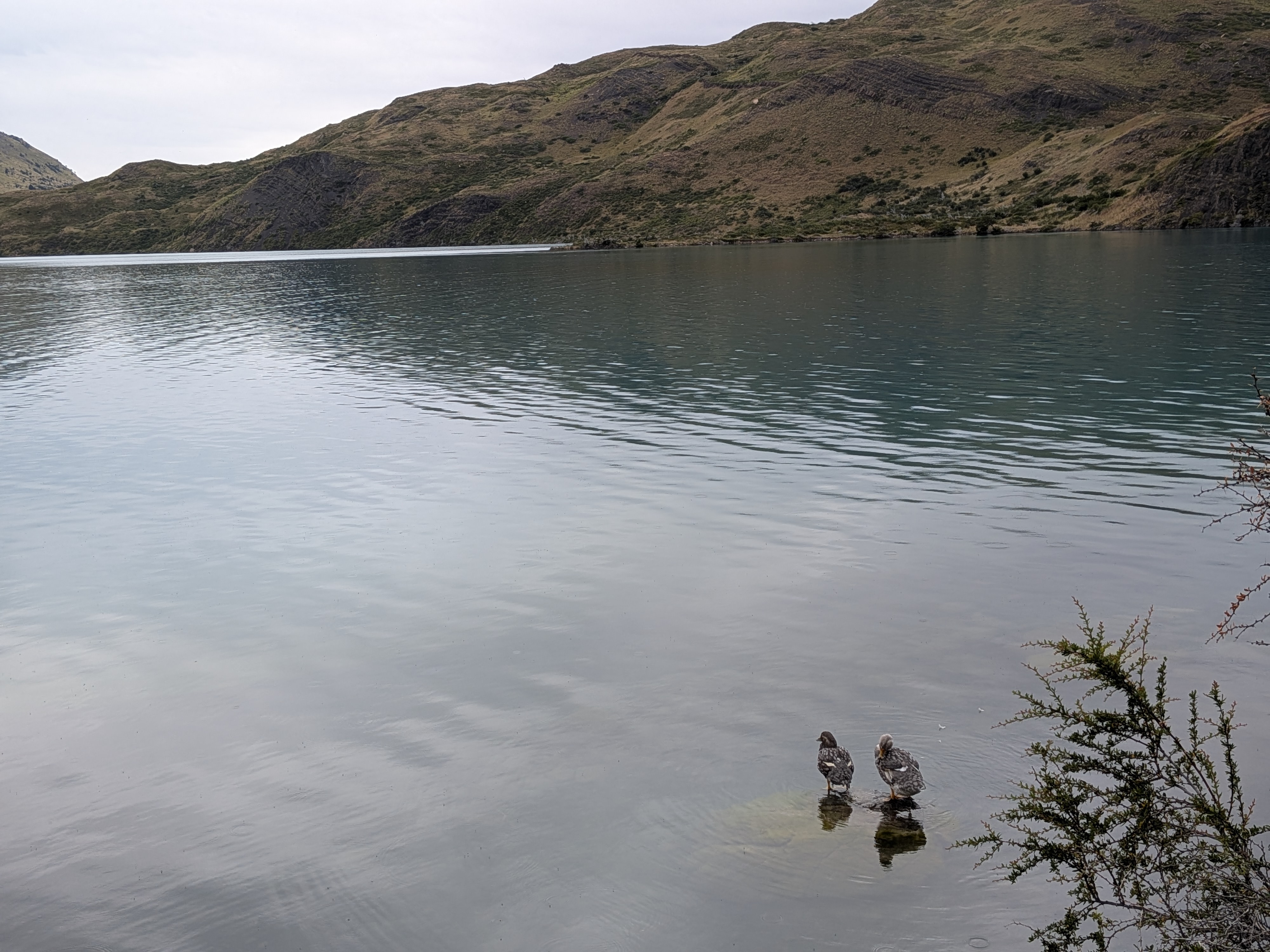
We backtracked and took the left turn this time because if we had gone straight from our original position, this would have taken us to the hotel. This part of the boardwalk seemed promising even though it was taking us down to the hotel’s spa. Still, there was another fork in the boardwalk that went right and took us down by the lake on the other side of the hotel. This followed the shore of the lake and its calm demeanor. We were able to get nice views from here as well, and there were even a couple of ducks sitting on the side of the lake that were there to greet us. Just to warn you, the boardwalk was at its most dangerous here with many of the board rotted and ready to break at any moment, but we took it slowly and were able to get to the other side without any problem.
This is where we were rewarded with the waterfall. We had to climb up a series of rickety wooden stairs to get to it, but once again we took it slowly and we made it up without a problem. Lo and behold, there was a waterfall there. It was a great spot to get some great photos and we were still able to talk over the roar. Even though it turned into a much longer hike than we were anticipating, it still made for a fun outing, and we were able to find some other nice viewpoints along the way.
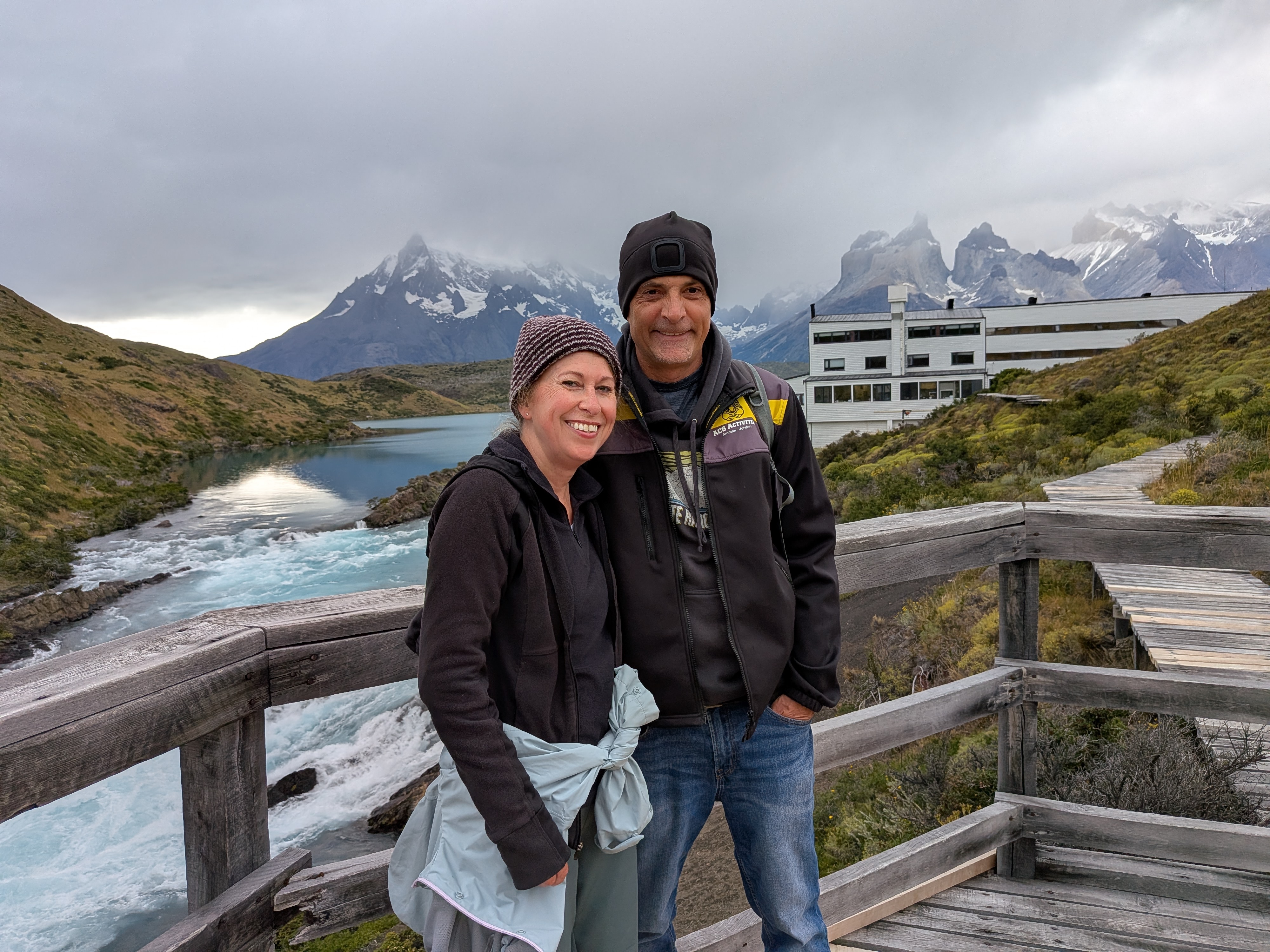
Going back we found the last of the boardwalks that took us straight to the hotel’s parking lot. It took us a lot longer than we expected but eventually we found the path that we were originally supposed to take to make this a twenty minute stroll instead of the afternoon adventure that we had. Still, I am glad that we did it the way that we did because I think we got more out of the experience. It is a great way to spend some time if you have a lovely afternoon and you really do not have anything better to do.

Campground Pehoe – Torres del Paine, Chile – Without the W or the O Part 2

When hiking the W loop or the O loop in Torres del Paine in Chilean part of Patagonia, one of the benefits of it is having a place to stay each night while out there. Anybody who has looked into staying out in this national park has discovered that the price of lodging is through the roof. Some people find it so expensive that they decide to do day trips from Puerto Natalis instead, but doing that means that you are missing half of the fun that can be found in this park. I have enjoyed staying in the park, but I will admit that it was expensive to do so, but I did not go for the hotel option. Instead, we stayed at the Campground Pehoe. It is situated in between to of the bigger hotels in the park, and it is considerably more affordable than the hotels.

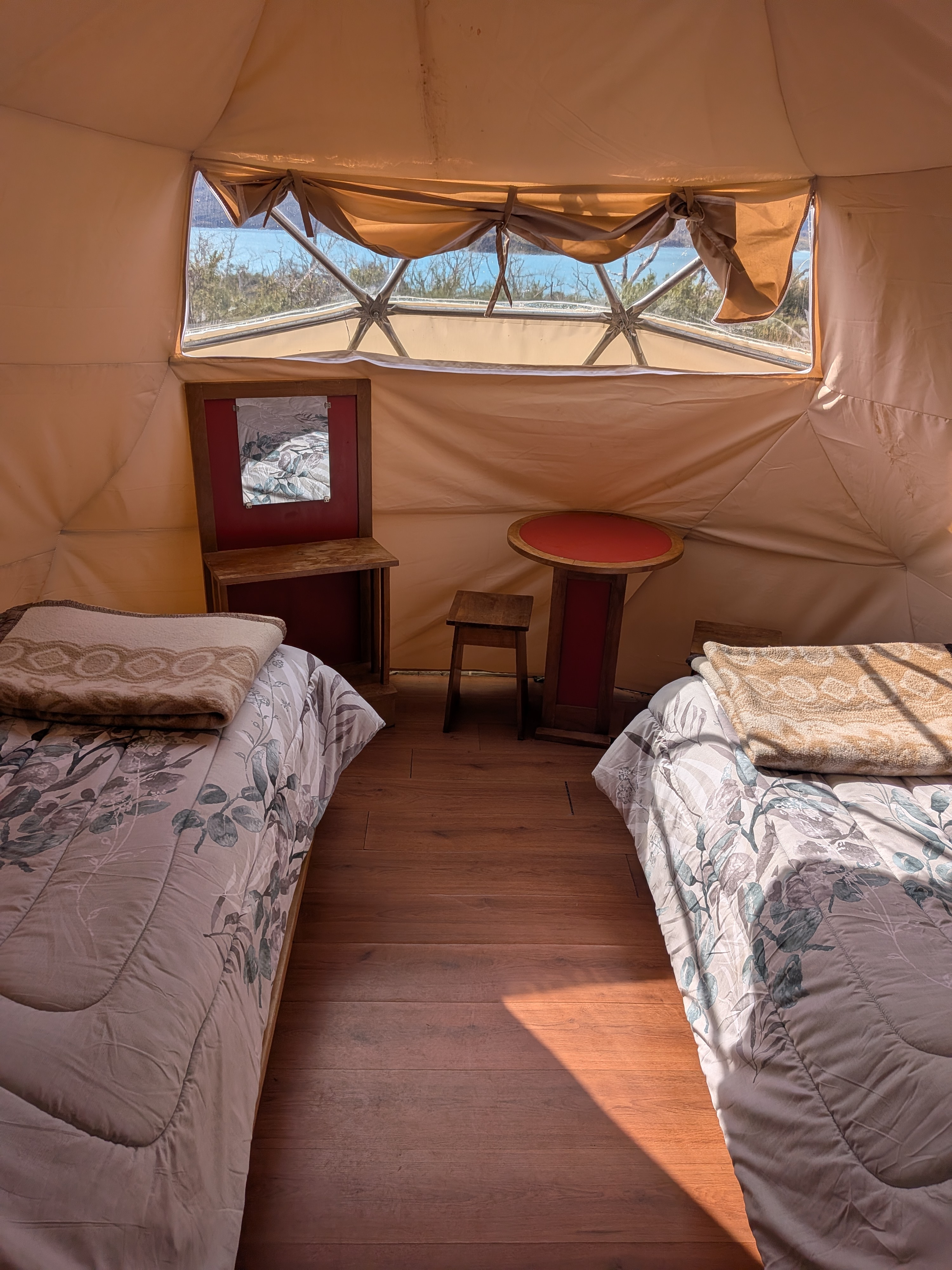
Now keep in mind that affordablity is a relative term. Campground Pehoe is easily the most expensive campground that I have ever stayed at, and the benefits to staying at this place do not necessarily match with some less expensive campgrounds I have stayed at around the world. We stayed in one of the canvas domes that are on the edge of the campground. They do offer some amazing views of the mountains over the lake, and we did not have to set up camp, but we were still paying over $130 a night in U.S. currency. This did not come with any great ammenities such as electricity or heat. It was a basic room with a couple pieces of furniture, a bed, and a hardwood floor. It stayed cool during the day, but I could see if the sun came out that the tent would get extremely hot. Fortunately, we were in Patagonia where the weather rarely gets that hot, so it always stayed at a comfortable temperature.

There is a shared restroom not too far away which is great during the daylight hours, but makes for a cool, slow trek at night, especially if the moon is not creating enough light. On the other hand, at night when it is clear, you can see a vast network of stars because you are far enough away from any light pollution to destroy this spectacle for you. There is also a restaurant close by that also acts as a cafateria. It does not have a lot of amenities that you can use, but it does supply hot water in the morning for coffee, and a place to sit during down time or while rain comes blowing in. In other words, even the best of spots in this place offer to simplest of features for you to enjoy your time there.

They do have camp shelters as well. There are plenty of these around, and they still cost more than you would find at a typical campsight in other parts of the world. They do offer you a shelter though for you to set up your tent and to protect you from the wind and rain that come intermittently in this campground. The problem comes with the fact that you need to bring all of your camping gear with you. If you are able to do that this is a bargain, but if not, you can still rent all of the equipment from the campsight, but when you add up all of the costs, it ends up costing almost the same as renting a dome, and then you have to spend a lot of time setting it all up.

They do have a restaurant there where they cook everything over a grill heated up by throwing big logs on to a fire. The selection is not amazing, but after a long day of hiking and exploring the park, the choice between a huge steak or a hunk of grilled salmon is the only thing you really need to think about. The food portions are huge, and they are not fancy, but they are prepared well. I was never disappointed in the food, and when I wanted a snack, they had a selection of quick grocery store bites that could satisfy that hunger during the day. They also had hot water in the morning and throughout the day, so if you were looking for a cup of coffee in the morning, or a cup of instant soup in the afternoon, it was really easy to make. They do turn off the water for dinner which we found out the hard way, but if you plan ahead, it is not a problem.

Overall, it is a great place to stay despite the price. It keeps you warm and dry during the crazy changes in the weather that can be found at Torres del Paine, and when it is gorgeous outside, the campgrounds might have some of the best views in the park. It is the perfect place for those who are looking to spend time in the park but have more of a budget. It isn’t perfect, and if you go in thinking that it is a couple of nights camping, you will be happy with what you get out of it.

Mirador Condor – Torres del Paine, Chile – Without the W or the O Part 1

It is a badge among many hikers to travel all the way down to the southern tip of South America and do the five or six day hikes that are a part of the W loop or O loop in Torres del Paine. Not to take away from the people that are able to accomplish these great feats, but there are many other ways, and many other hikes to take that are just as spectacular in this National Park of Chile. It also does not require you to book the hikes six months in advance to make sure that you have the limited spots that are available on these paths, and if you can find the trailheads, you are welcome to enjoy these hikes on your own time. This short series will explore some of the paths and other things available that I was able to take during my five night stay in the park, and it might help you plan your trip if you were not able to book the W or O loops.

The first one is one of the easiest to find, Mirador Condor. It is a forty-five minute hike out, and forty-five minutes back that takes you to the top of a ridge that will give you some of the more iconic views from the park. The path is groomed well, and for the most part is pretty easy to travel on. It is a little steep on the way up, and there are parts with loose soil that makes footing a little slippery, but if you take it slow on the way up, it is still not too difficult. I would recommend bringing hiking poles as well and this will help give you the balance that you need to reach the top.

The views are not the only reason to take this hike. Just as the name implies, this is also the scrounching grounds for condors, and if you are lucky, you can find them hunting for food. These birds are enormous, and watching their graceful dance as they float over the peaks was one of the highlights of this trip. They are not always out, but they usually hunt in the morning hours when it is not too windy, so if you plan your trip well, it will increase your chances to see them. I know that the picture I included does not make it look like they are that great, but it is hard to take a picture of one of these birds that does it justice. You just have to go out an visit to see how majestic these birds really are. Also, I am told that nine times out of ten when making the hike up to this peak, people will not see condors, so if you do see them, consider yourself extremely lucky.

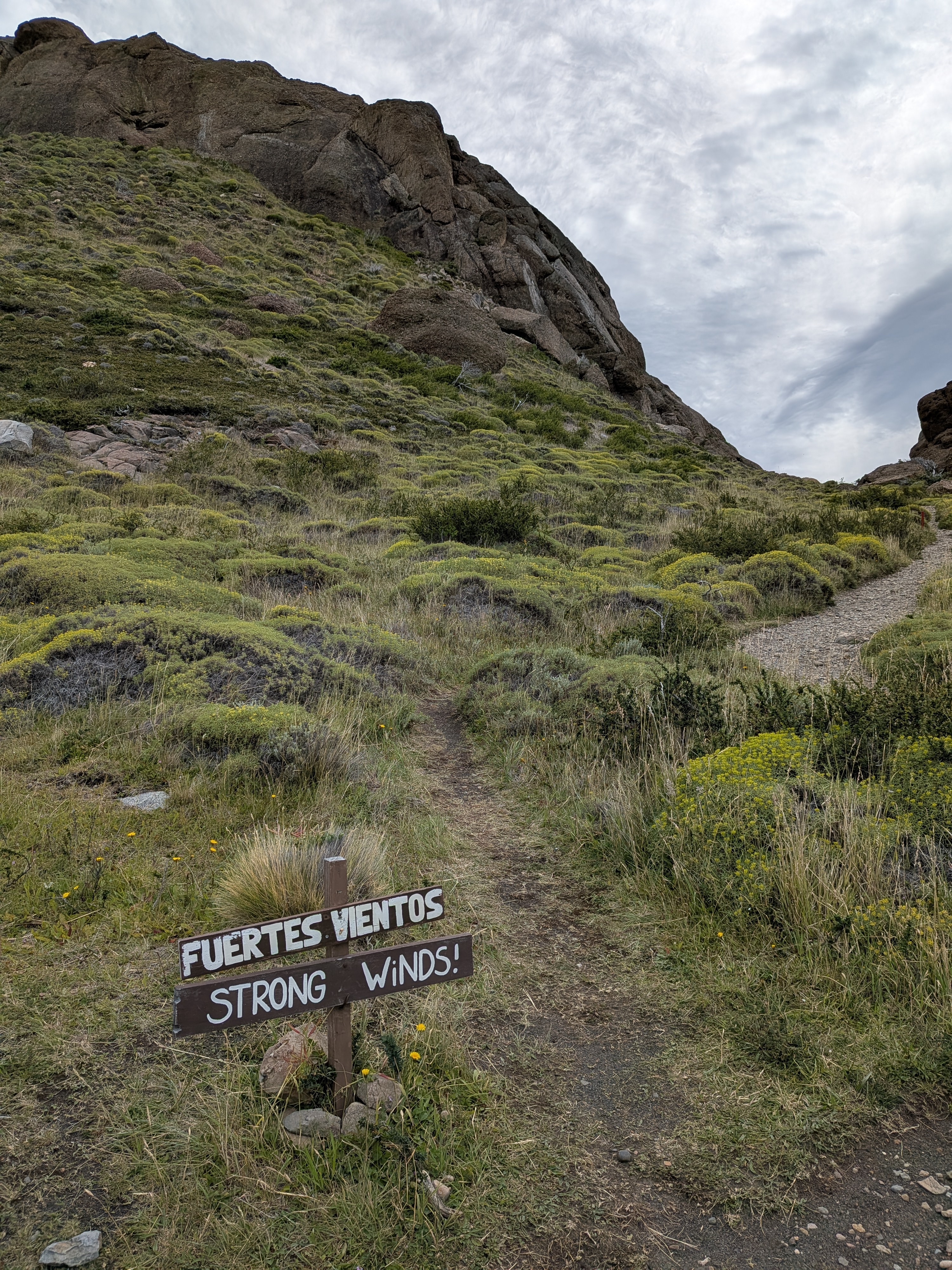
Another reason that you might want to go earlier in the morning is because of the winds. On the way up, it was not very windy, and I even joked about some of the signs we ran into that warned about the high winds. Right when we summited, the winds came, and apparently heard me joking about them because they came in strong. They were not joking about the wind either. It blows so hard that it feels like it could easily sweep you off of the mountain, and there was a saddleback in between two peaks where the path takes you, and it is here where the wind was at its worst. We ended up walking directly into the wind on the way down in this part, and that might have been the most strenuous part of the whole hike.

The trail head is pretty easy to find. We left from Campground Pehoe. If you are leaving from the parking lot with the restaurant in it, it is to your left. We walked down that way, and we reached where the parking lot for the trailhead was in a couple of minutes. It was really easy to find, and there is even signs that point to where it starts. This is not the only way to the peak. There is another path on the other side of the mountain that you can find by traveling another kilometer and you will be able to find the parking lot right before the bridge that takes you to the hotel on the island in the middle of the lake. We did not take this path, but we talked to some people on top of the peak, and it sounds like it was just as difficult as the one that we took. Either way, you should be able to find your way up to this amazing viewpoint in the middle of Torres del Paine.

Cueva del Milodon Natural Monument – Patagonia, Chile

One of the biggest attractions in Patagonia is the national park, Torres del Paine, and you can find a stream of cars, campers, and tour buses taking the one road out of Puerto Natalis every day during the summer to bring various travelers to this spot to enjoy the scenery, take in the hikes, and snap a few pictures to bring back as momentoes. But there is a stop along the way that many people skip out on and they should take the time to explore this spot, Milodon Ceuvas. This is three natural caves that were formed when the sea levels had reached the lower shelves of the mountains, and dug away the sediment to create these caves.

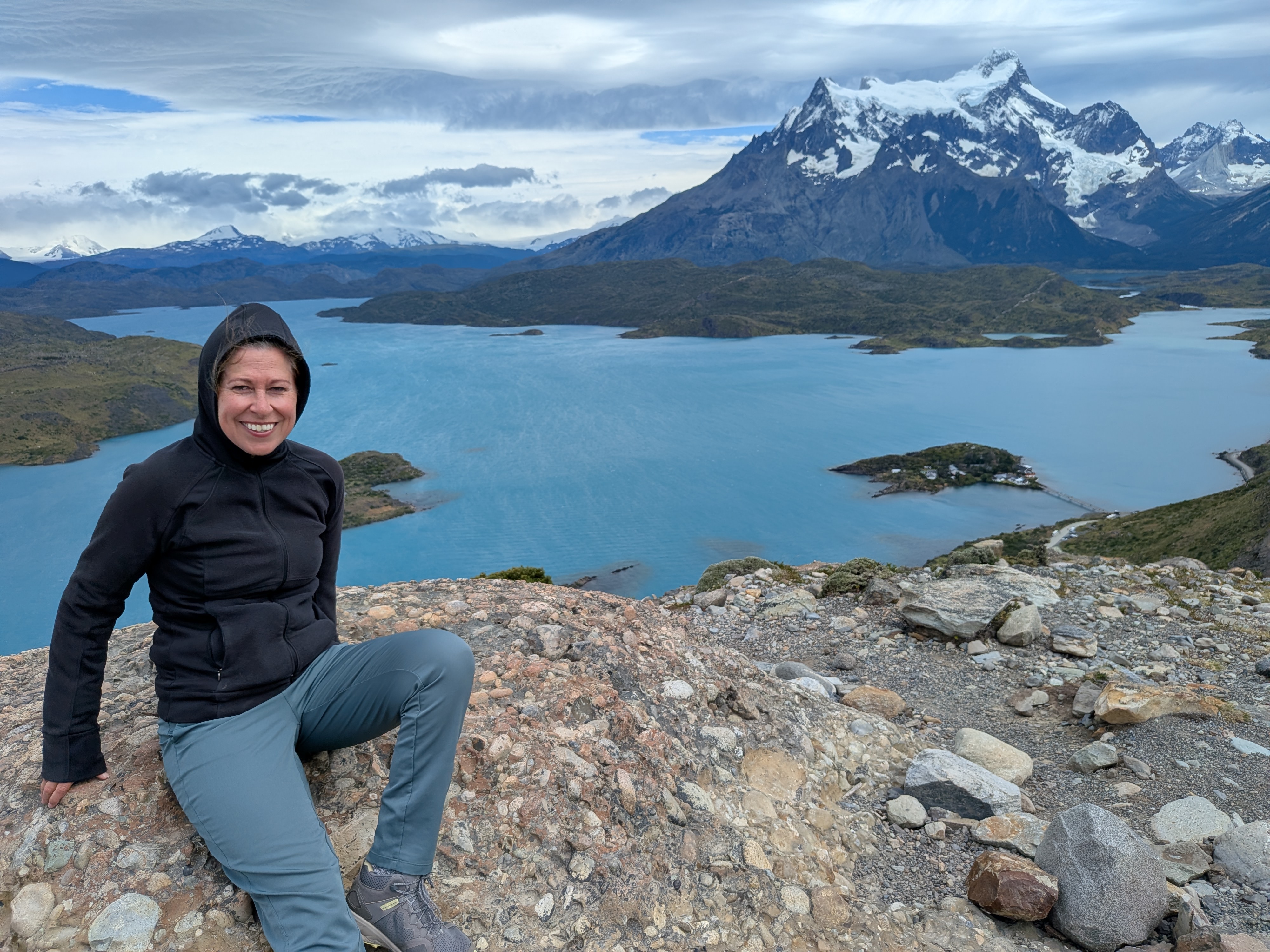
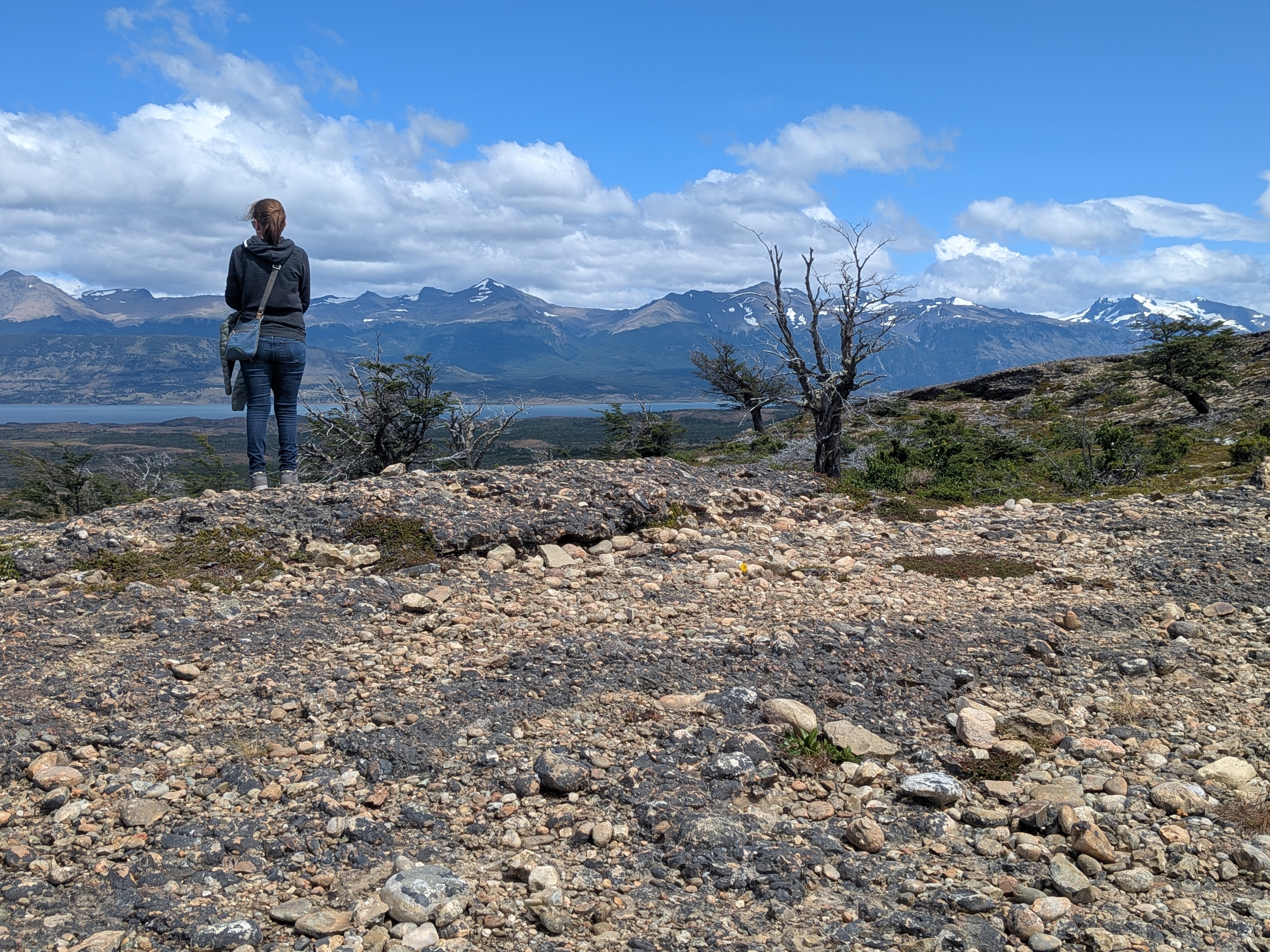
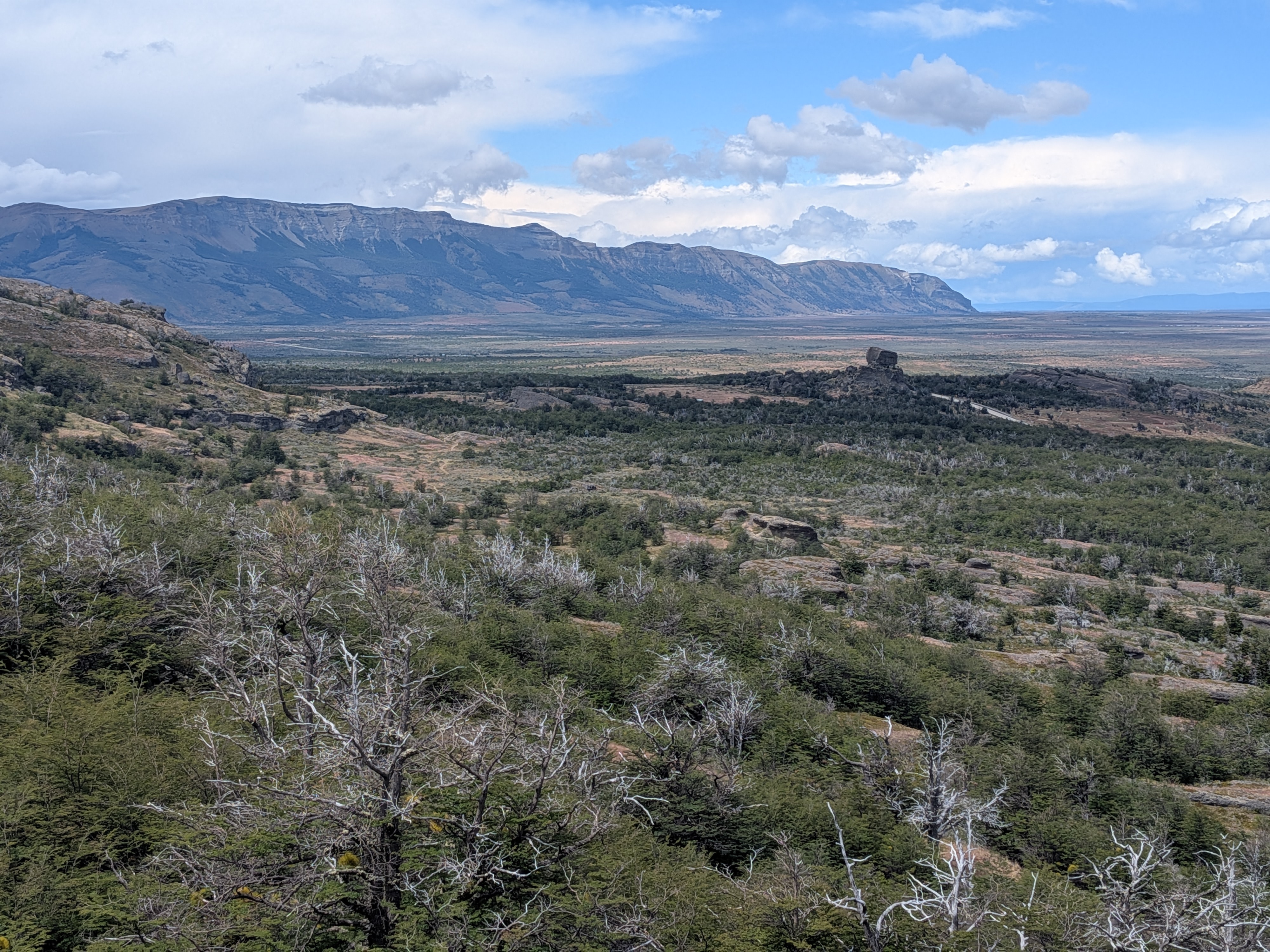
There are many reasons to make this stop besides the caves. The first is a short hike about an hour long there and back that will take you to the top of a plateau that overlooks the whole valley all the way from Puerto Natalis to the start of Torres del Paine. It is a little bit of a rocky hike up to the top, but with some good hiking boots, and a bottle of water, most people can make it to the top without any trouble. I especially like the hike because when you get there and take a couple of pictures from the right angles, it looks like you accomplished a more difficult hike than you really did.

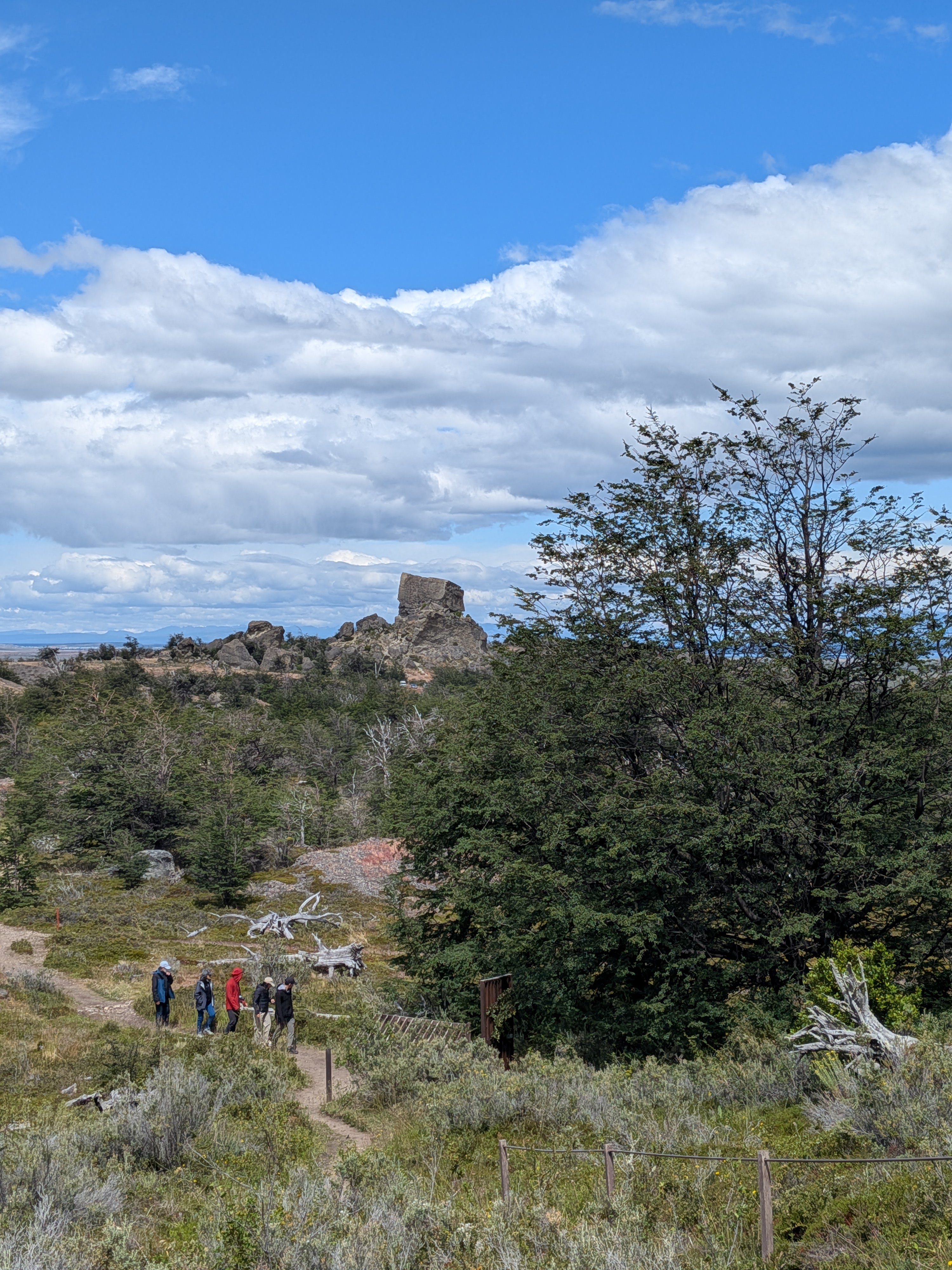
The other big attraction is the Devil’s Chair. It is a rock formation that sits right off the road and is the first impressive sight that you will see on your way to Torres del Paine. This can be easily reached by hiking along the valley for a kilometer from the visitor’s center, or for those that are not as adventerous, you can open the gate and drive your car down the dirt road to the rock and look at it. If there is one thing to skip on this trip, it is the hike out to the rock. It does not look as impressive up close as it does when you are further away, and there are plenty of views of it as you explore the rest of the area.

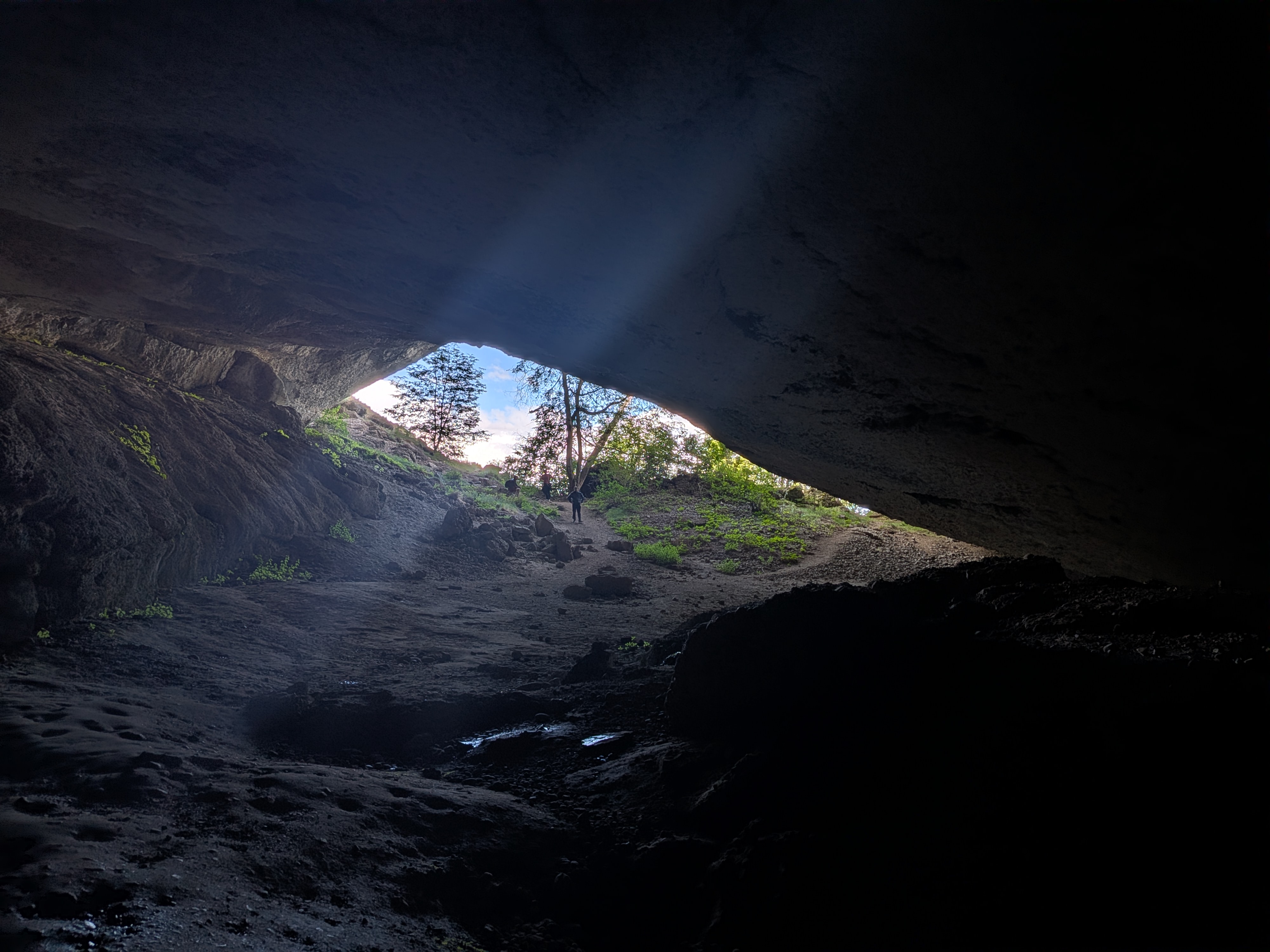
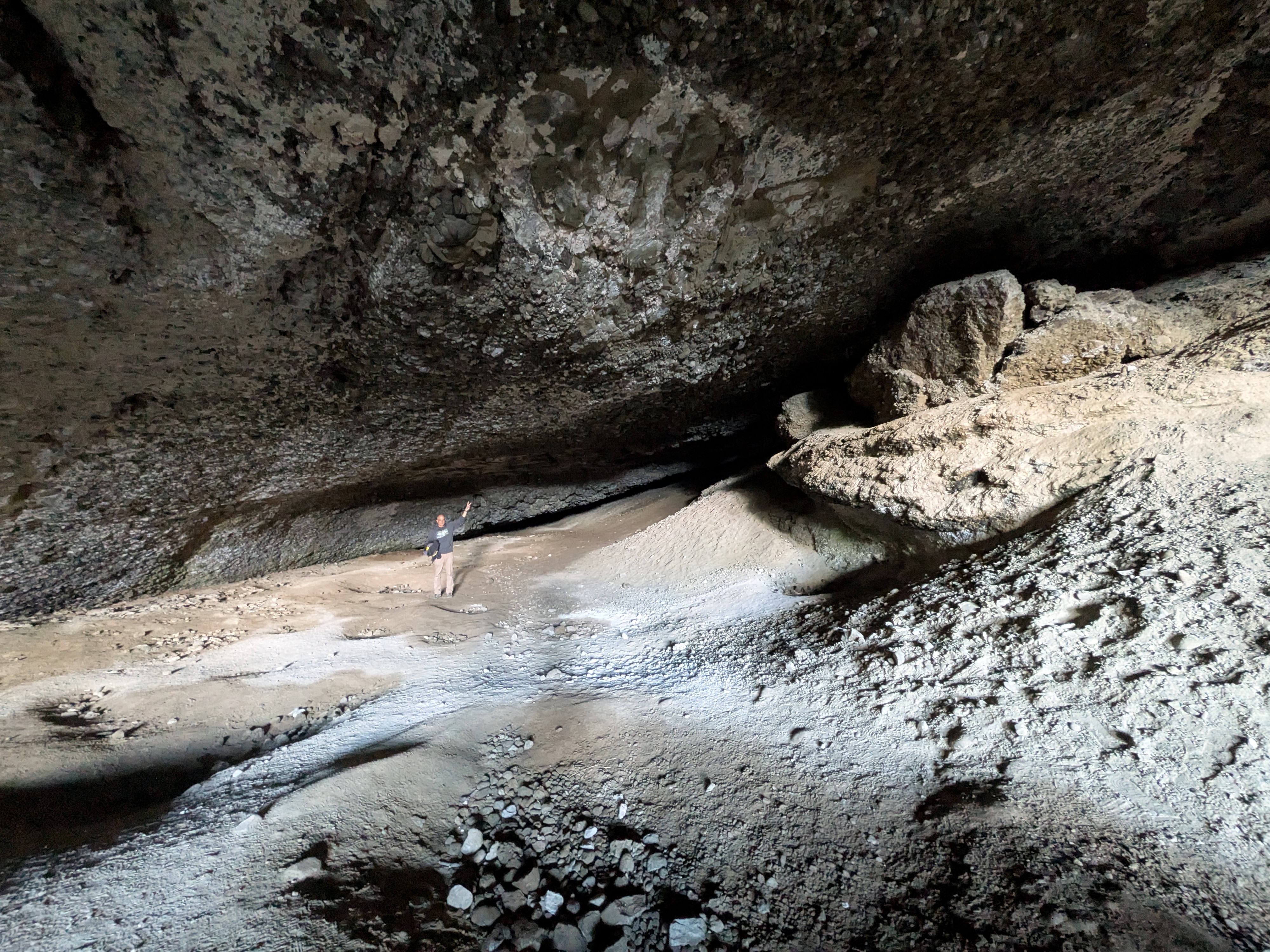
The thing to stop for is the caves. The one closest to the visitor’s center is the easiest to get to and has a paved path all of the way up there. The walkway has many signs along the way that talk about the formation of the caves, the various types of animals that used to live in the area over the centuries, and the how the first people in the area used to live. It is also the biggest of the caves, and it looks like most of the time people are allowed to walk all the way around the cave, but the back portion of the cave was closed while I was out there. It is also a very yound cave in terms of what features can be found there. There are only a few stalagtites being formed so far, but most of the ceiling and walls look as smooth as a new canvas waiting for the artist to deliver his paint.

The other two caves are similar and it takes a couple of kilometers to get out to the furthest one. The one in the middle is considered one of the most important finds in all of Patagonia as it had human remains in there that show that this was the oldest place of human habitation in all of the region. The caves are neat, but they do not take much time to explore so if you are not up for a good hike, then they might not be worth the effort. I enjoyed them a lot and would do the hike again, and it does not take more than a couple of hours to do the whole loop.

If you are taking that drive out to Torres del Paine, I would recommend making this stop along the way. It will whet you appetite for the exciting things you will see when you finally make it to the national park.

Kayaking to Moreno Glacier – El Calafate, Argentina


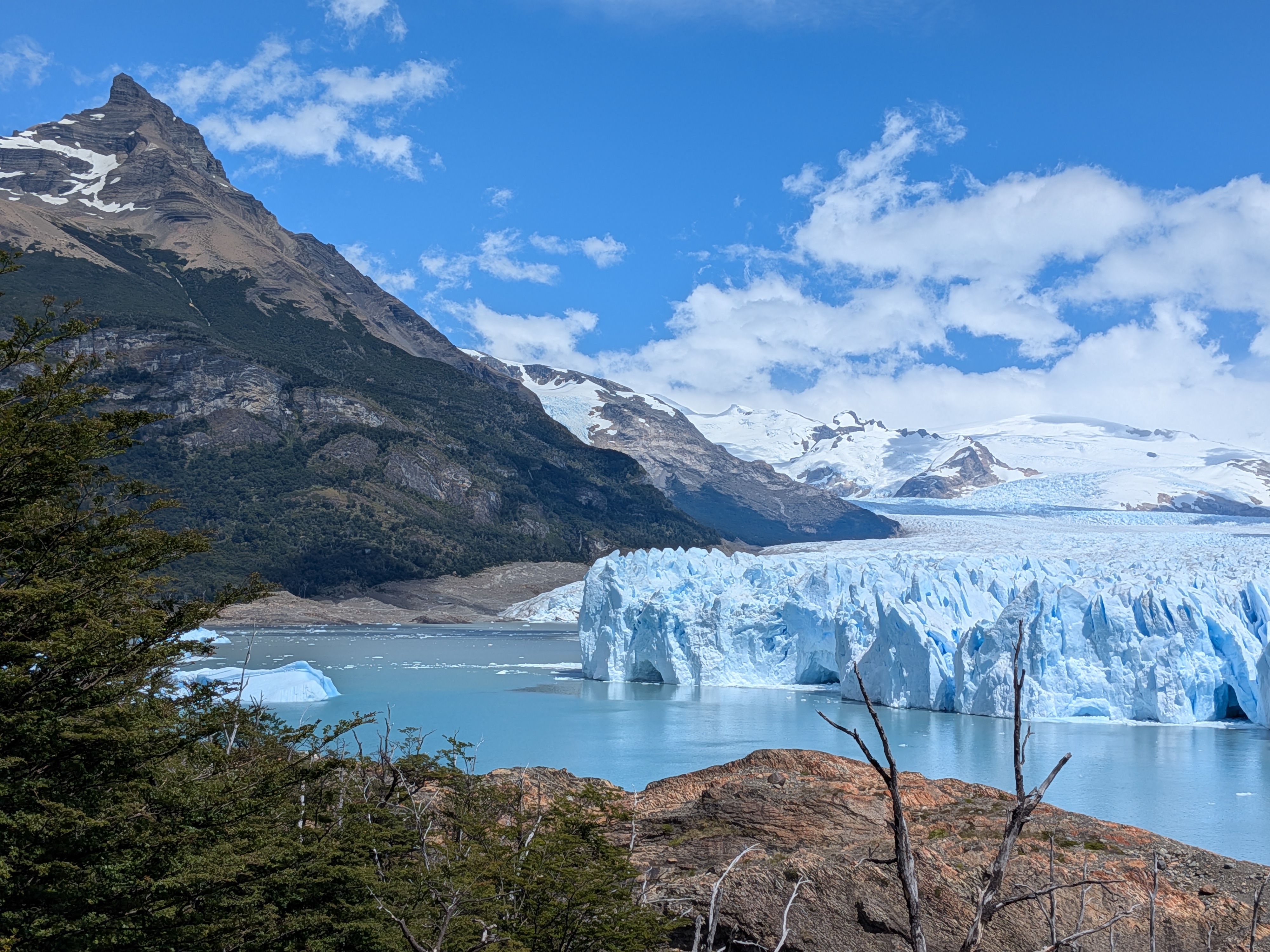
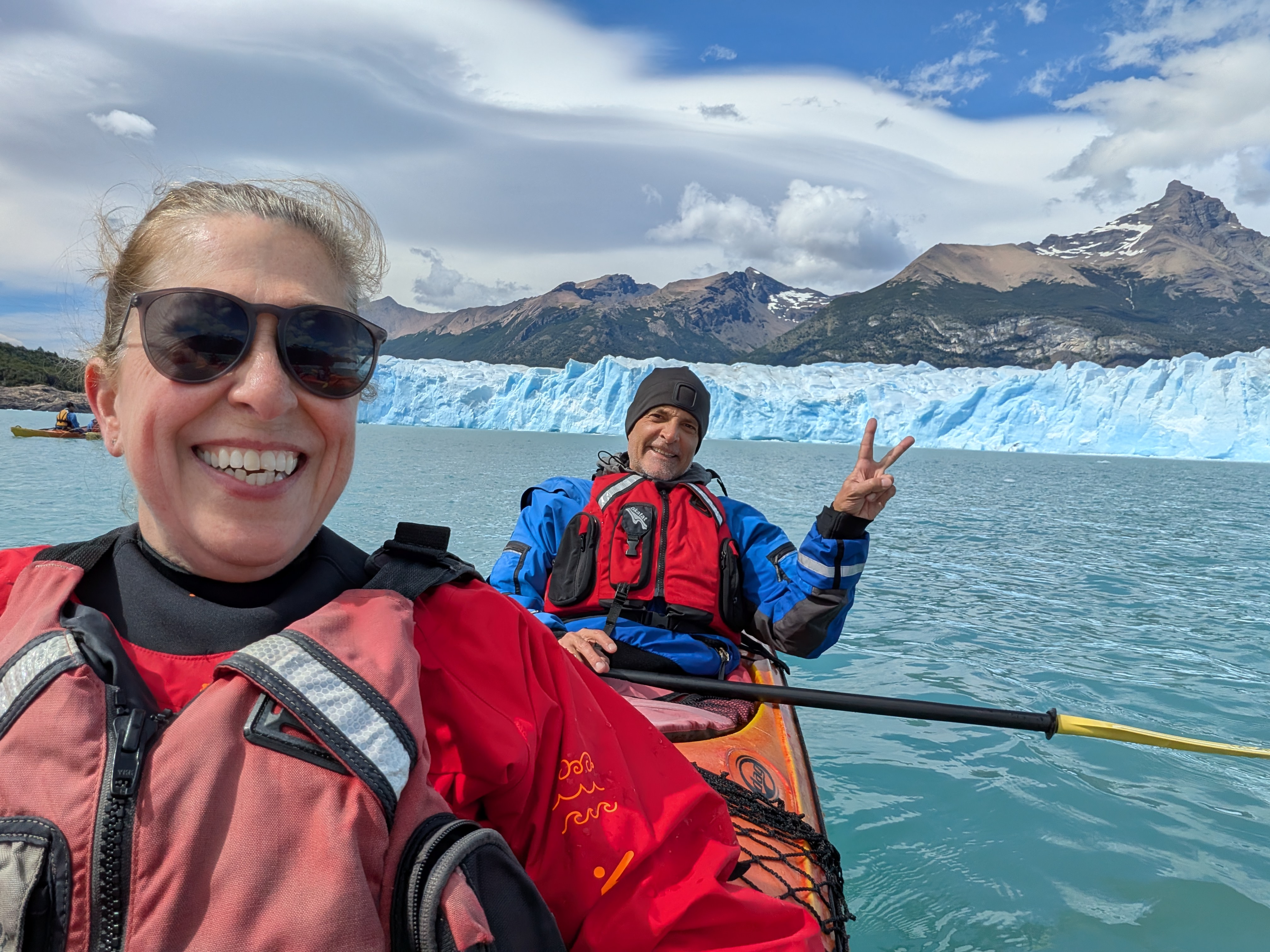
There are two big attractions outside of El Calafate, both of which are for the outdoor enthusiast. The bigger of the two, or the one that I am told is the most visited sight in Patagonia is the Moreno Glacier. There are many ways to experience this glacier. There are treks that will take you out on the ice. One is more of an adventure than the other one, so depending on your hiking level, you find the one more appropriate to you. There is also a ferry like ship that people can book passage on and it will give them a tour of the lake, getting close to the glacier so people can see it calf. Many people load up their cars and drive up to the main visitor center where there is a walkway that will take them to many great viewpoints where they can still hear the rumble of the ice as it falls into the water. And there is the option that we took which is to put on some wetsuits, grab a paddle, and push a kayak off from a sandy shore two kilometers from the base of the glacier.


Each one of these options allow you to explore the glacier in many different ways but they limit the amount of people that can experience any of the options except for the walkways by the visitor’s center. Because of these limitations, the excursions have a tendency to start to book up, so I would recommend to book them at least a month in advance, or if you are trying to play the weather game to look for a good day to enjoy the glacier, no later than a week earlier. If you do wait until later do understand that some options might not be available. This is what happened to us, and part of the reason that we ended up kayaking instead of doing one of the treks.

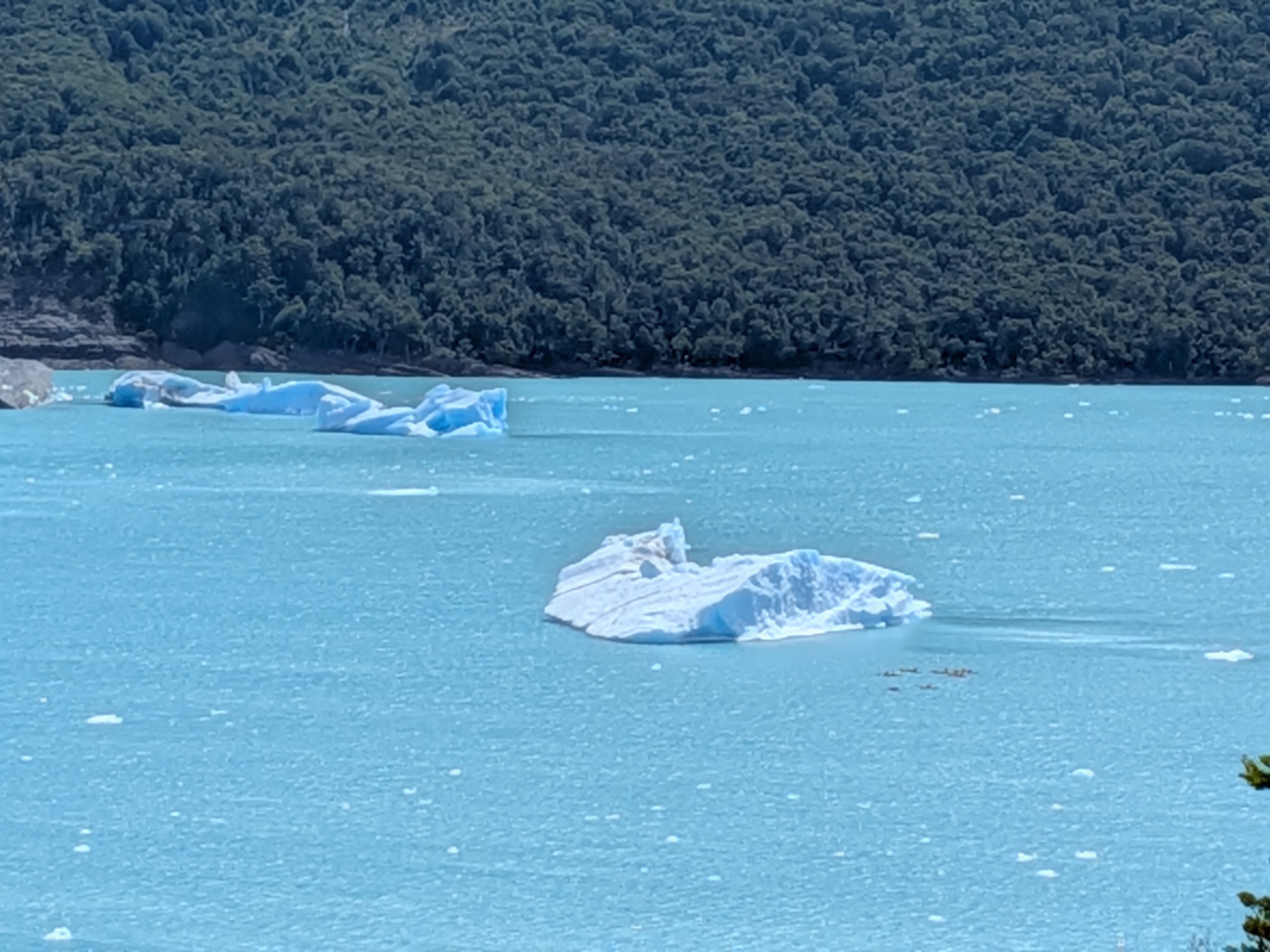
This is not to say that kayaking is a bad option. I love kayaking, and though it does not get you as close to the glaciers as the big boat will, it still gets you close, and the perspective you get from being low on the water makes the glacier look the most impressive. It towers over you and a couple of times, we actually felt the waves created by the glacier shedding a cathedral-sized hunk of ice from its edge. My issue was seeing the glacier this way was that I have visited a couple of glaciers by kayak, and I really want to try voyaging over one some time in my lifetime.

Still, the company, Patagonia Chic, we went with supplied us with the perfect day to go out and do this. It did require an early morning as they came by our hotel with a bus to take up into the national park. On the ride up, a guide talked to us about the area and some interesting facts about it. My favorite was where the name of the town, El Calafate comes from. There is a berry that grows on wild bushes in the area that is called calafate. It looks like a tiny blueberry, and people pick them to eat or turn into a jam that you can find all over the town.

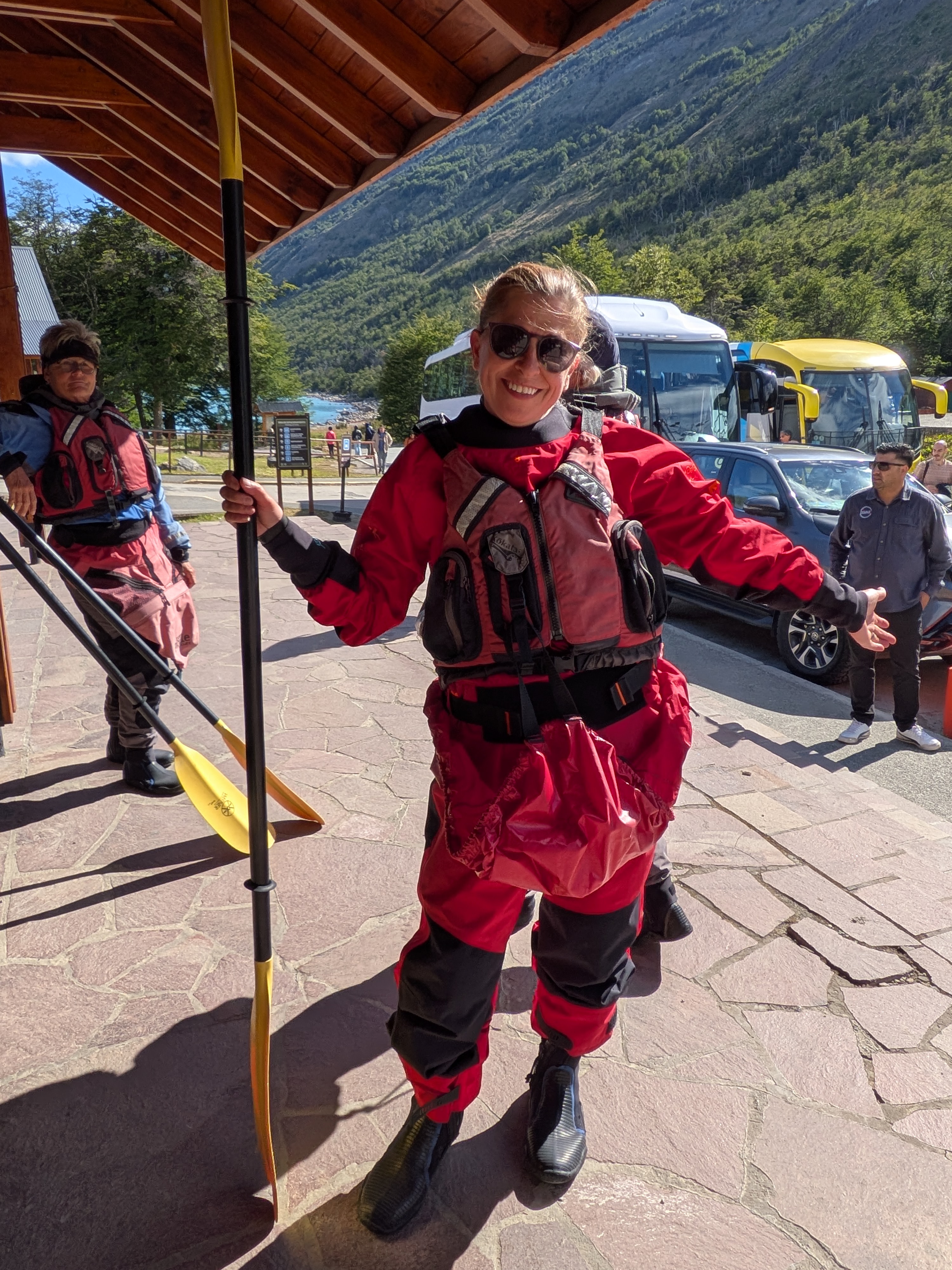
After an hour and half ride, they dropped us off with the kayaking company. The company supplied us with wetsuits, kayaks, and two guides. There was a little talk about how to operate a kayak which is always nice to have, especially for those that have never kayaked before, and our guide was so good that he gave me a couple of pointers that I have never heard before making my kayaking experience even better.

We had a beautiful day to go out to see the glacier and explore some of the recently birthed icebergs. The weather was 21 degrees Celsius which I am told eight degrees warmer than the typical temperature during this time of the year. I am also told that they do still go out in adverse weather conditions, but they do go out with two expert guides to educate and help people guide themselves through choppy waters. The also have a Zodiac boat that follows a safe distance away so as to appear as if it is not there at all. This is mainly for those times when some capsizes their boat so they can pull them out of the chilly water as fast as they can. Not that we needed it, but it was nice to know that the company took safety very seriously.

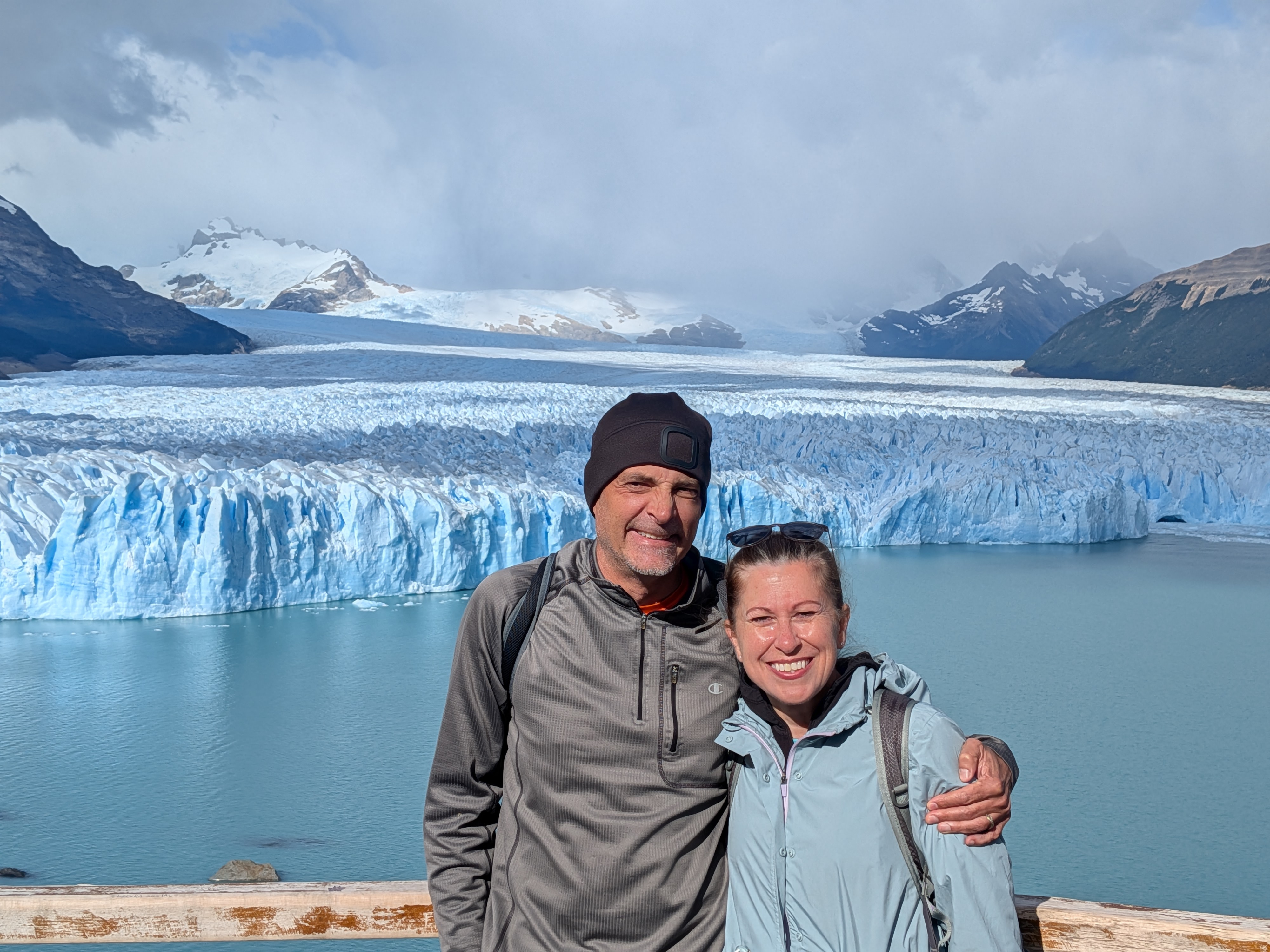
The whole experience on the water lasts for about an hour and a half. Patagonia Chic gave us a couple more hours to enjoy ourselves at the visitor’s center. There is a cafeteria style restaurant for food if you are hungry but you can also bring your own food and enjoy it at one of the park benches close to the walkways. It also gives you plenty of time to explore all of the walkways at a leisurely pace allowing for more pictures of the glacier from many different angles. It makes for a long day, but one that you will not soon forget. I also like the many options that are available to explore the glacier. Though I did not stay out in El Calafate long enough to try another excursion, I now live close enough that I am now thinking about doing a different excursion if I ever find myself out in this area of the world again.

Until next time, I hope you are able to find those experiences that are amazing, no matter how you get to enjoy them.

Laguna Nimez – El Calafate, Argentina

I have made it to the tip of the Americas, and it is here that I have found another frontier that is free of people and big on beauty. It is a big portion of the continent that spreads out over the countries of Argentina and Peru and is known as Patagonia. People do make their way to this part of the world to explore the wonders of nature and enjoy one of the places left where you can feel as if you are not fighting through crowds, traffic, or the annoying barrage of modern society. It presents itself with a calming Zen like atmosphere that I feel I will enjoy as I explore the area over the next couple of weeks.

The people that make their way out here are usually looking for the adventures that the mountains and expanses of wilderness have to offer, and I have made some plans to make sure I participate in this, but I first needed to acclimate myself to the area after a long day of travel to get down here. I wanted to get out and explore the area, but not do anything too strenuous to start off. The obvious choice came from a wetland preserve on the edge of El Calafate called Laguna Nimez.

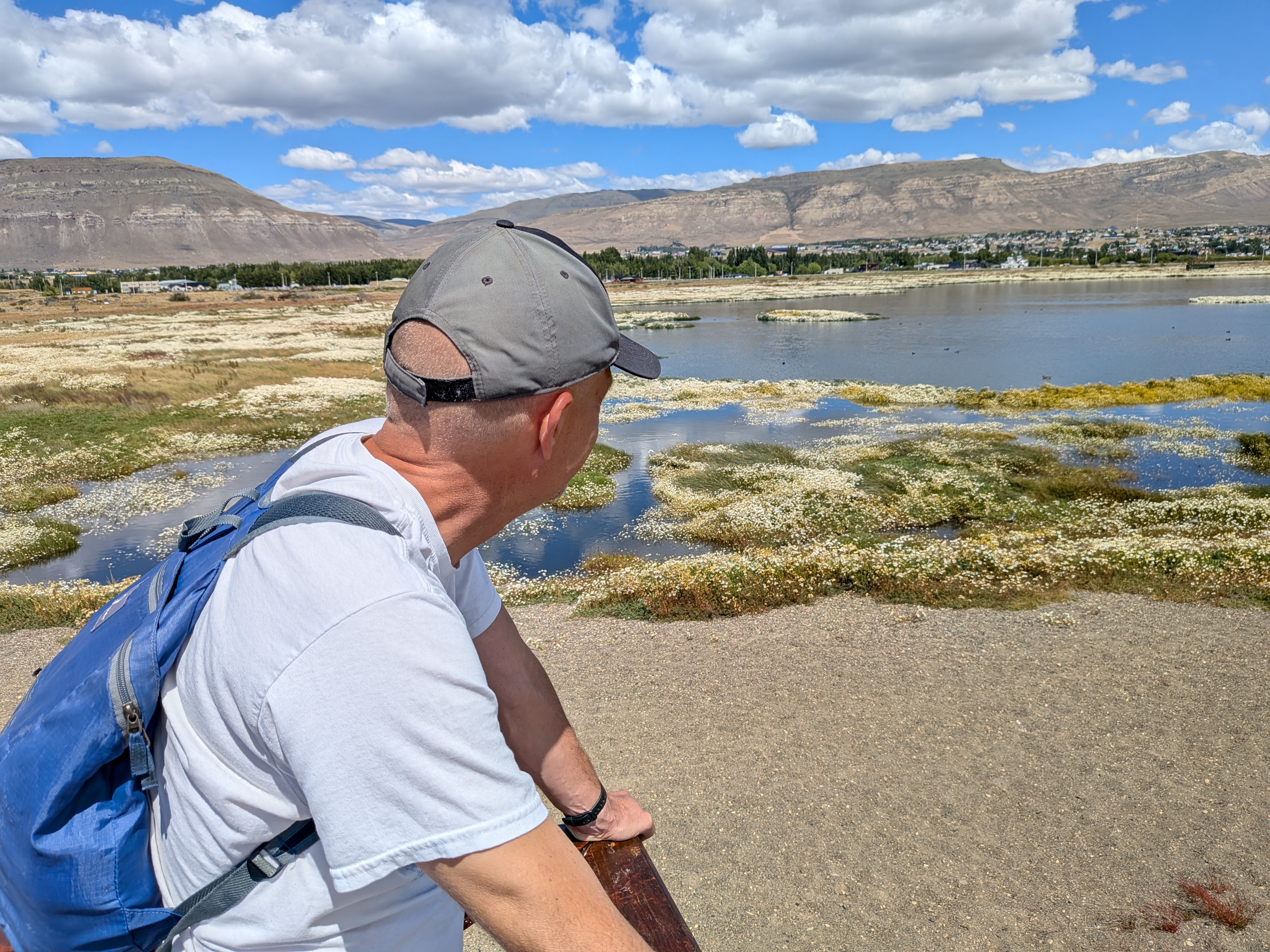
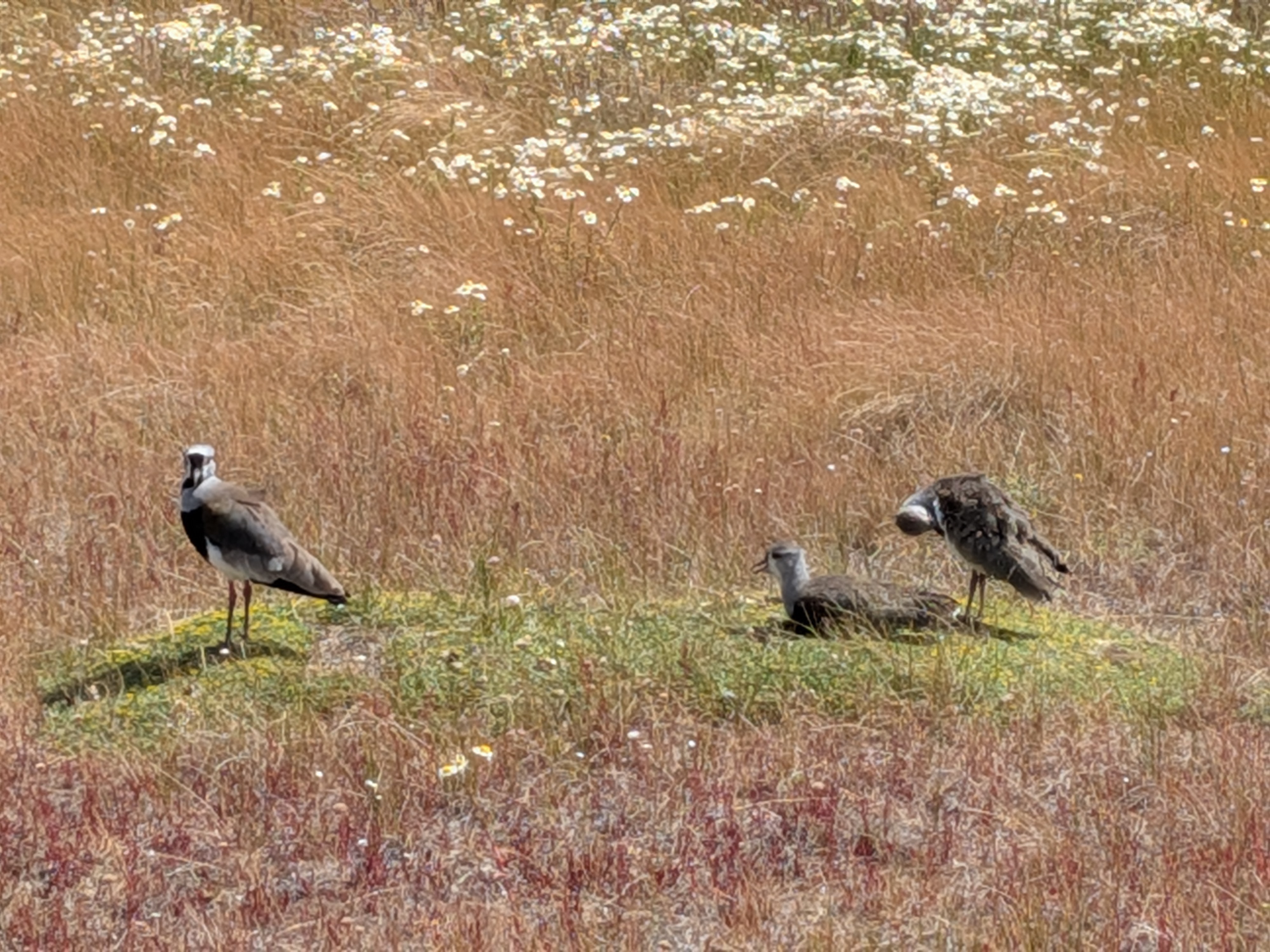
The preserve is a avian sanctuary where numerous types of birds find themselves at home. There are many types of sparrows, finches, ducks, swans and other birds that hide among the tall vegetation, swim in the lakes, or hunt along the sandy shores. Most people make their way here to see flamingos as they graze in the wetlands, and take pictures of the beautiful landscape along the way.

Though we spent time looking for these colorful birds, we did not find any while we were out there. We were told that they are in town year round, but the prime viewing times happen in the spring or fall months. We were hoping to get lucky, but it just did not happen. Still, we saw many ducks, and other kinds of birds to satisfy our curiosity about the place.

And what we did not see with birds was made up for by the bounty of nature that was blooming all over the location. The fields of wild flowers was just as beautiful to look at as did the landscape of mountains and blue waters that were all over the place. It no longer was about the birds as we strolled through this area. Instead, we just enjoyed the scenery.

The walk was not that difficult either. The whole path is three kilometers long, and basically flat. Most of it follows a wooden boardwalk that they would like you to stay on so that you do not disturb the fauna of the region. Even if you tire out, there are many benches along the way that you can sit down and enjoy the relaxing views while you collect your breath, but that was not necessary for someone who spends a lot of their time outdoors. But for those who struggle with longer walks, this is a great one to take because it is not too strenuous and has a lot to see at the same time.

There is even a place where you can pop out of the wet lands and go to the sandy shore of the lake. It would be a wonderful place to spend an hour or two and the tickets for the location allow for access to the sight for ten days. So if you go down to look at the birds one day, you can come back the next day and enjoy the beach. It is a nice ticket to have if you are spending a couple of days at El Calafate.

There are many things to do in the town of El Calafate and most people spend that time up in the hills and the glaciers, but Laguna Nimez is a nice way to ease yourself into the business that will happen when you start to explore these other places. It is a nice way to get out in nature, and enjoy what this part of Patagonia has to offer. It is definitely worth an afternoon to stroll around the place, enjoy the birds and the scenery.

Six Months in Lima

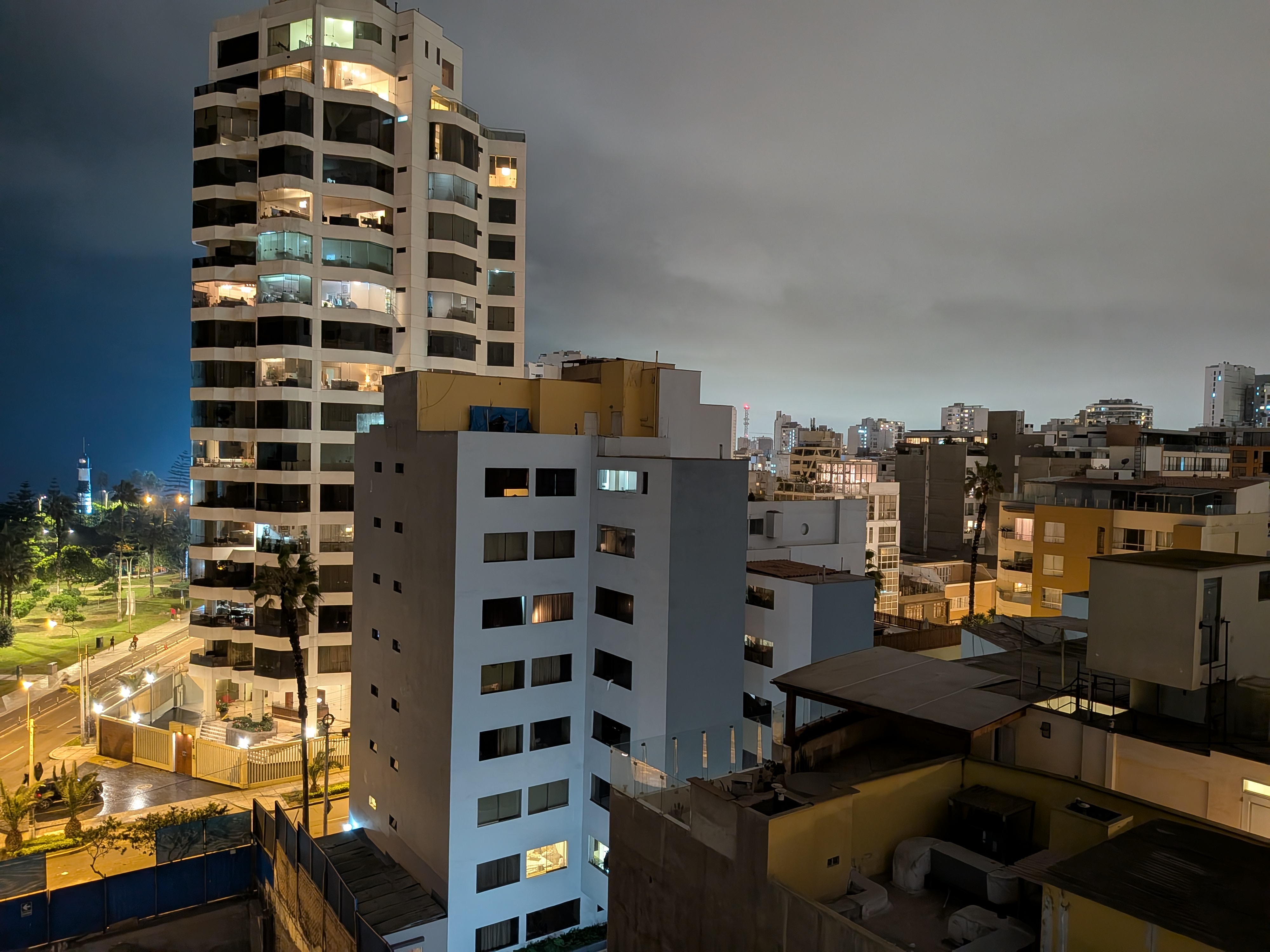
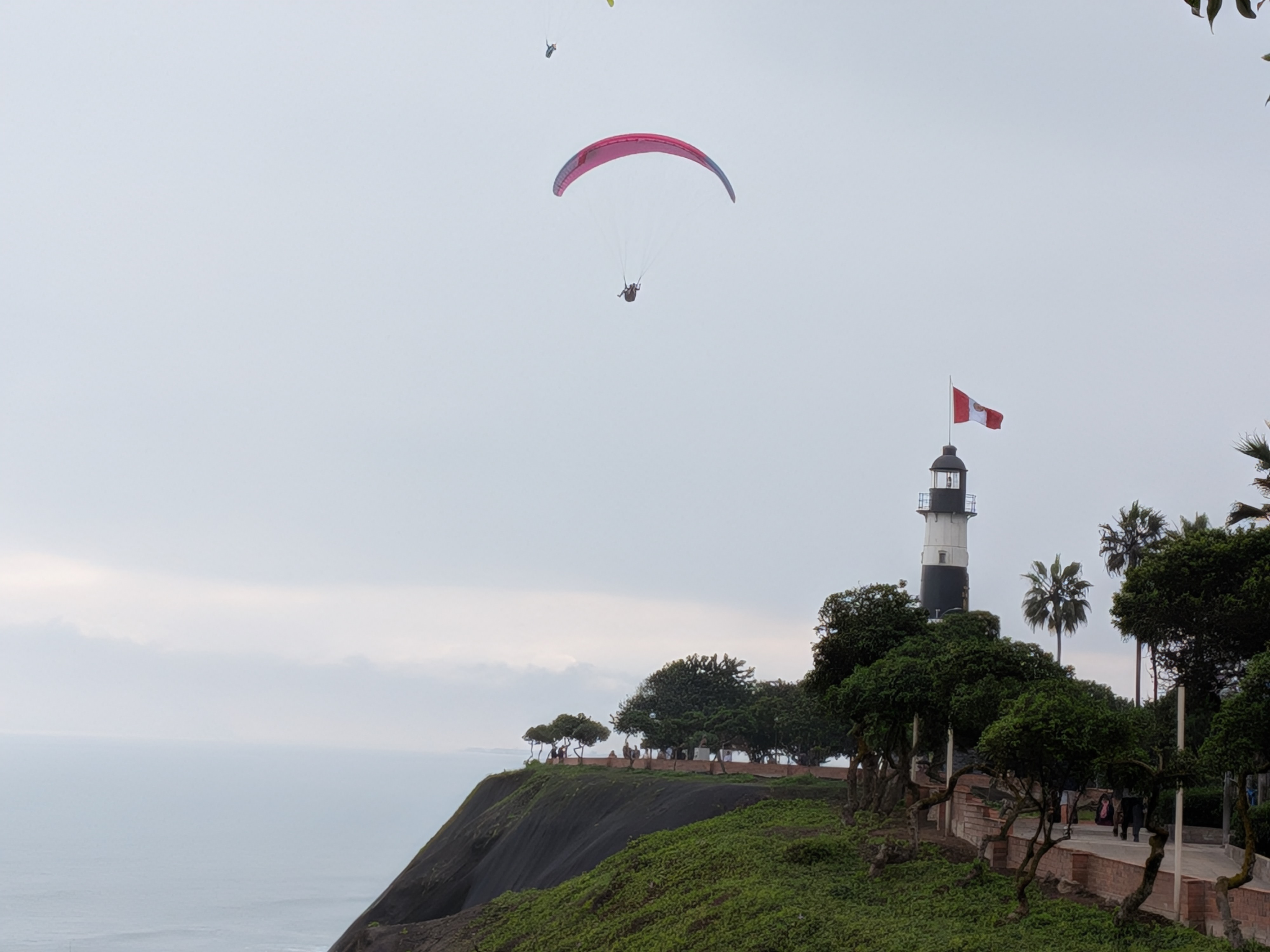
On a cold, damp winter night six months ago, I landed in my new life in South America, and was driven, tired and worn out to my new apartment that overlooked the Malaecon, a stretch of parks that lines the coast of Lima, Peru. As an international teacher, I get the excitement of moving to new locations around the world and settling into those new places to learn about the cultures of wherever I land. It has been a great way of learning about the world and I get the opportunity to travel and see many of the places centered around these locations.

While I write often about those travel experiences, rarely do I talk about the places where I actually live. I think a lot of that has to do with the fact that when I am at home, and going through my routine, I no longer think about those places as exciting and I do not spend the time to share it with other people. The other thing is that I have never lived in the heart of a place that allowed me to experience it just as the tourists would if they came out to visit. Most of the places where I have landed have been deep in the cities, or skirting the suburbs, and not at the hot spots of the country. My experience so far in Lima has been different. I am in one of the bigger tourist areas of the city, and it is nice to be able to get up every morning and experience the parks, and food that comes with my neighborhood.

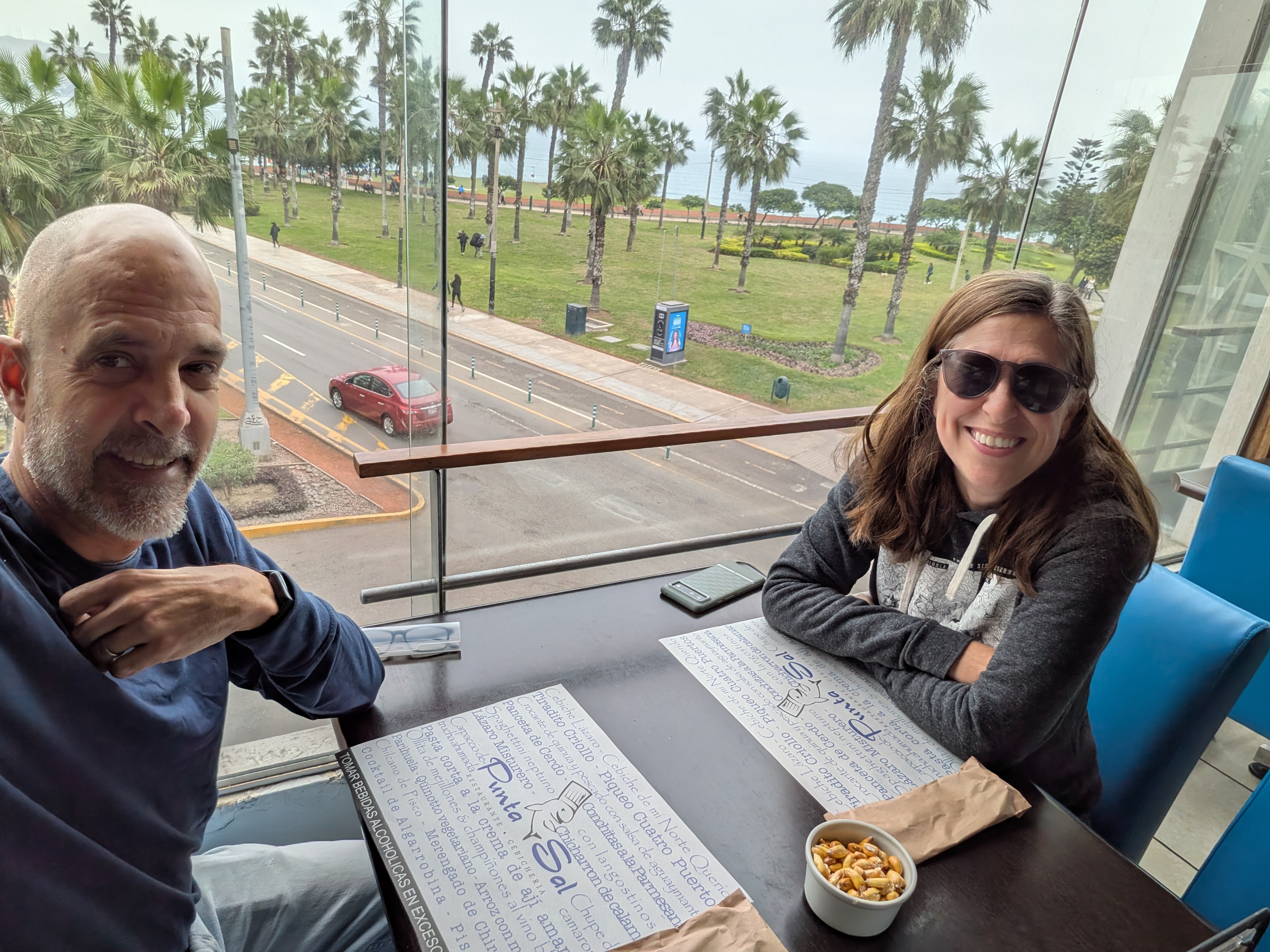
The combination of the two has made for a great experience. There are so many great restaurants in my neighborhood and I get to enjoy the Peruvian dishes that have made this cuisine famous around the world. Whether it is eating fresh ceviche, or finding my favorite version of lomo saltado, I am never without a new experience that I can try. Very rarely have I gone to the same restaurant twice, and it is a joy to go out and experience the dining lifestyle that is affordable. It also doesn’t hurt that the views that we get from a lot of these restaurants look out over the beautiful spots that attract people to Lima in the first place.

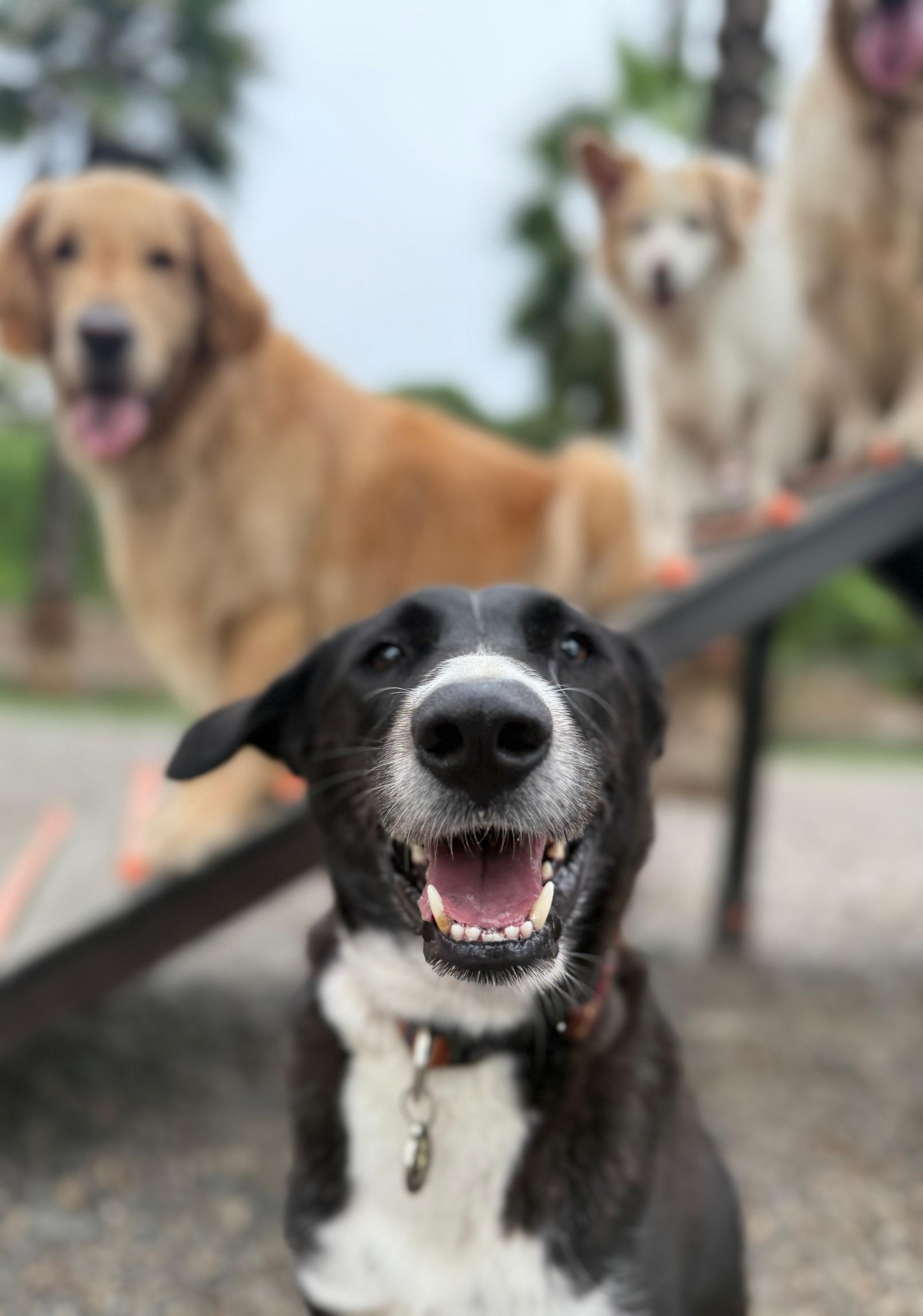
My dog, Zoey, has also enjoyed the change of pace. The Malecon has been a great place to walk even though we are still working on making her understand that she is not the only dog allowed on the Malecon, and she can make friends with the dogs instead of demanding that they get off her lawn. Despite this occasional energy, she has found many other four legged friends and is eager to go out and explore the areas around our neighborhood. There has also been numerous dog parks around where she could get her run on, and our place has a huge rooftop patio that allows her to lay out in the sun.

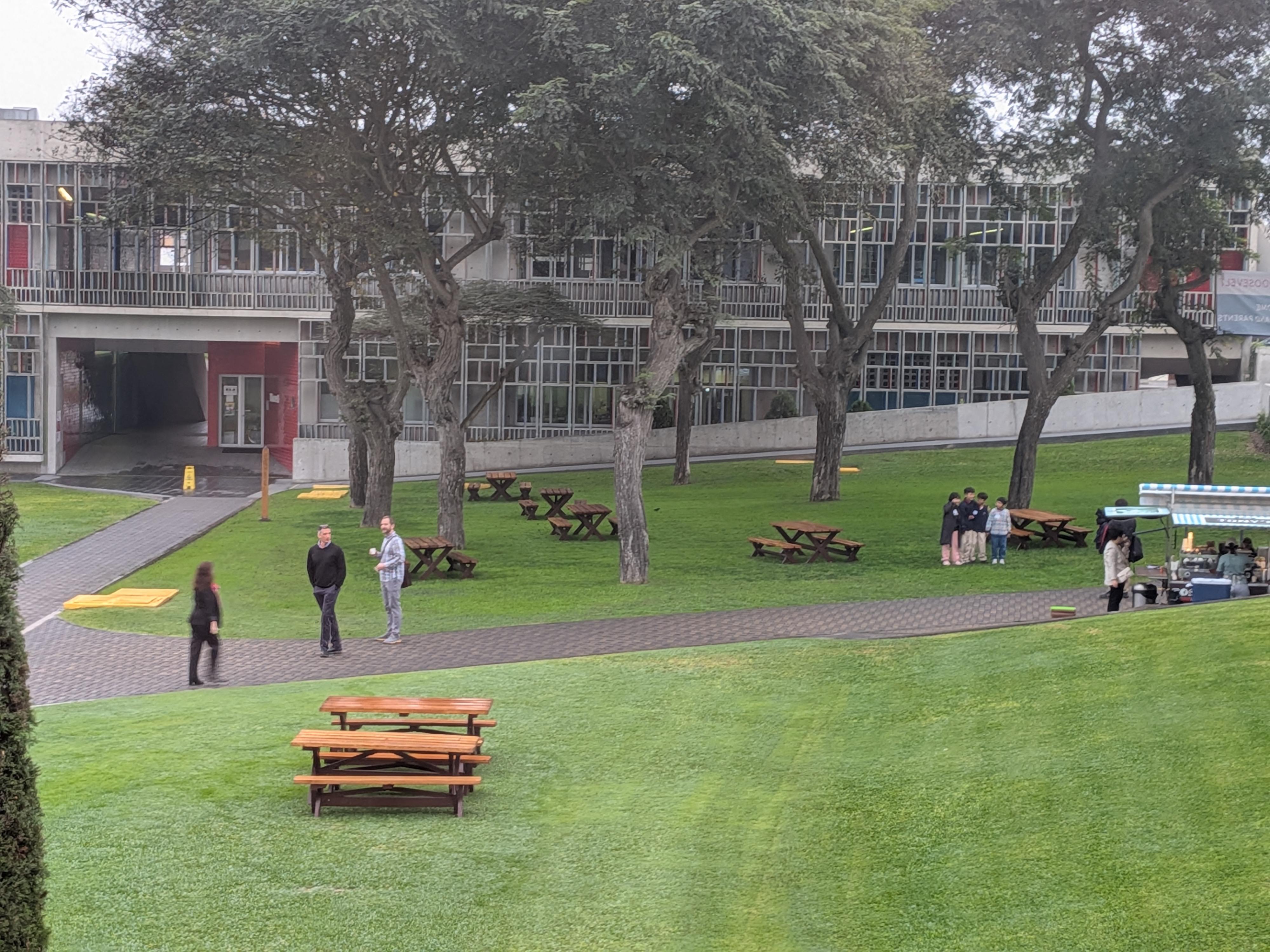
I am also lucky to have landed at a great school. Colegio de Franklin Delanor Roosevelt has been an institution in Lima for almost eighty years, and it has established itself as one of the premiere schools in South America. I am working in an amazing program in the school that combines design, English, and media studies to bring students a new experience about interpreting and understanding the world in which the reside. It has renewed my excitement for being a teacher, and I enjoy most of the days that I have to go into work.

I have also been able to sneak out of Lima from time to time to see the amazing landscape that can be found in Peru. The country is one of the most diverse I have ever experienced. There is desert, high mountains, rain forests, and places that create their own way of life by finding a way to turn what is brown and desolate into green and thriving. After six months, I have only begun to scratch the surface of what this country has to offer, and I cannot wait to explore more of the hidden corners that I know are out there.

Ollantaytambo Ruins, Peru

Many people have Peru on their travel bucket list, and when they think of the country, they think of Machu Picchu, and making the hike to this fabled city high in the Andes. It isn’t until they start looking into the voyage that they realize that the first stop they will need to make before getting there is Ollantaytambo, a small city where the roads end and the real trek begins.

There are two ways to get to Machu Picchu from this town. The more popular of the two is the train. It hugs the sacred valley, and will take people to Aquacalientes, the even smaller town that a series of paths will allow them to reach their destination. For the more adventurous traveler, Ollantaytambo is the start f the Inka Trail, the four day hike that will take them through the same sacred valley, but allow people to feel like the explorers that discovered this destination in the first place. Whether by trek or train, the town of Ollantaytambo is definitely worth a couple of days before going on to Machu Picchu.

The first thing that many people will have to do upon arriving in the area is to make the adjustment to the altitude. Back in my Colorado days, this would not have worried me much because Ollantaytambo is only 9,000 feet above sea level. But since I have moved to Lima, and live only a couple hundred feet above sea level, it took me a couple of days to fully adjust. This is also nice because Machu Picchu is about a thousand feet lower, so when I finally arrive, I should not have to worry about the adjustment at all.

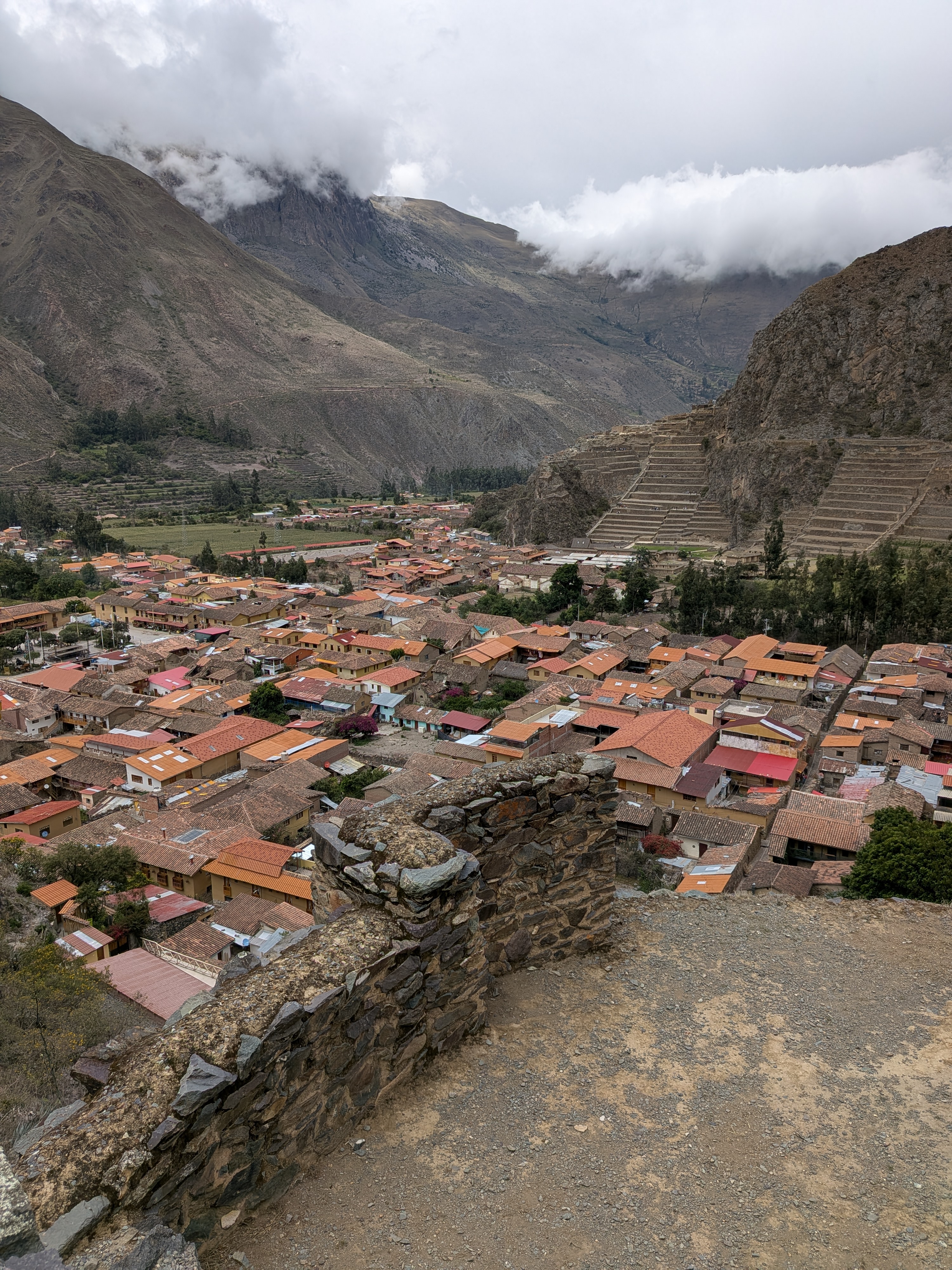
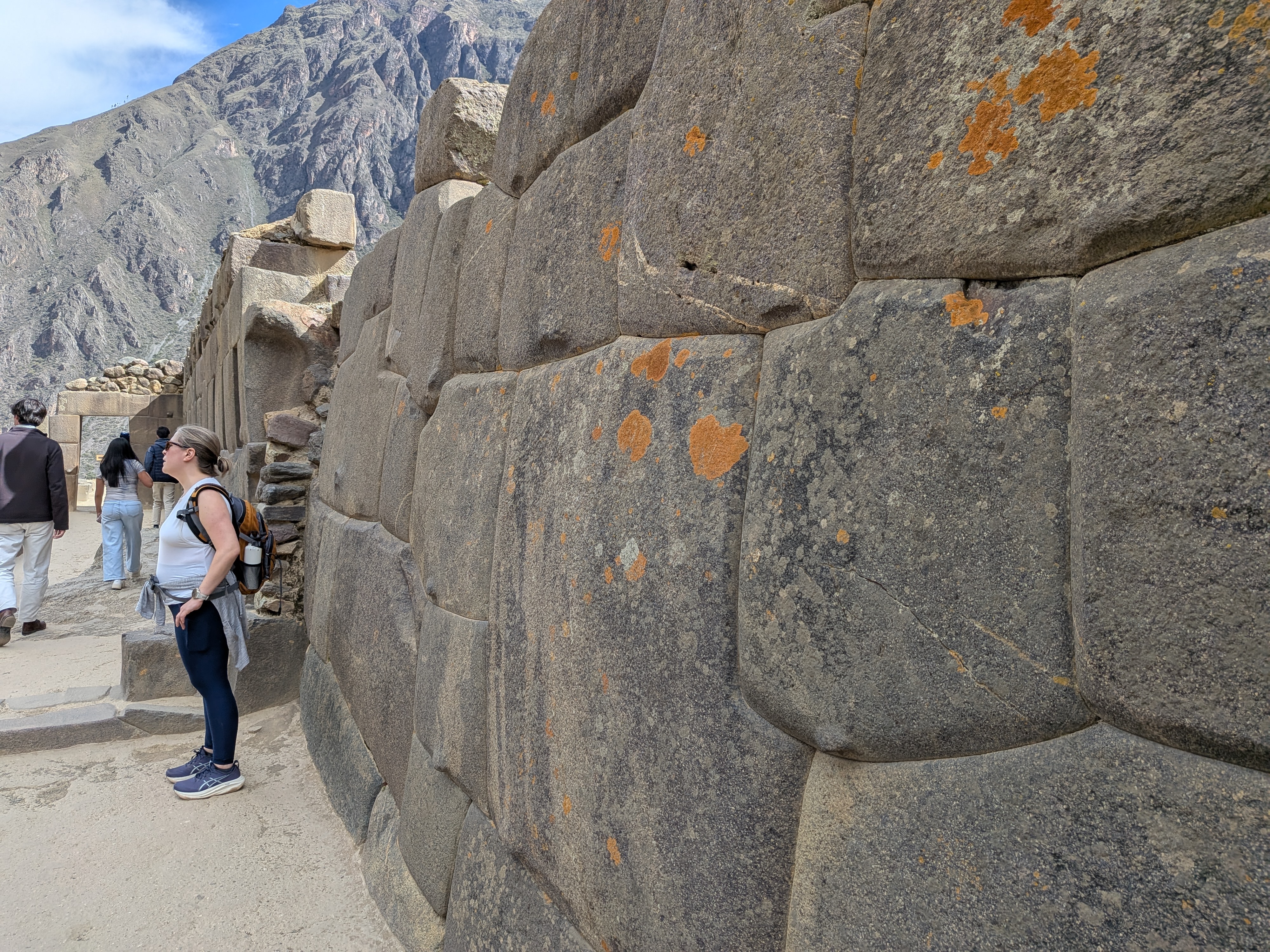
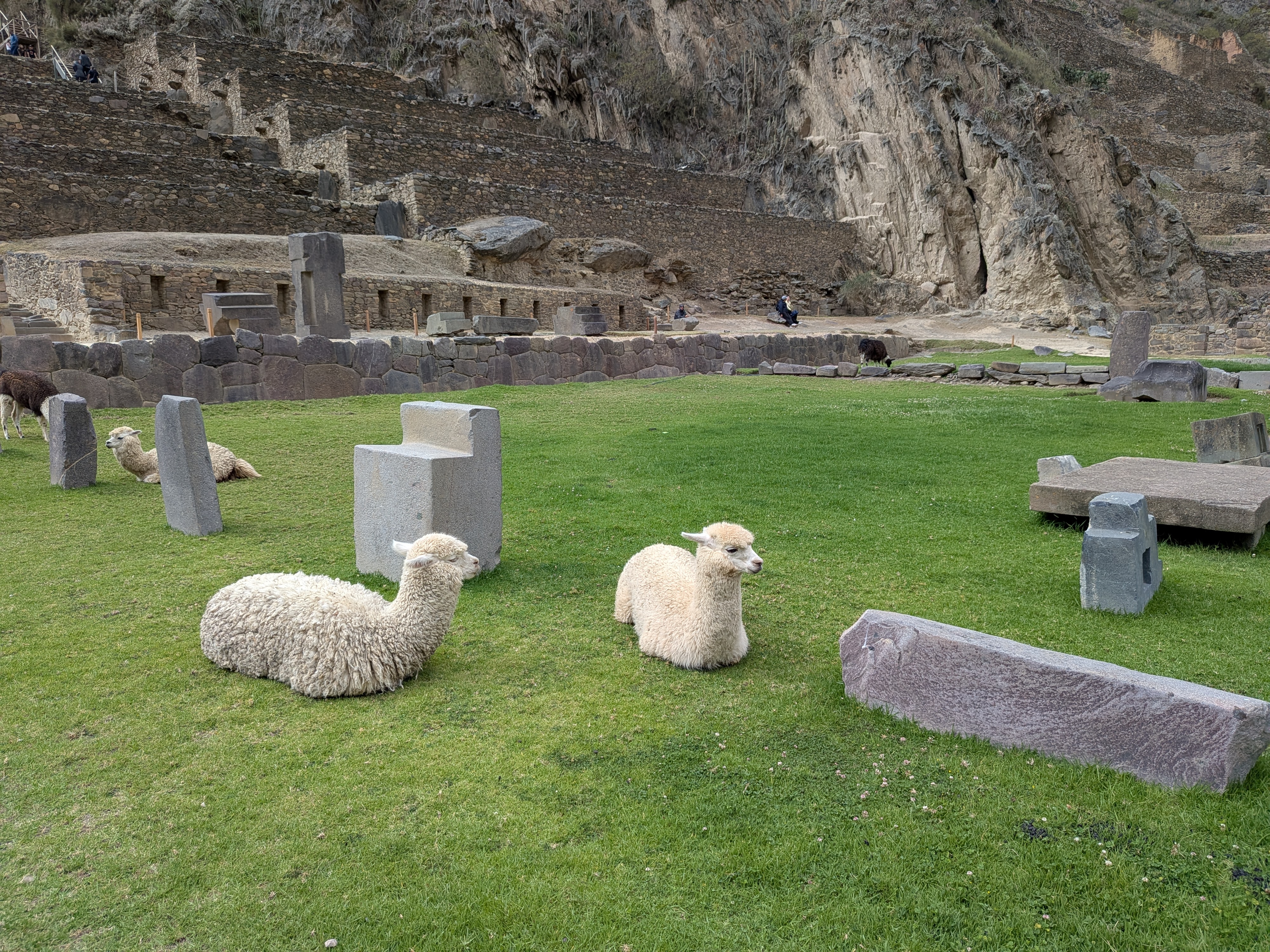
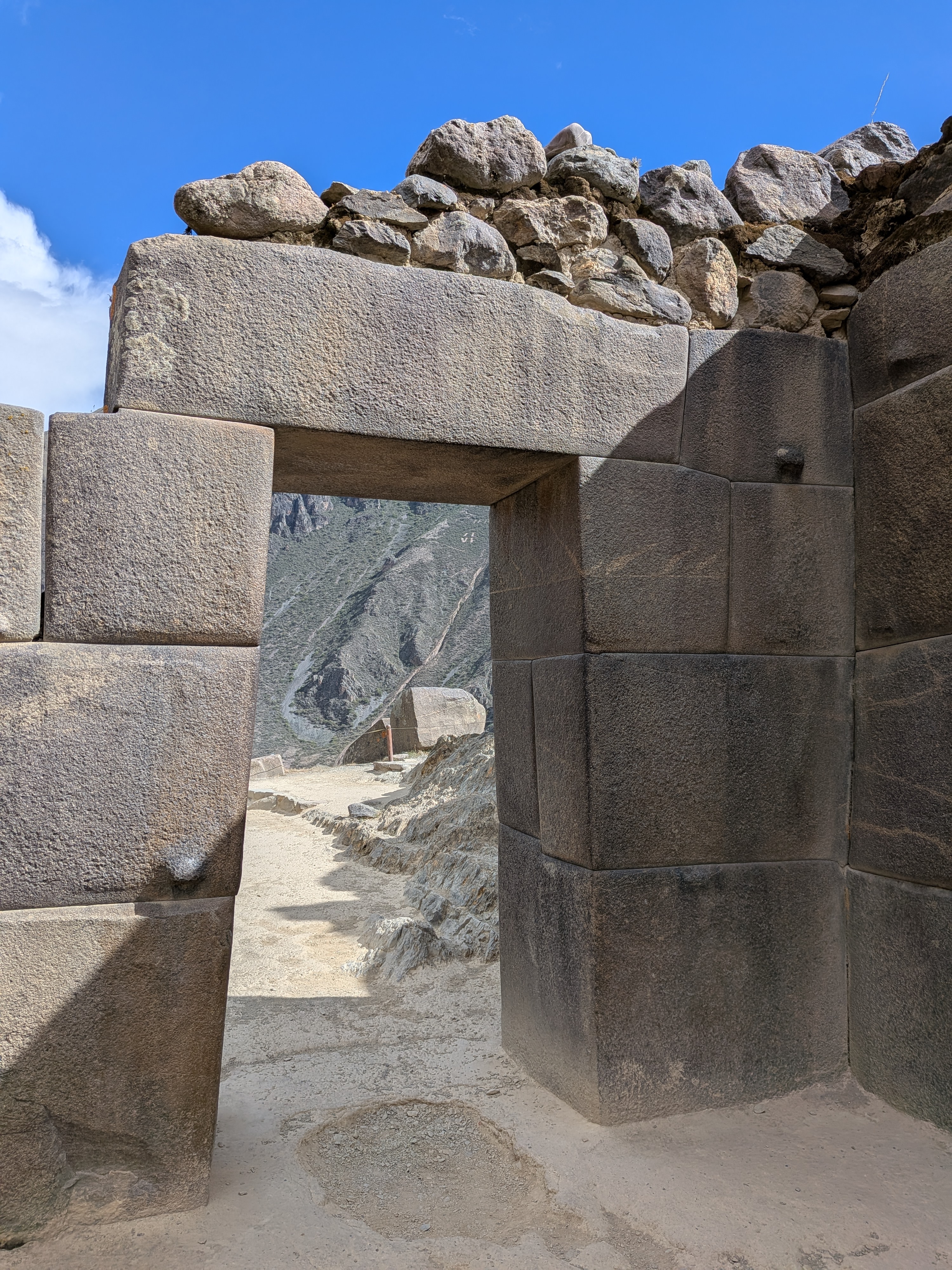
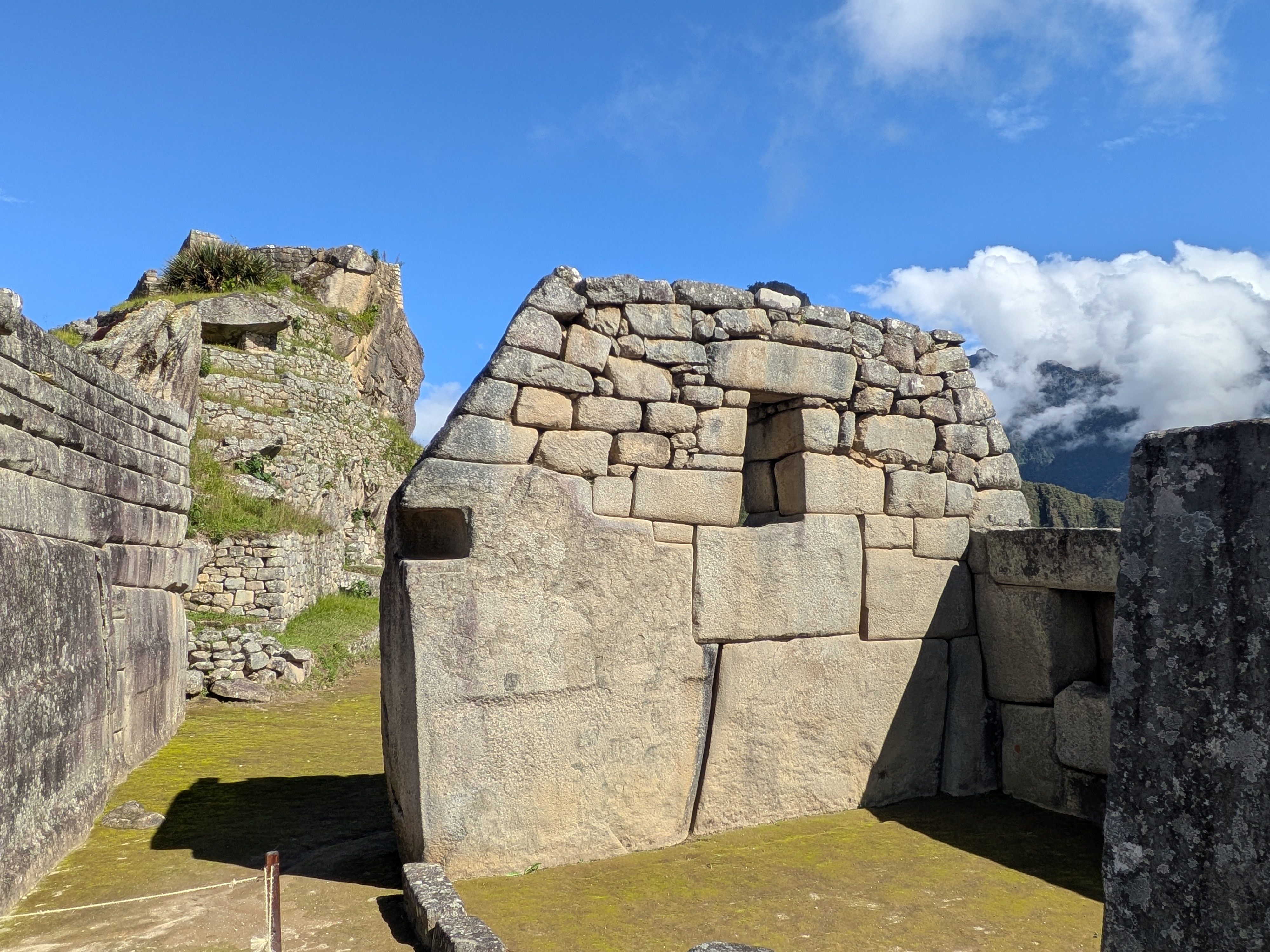
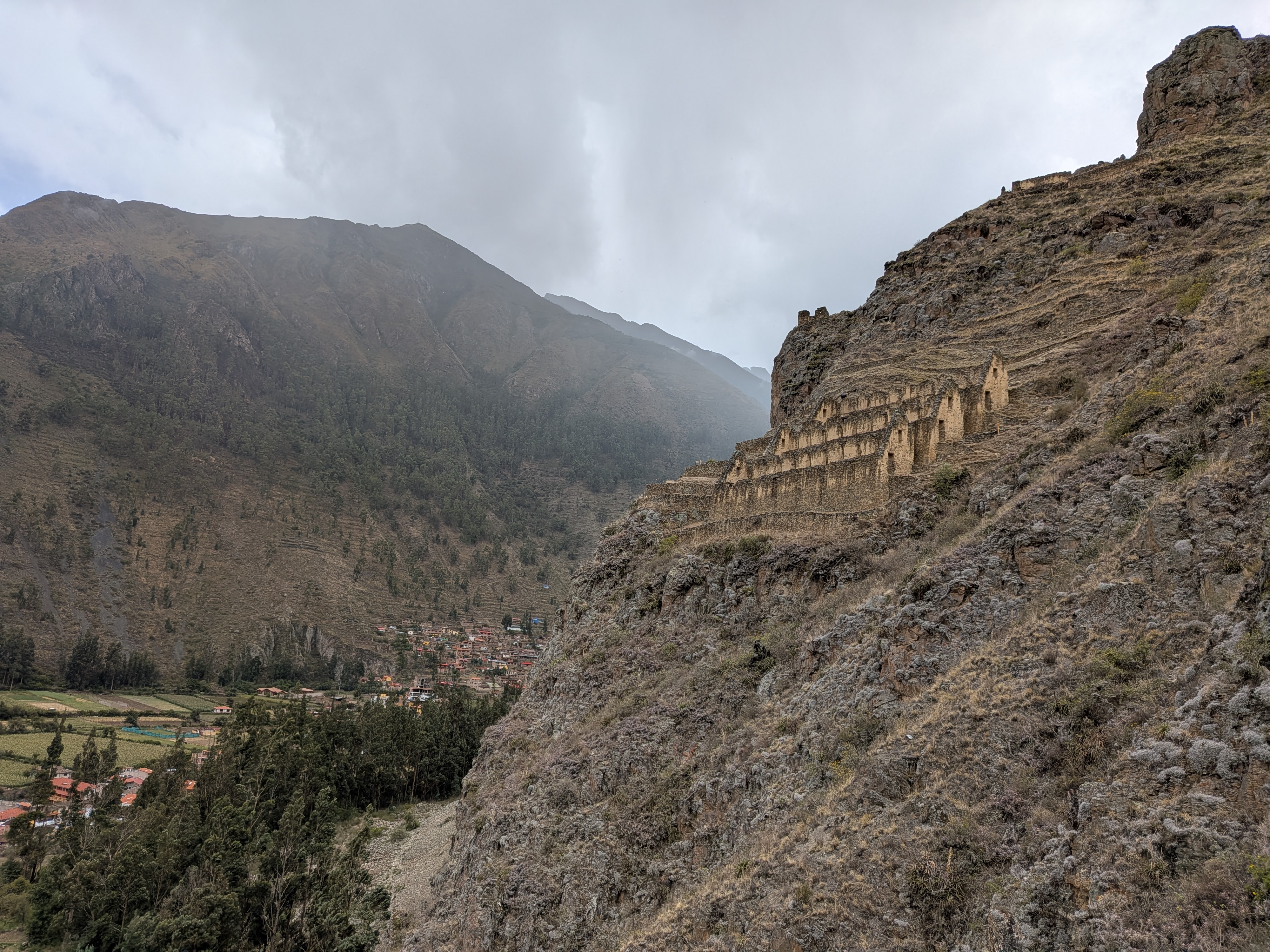
Ollantaytambo is a great town to visit though. There is an old part of the city where old Inca walls have been preserved and new building have been built on top of them. They did not try to continue the aesthetic, but built with a significant difference, so people could notice the old walls, and how far the town spread.

They also have a Spanish feeling plaza that is covered with various vendors, and good Peruvian restaurants. Most of them serve simple meals, but there are a couple that stand out; Amanta and Chuncho had more traditional Peruvian fare, and the later one even brewed its own distilled liquor that they used in all of their cocktails.

The Spanish came in the way that they always did, thinking that they would easily overpower them. What they did not count on was the Inca flooding the valley causing them to retreat. During this retreat, the Inca sent down their most powerful warriors to attack the Spanish and in the process slaughtered many of them. It was a short lived victory though because the Spanish returned with four times the original forces and eventually took over the sight. Still, it was one of the few times that the Spanish suffered a defeat at the hands of the Inca.

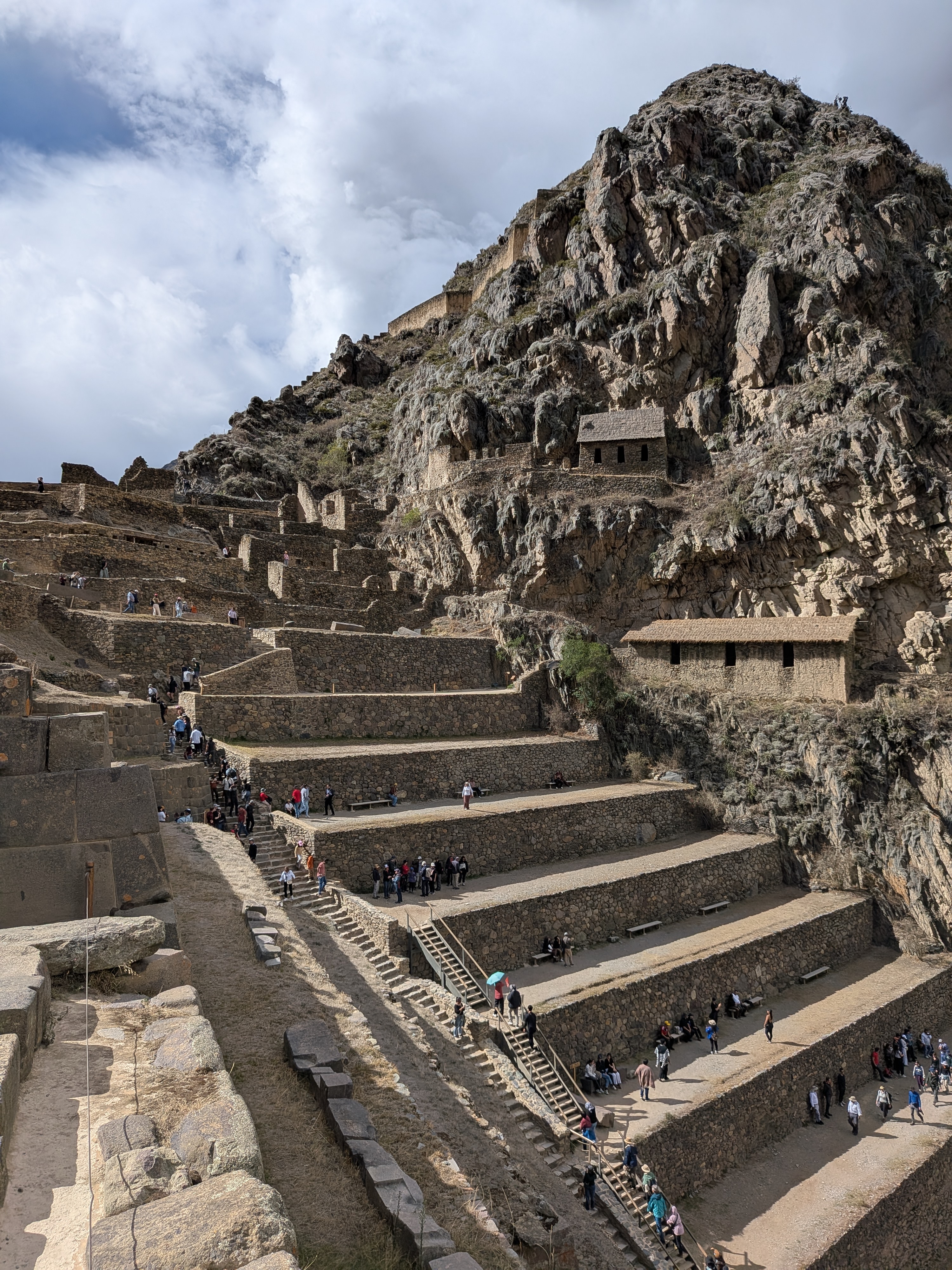
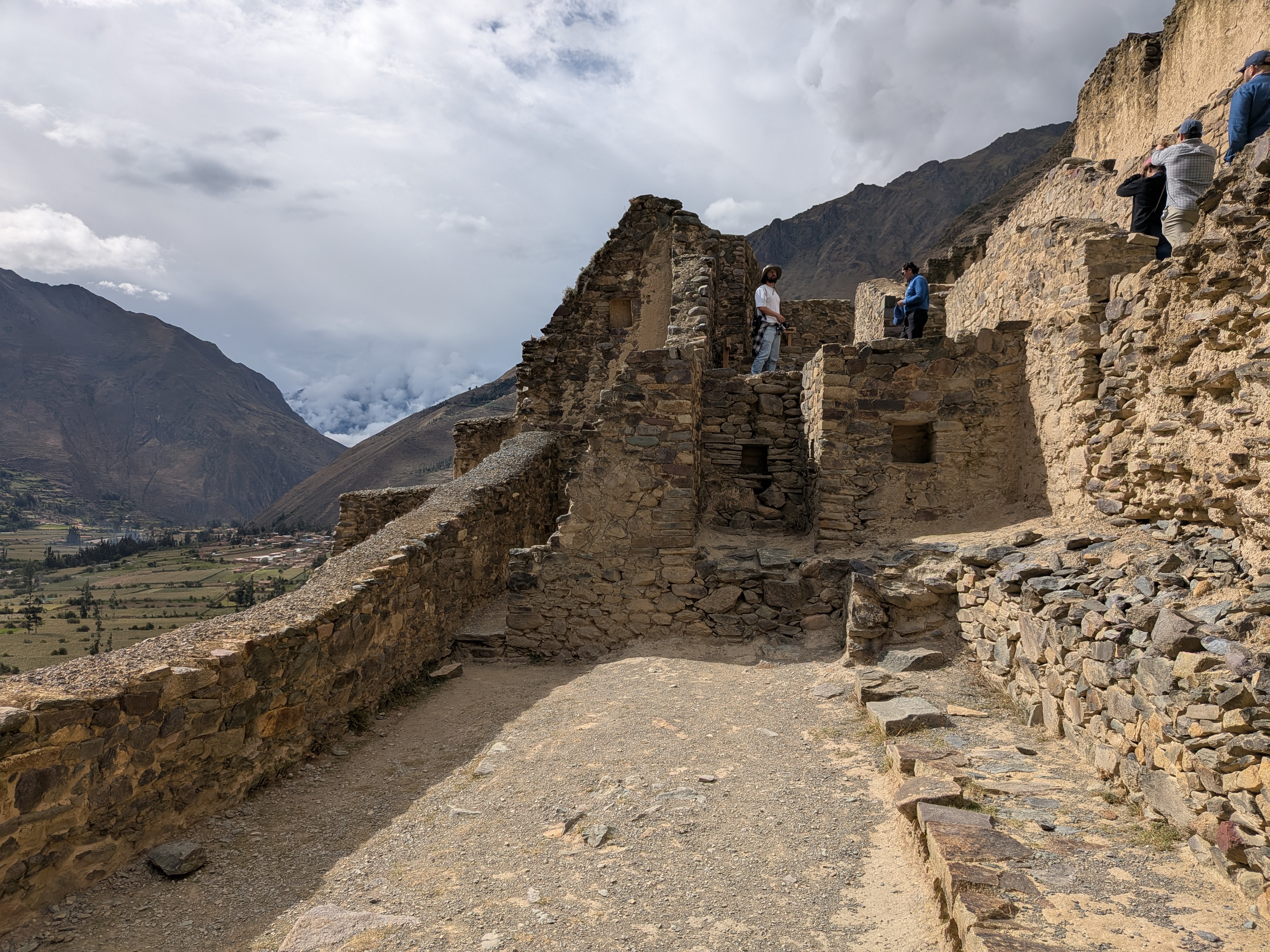
The fortress is well-preserved today, and though it might take a couple of stops along the way up to catch your breath, it is easily accessible for most people. It also offers amazing views of the town, and the surrounding valley. It might not have the location view that Machu Picchu does, but it is a great little taster before continuing on to that historic sight.

The other side of the valley has another set of ruins that at the time of writing this entry are free to enter. They do not attract the big crowds that the fortress does, but the ruins are just as impressive. The hike up requires a little more patience because it requires some more difficult terrain, but the sign will guide people as to which way they should go to avoid creating road blocks.

I would suggest going early in the morning because the crowds are almost non-existent at that time, and it makes you feel as if you have the ruins to yourself. It is a little difficult to find the entrance because it is not a big ticket booth like the fortress has, but it is on block south of the plaza. Take the first left and walk down the cobblestone path for a bit. You know you are in the right place because there will be an Inca made aqueduct on your right hand side. If you look to the right you will see the entrance with stairs leading up the mountain on the other side.

I have thoroughly enjoyed my time in this small town before going on to the main event, and I never thought that an entrance town could be just as exciting as the whole reason I came out to this part of the world in the first place. It has gotten me excited about Machu Picchu by showing me what I should expect when I get out there. I hope this inspires you to take the voyage, and until next time, keep looking for those hidden gems that you know are out there.

Happy New Year from Machu Picchu

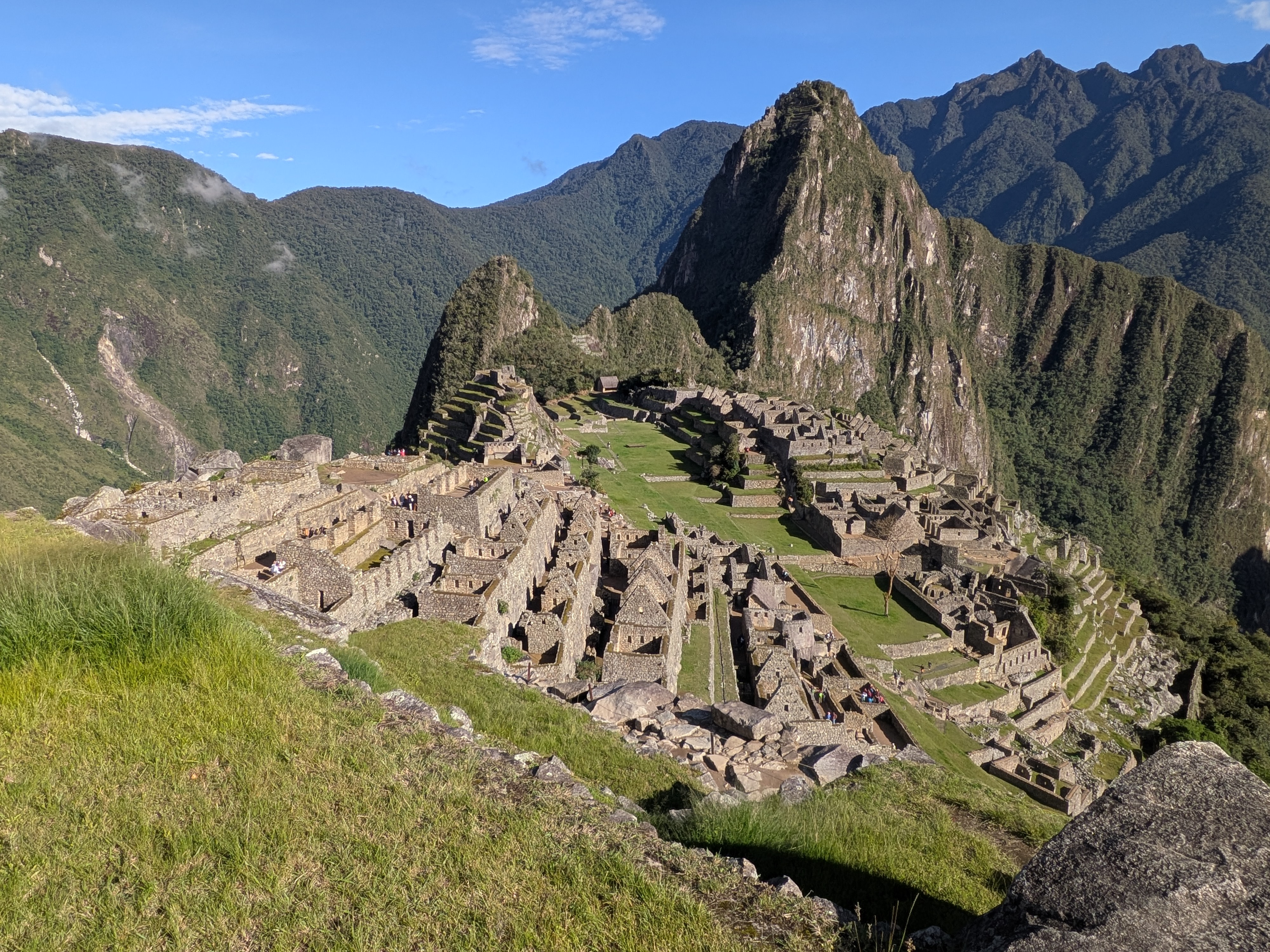
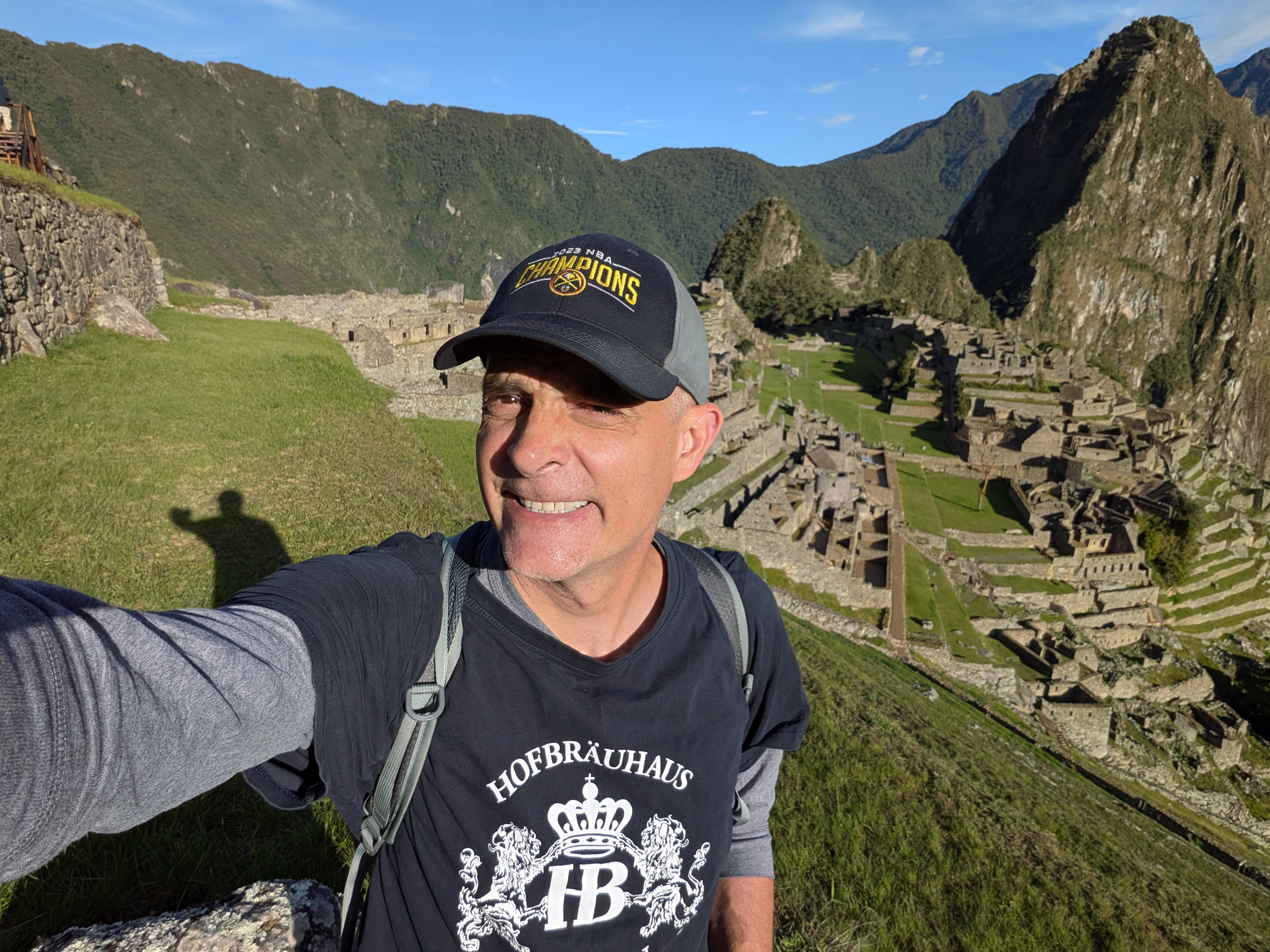
It is one of the most recognizable sights in the world. People have put it on their bucket list as one of the things that they want to see in their lifetimes. It is the center of one of the most mysterious and intriguing cultures of the world. Lots have already been written about it, from its discoveries, to its conflict with the Spanish conquistadors, to the way people make a pilgrimage out of it in the modern day. There has already been a lot written about Machu Picchu, so I will not try to cover the same material and will give you my wandering thoughts about the place because I cannot visit a place like this without writing about it.

To start off, I have been holding off on visiting this place because I knew any visitor I had in Peru would want to make a stop there, so there was no reason to go out of my way to visit if I knew that I was going to go there anyway. I had made this mistake with Petra in Jordan and by the time I left after four years, I was starting to become an expert with that sight. Even with this wait, I still made my first visit to Machu Picchu within six months of moving to Peru. It just shows you how willing people were to jump on that chance to visit this sight that I was taking the trek during my first big break in the region.

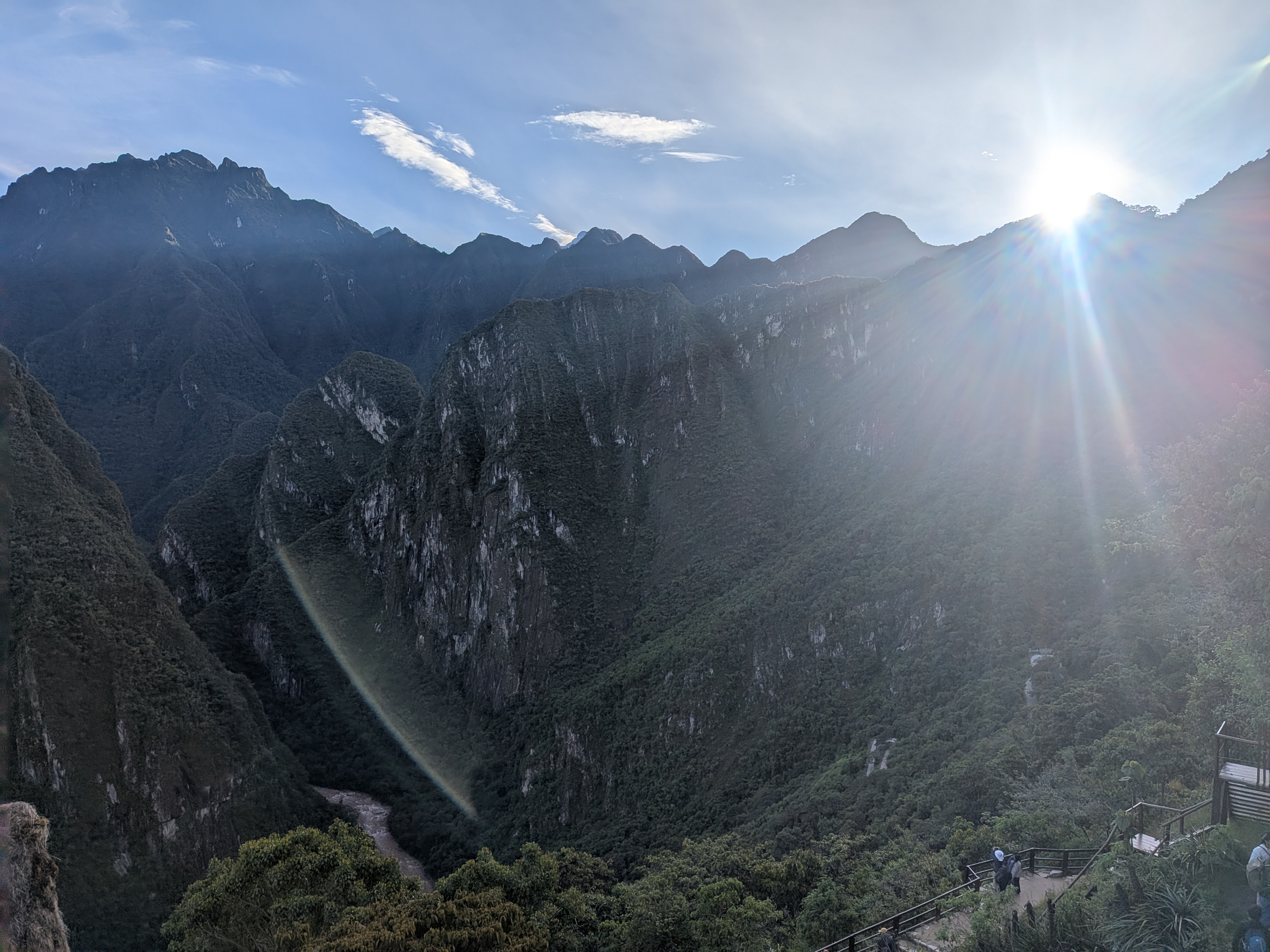
I also went during a slower season. There are many paths that are opened to guests to travel through the sight so they are not just running any direction that they want and threatening to damage the beauty of this location. It was during the rainy season or Peru’s summer. Not all of the paths were open at this time because some of the more adventurous ones are too dangerous tonight travel on. Also, most people avoid this time because Machu Picchu can be covered in clouds, making it hard to see, especially in the morning. We were exceptionally lucky in this regard. We had scheduled a hike through the complex during the late afternoon, and another hike around the outside of the complex during the morning. On both occasions, we avoided the weather, and the clouds, but I am told that this is not the norm during this time of the year. I will have to come back during the high tourist season to see what the difference actually is.

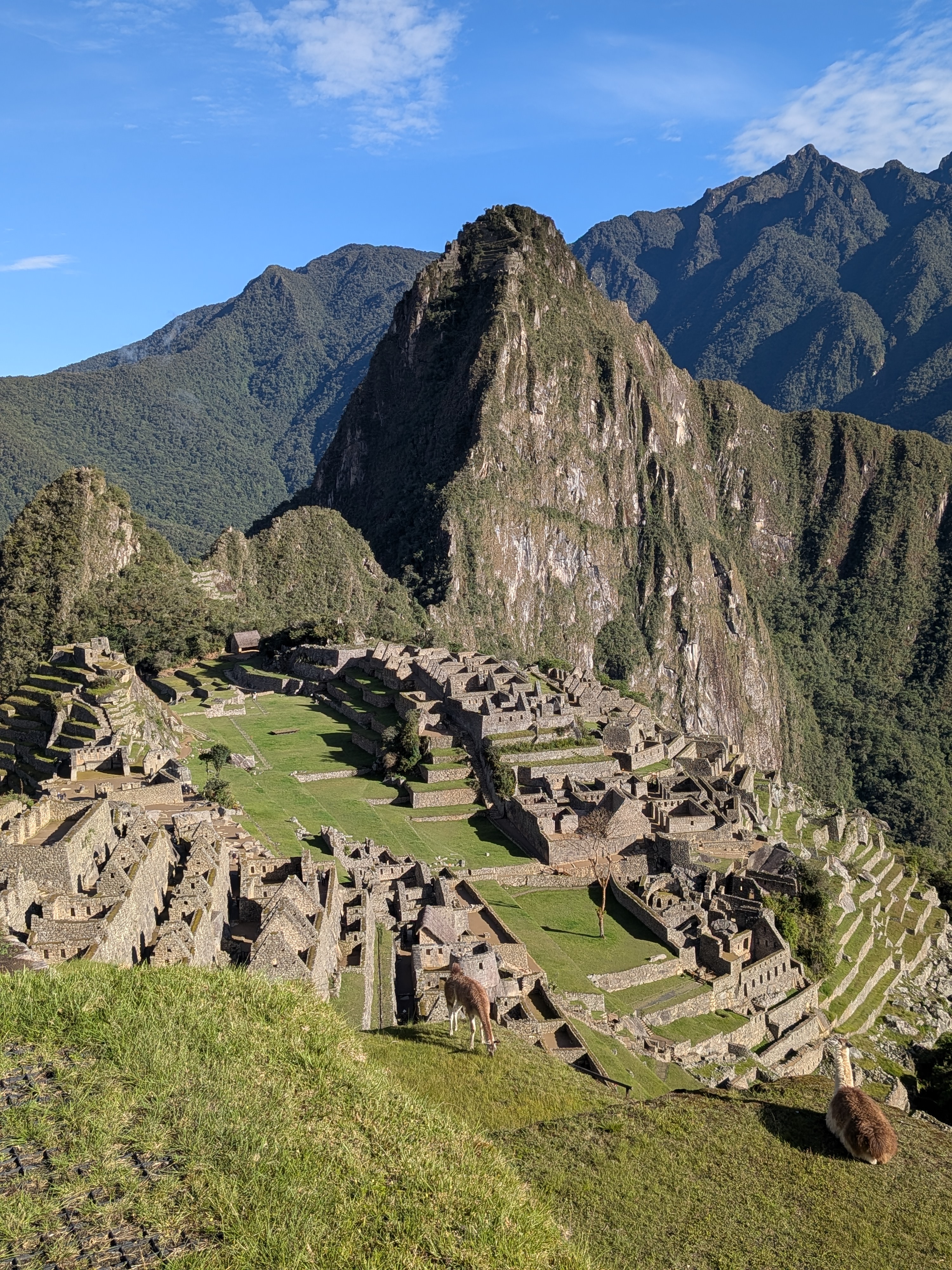
There are two paths connected with the sight, one that I knew about, the other I didn’t, that I really want to do. The first is the Inka Trail. It is a four day trek that takes you over the ridge that gives you the iconic picture of Machu Picchu that everybody has seen. The other is a steep hike up the mountain that sits in the background of the iconic photo that takes people to a more obscure collection of buildings where the high shaman used to live. It is supposed to be a tough hike, but the views from that place have to be amazing.
There are also guides that sit outside of the sight and are willing to take you in and give you more context of what you are seeing. If you are doing route 3, I would highly recommend hiring one of them. They are very knowledgeable and ours was a great photographer as well, getting us pictures with everybody in it. Our guide was able to point out a lot of the subtleties of the buildings while giving us a perspective of the Inka culture that we would have missed without them. It was also nice having that knowledge with us as we did route 2 without a guide because we could now look at things with a different perspective and still know what we were looking at. At the time this post is being written, the going rate was 70 soles for person which translates to about 15 dollars. Totally worth it, though I am sure that if I go back enough, I will be able to supply the information without the guide.

Also, the llamas rule the sight. We were told that there were sixteen of them on the ground with the newest one just having been born. They make for some great pictures and they are used to the tourists who go up to them to get that snapshot. They serve another purpose because they graze on the grass that grows on the terraces, keeping it relatively short. I know they are not the most majestic of animals, but in this environment, they look regal.

It was a great first trip to this sight, and I know I will come back again to try a different experience there. I can’t wait for those moments just as could not wait for this one, but I will because I know I will eventually have more visitors and I will get to see the sight through their eyes the next time around.

Until next time, look forward to those adventures you have always wanted to take and get excited when you eventually get to take them.

Above the Canopy

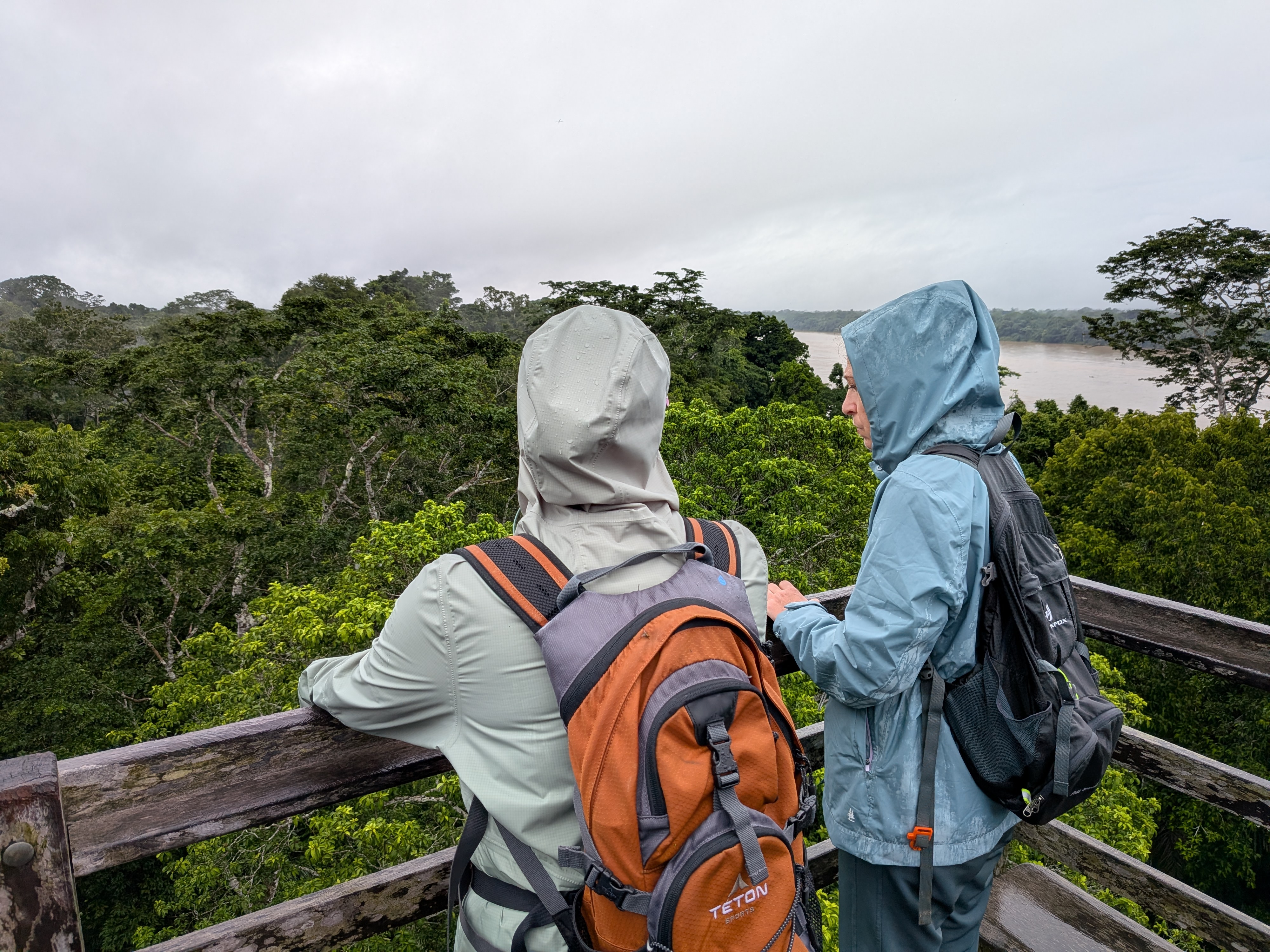
There is an all-inclusive resort close called Inkaterra to Porto Maldonado, Peru in the Amazon rain forest where they have many different activities to keep the guests busy. Each day is supplied with various hikes, boat rides or excursions that will take you to various parts of the rain forest to explore. My favorite excursion so far has been the canopy hike. It allows for a view of the forest that is hard to come by. You are allowed to raise yourself above the lower levels and get to look at it the same way that the monkeys and birds that wander through the forest get to see it. 

It does take a little bit of a voyage to get to the towers that will take you above the canopy of the forest. The resort will load everybody on a boat and take them down the river to a short trail that will take you to the first tower. They will take you out there during the planned time whether it is sunny, rainy, or just murky out, so go out there making sure you are wearing the right clothes you will need to stay dry. I took the boat rise during a torrential downpour and was stuck in the front of the boat. Though I was wearing my best protective gear, I was still soaked to the bone by the time I arrived.

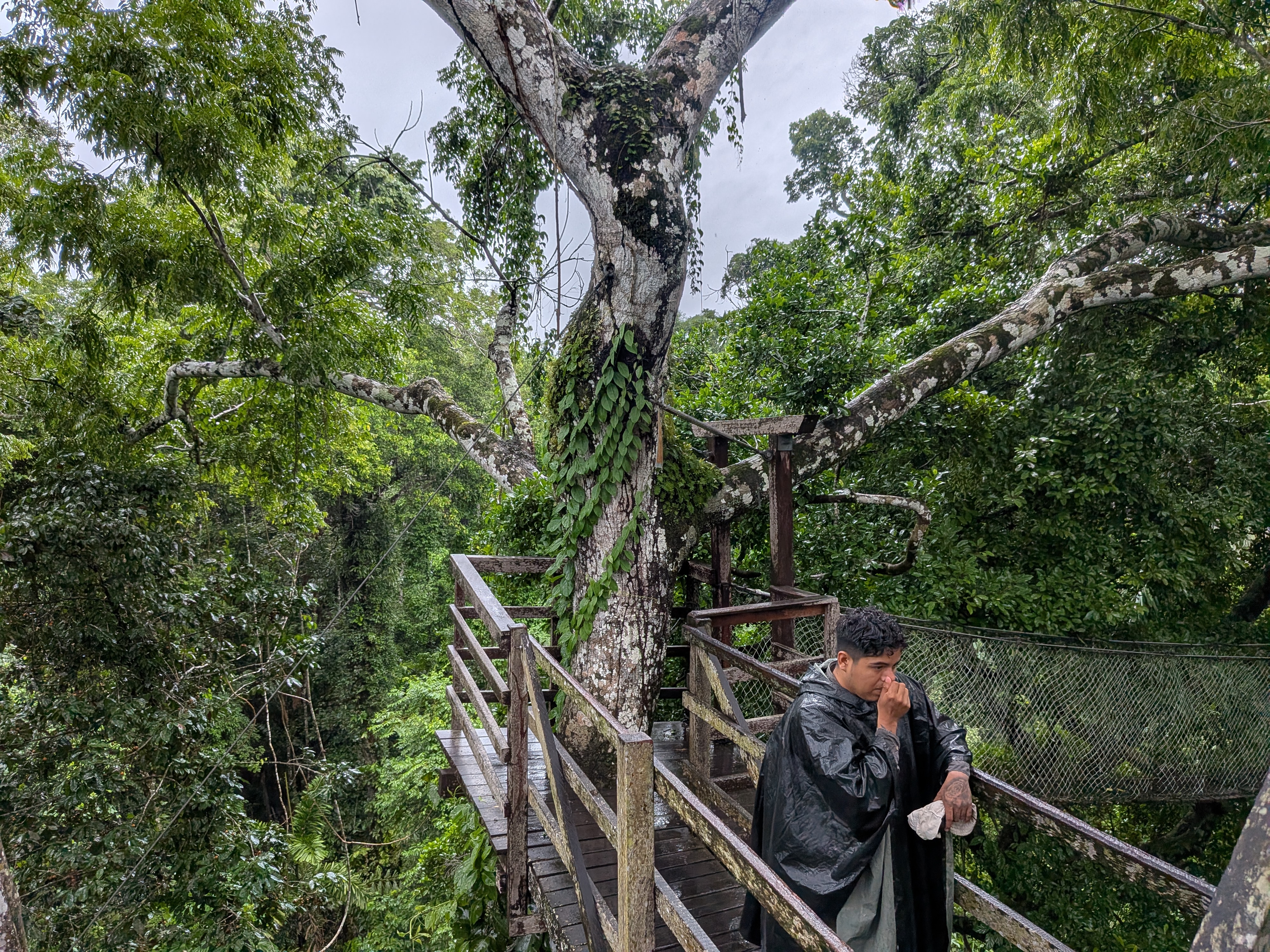
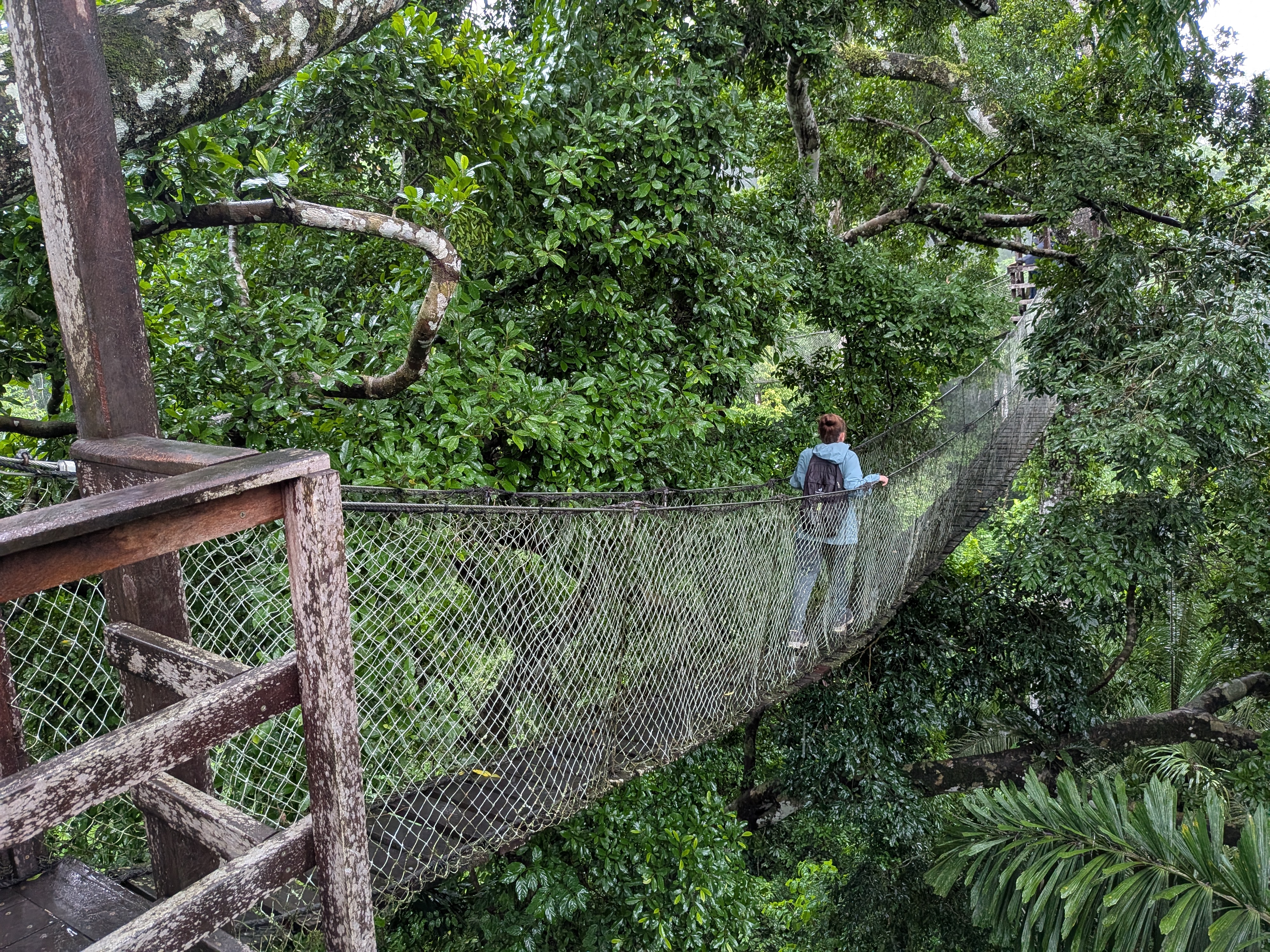
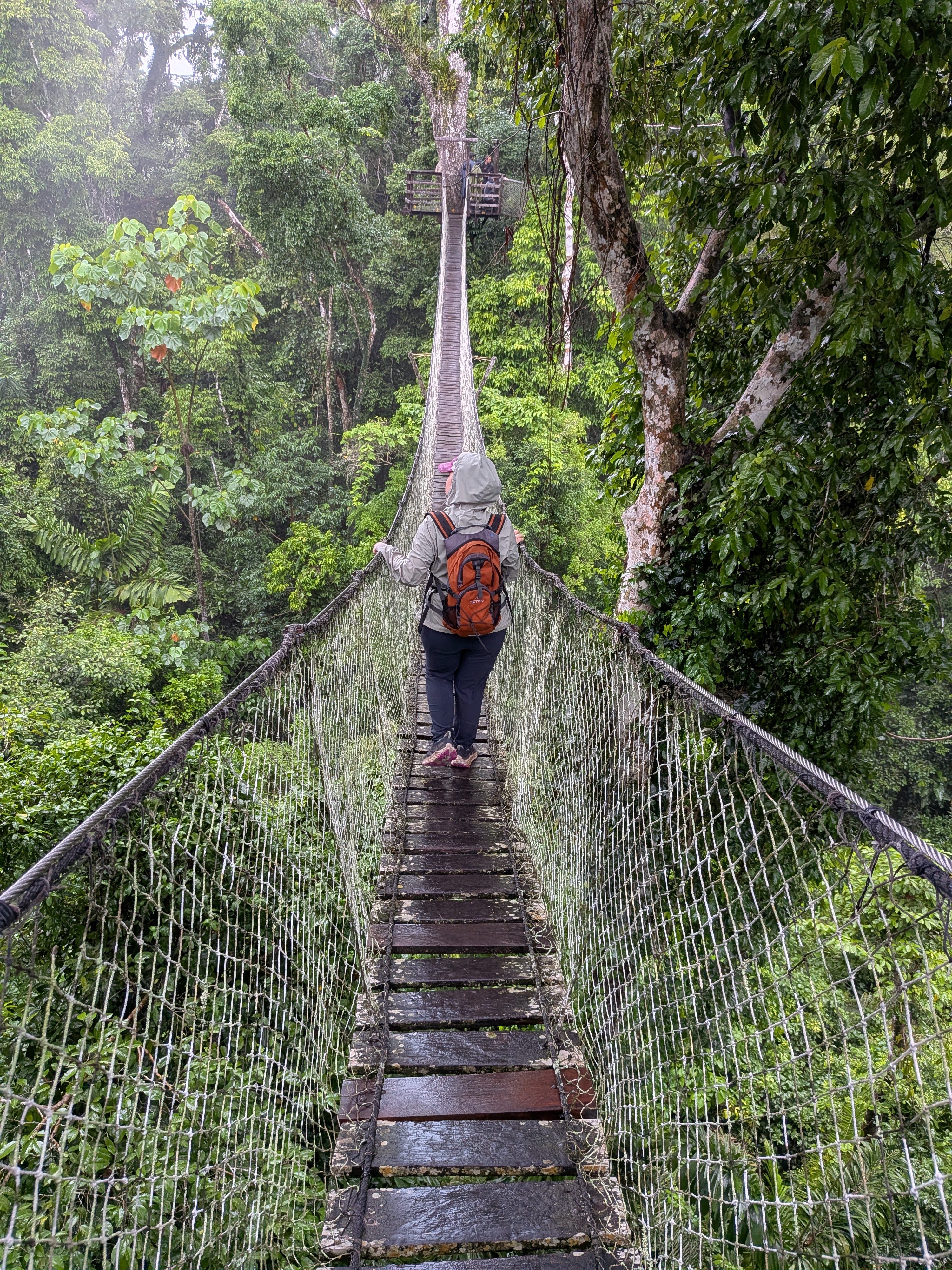
Still, being wet did not take away from the experience. I climbed up a tower built out of rust wood, a strong wood from the forest that looks like it is rotting away, but is actually super strong. The tower took us up forty meters to look down at the first canopy of the forest with six suspension bridges in-between the two towers that were connected to the bigger trees in the forest. The goal was to walk over the six bridges to get to the other side while looking down on the forest and hopefully catching sight of some of the birds and animals that live in this altitude of the trees. 

Because of the rain, we were not able to find any animals, but it had cleared off enough for us to enjoy the view. They would only let one person walk across the bridge at a time which was probably a good thing because even with one person, it was rather bouncy. It also caused us to take a good amount of time for the whole group to get from one side to the other, but once things got started on the bridges, it did not feel like the wait took too long between the bridges.

I would not claim that those who are afraid of heights would have a problem with this excursion, but I did go with a couple of people that are not big fans of heights, and they never felt as if their lives were in danger. The bridges are a little bouncy, but you feel secure as you cross over them, and there are places to hold on to allowing you to feel as if nothing really bad could happen as you cross over. When all was said and done, it was a lot of fun, and if the place allowed for it to happen, I would easily go out there to experience it again. Maybe the next time I would be dry and get to be able to see the animals come out of their hiding. Until then, I will just have to enjoy the next experience that life has planned for me.