Sitting on a whole city block in the middle of the old part of the city of Arequipa sits the winding streets and bright walls of one of the oldest European claims in South America, the Santa Catalina Monastery. This is a must-see sight if ever visiting Arequipa, and when you do, plan to take a couple hours to explore all that it has to offer. I would also recommend that you make it one of the first things you do in the morning to avoid the heat of the day and the large crowds that eventually make their way to this place. It is nice to be one of the first people of the day to walk through the location because it will make you feel as if you have the place to yourself.
The monastery is a nunnery that is still in use today even though it no longer boasts the number of nuns that it held during colonial times, and it is a rare sight to see the nuns who live in the corner of this historic sight. At its height, there were about 500 people living on the grounds. Some of the women that lived here were given their own rooms if they came from a wealthy enough family to pay for this luxury; whereas, many of the other women found themselves to be a part of the big dormitory that sits in the middle of the monastery. Even with all of these people in this place, it would still feel rather large and it has easily enough space to accommodate all of them.
Not every woman that ended up in the monastery ended up becoming a nun. Many of them arrived when they were as young as twelve years old, and they were brought here to learn from the nuns, and prepare for a life outside of the monastery. They would live beside the nuns, and learn from them. As I was walking around the grounds, I found hints of this lifestyle in many of the corners, and the place itself reminded me of a large campus where I could imagine students, and nuns alike moving from place to place as they completed what needed to be done.
One of the most interesting spots on the grounds is the place where they did laundry. It was based upon an irrigation design that was brought over from Africa. Water would constantly flow down this little groove in a wall, and when someone wanted to divert it into the basin that they were using, they would place a rock in the path of the flow to have it go through the pipe that would lead to their basin. These basins were made out of old wine pots that were used to ferment the beverage. They could no longer be used for wine, but they made the perfect sink for washing clothes.
There are also magnificent gardens on the grounds that they could tend to so there could be some beauty added to the place. This is even more impressive due to the fact that the monastery sits in the middle of a high desert where a patch of green is hard to come by. Still, the nuns were able to create this zen paradise in the middle of this kind of environment.
If that was not the place where they wanted to spend their time, there was also the fountain which could be found in the middle of everything. I was told that it was the place where they would go to get their water, but I did not think that the green water that was found in the fountain while I was there would be worth drinking. Despite that, if you look closely enough into the water, you can find small koi fish swimming around in it. They are not as large as some of the koi ponds I have come across in my travels in Asia, but it was a nice addition to this little spot on the grounds.
Santa Catalina Monastery is a great place to visit, nestled in the heart of the old part of the city. It is easy to spend a morning there after breakfast, and you will have explored it thoroughly enough just in time for a great lunch in the neighborhood. It is worth walking through with a tour guide and they are only ten soles, or two and a-half dollars per person for an hour guided tour. They do have both English, and Spanish guided tours, and I think that I even heard French while I was being guided around. They have the ability to point out the nuances that would be missed if you went by yourself.
Otherwise, until next time, keep getting out there and see what the world has to offer.
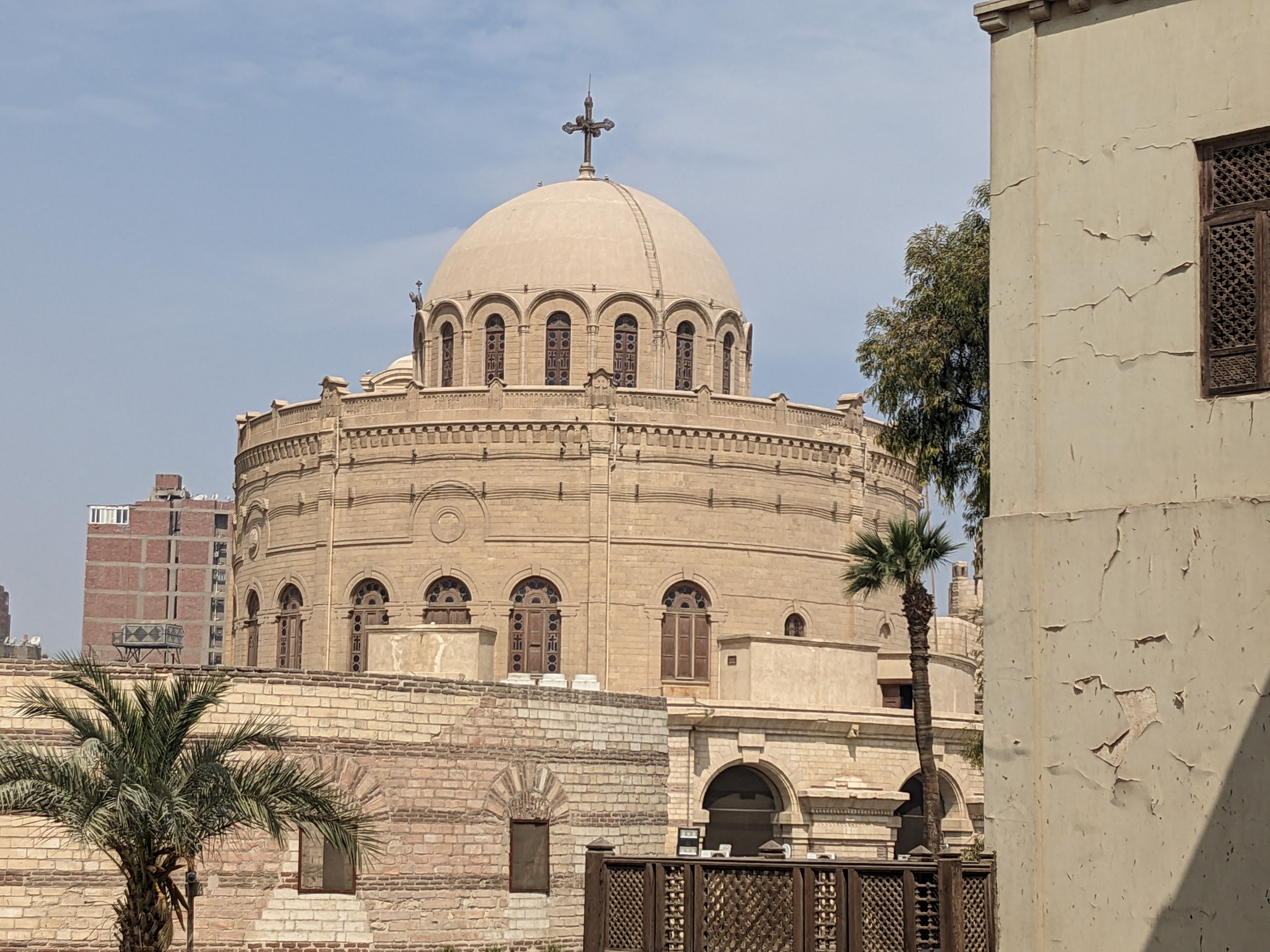
Cairo is one of the oldest cities in the world. It is surprising that what is considered the oldest part of town is still pretty modern in its overall history; this is just the part of the city that has survived the longest. Despite its age, it is one of the places that brings in tourists, pilgrims and curious because it is the Christian part of town, and boasts some impressive old Coptic churches that have their own history that adds more to a city that already has a lot to offer.
The most visited of these churches is the Church of St. George. It is a Greek Orthodox church that looms over the whole neighborhood, and its history emanates from the site. This is the place where St. George was held, and tortured for seven years as they tried to have him denounce his faith in the Catholic church.
The church holds many of the torture devices that were used to convince St. George of the conversion to no avail. They are housed in the same cell where he lived for the seven years, and even include the chain that was used to keep him captive. The chain is the main attraction for visitors here. It is said that if you hold the chain, and say a prayer that God will hear and grant this request. There is always a line of people waiting for their chance to hold the chain.
The history of this part of Cairo goes back even further than St. George. Another church that gathers a lot of people is Saint Sergius and Bacchus Church. It is told that in a cave underneath the altar there is a cave where the Holy Family stayed when they had escaped King Herod’s reign and voyaged into this region. Many people come to this church as well to hop into the line that allows them to walk through the cave and take quick pictures of what their lives might have looked like back then.
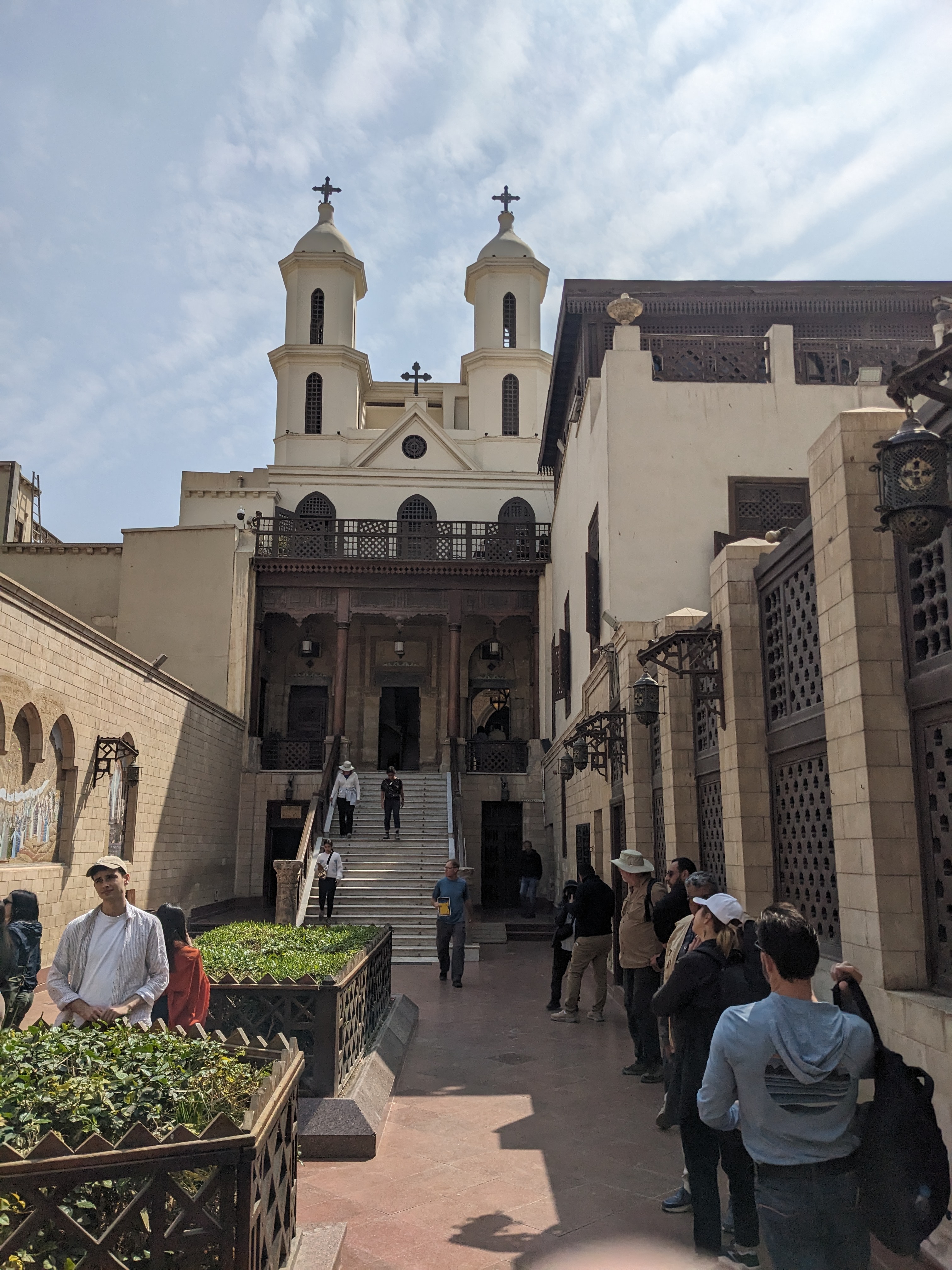
The hanging church also brings in many visitors. On the outside, it does not look like much, a plain church that sits on top of many steps in the middle of town. What many people do not realize when they first enter the church is that there in no bottom floor. Underneath the church is another street with a whole group of visitors passing by without ever knowing that there is a church above them. It is an interesting architectural marvel that once you are inside you can see why it has earned the name the hanging church.
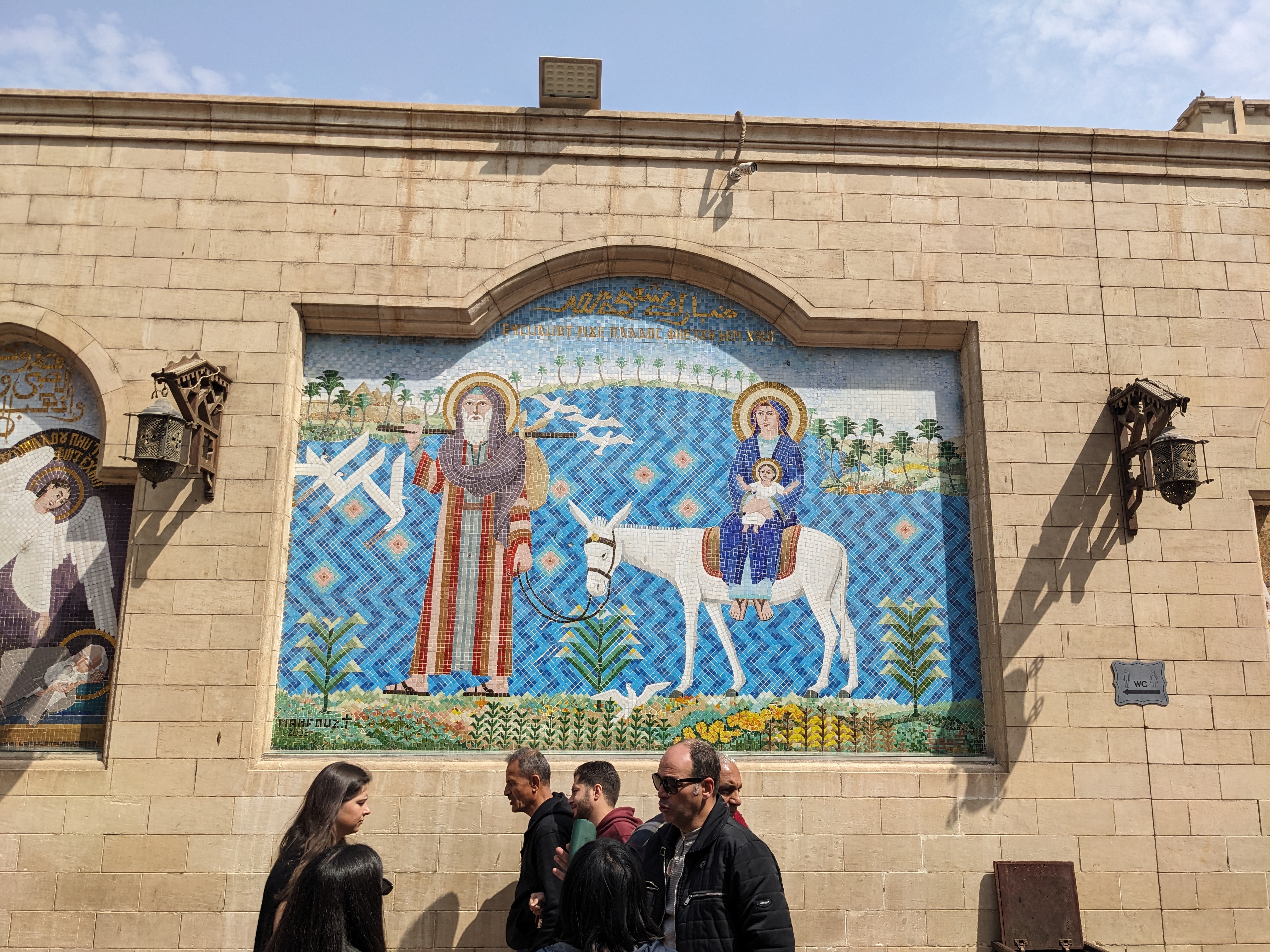
The courtyard of the church also has some beautiful mosaics to look at. Though they have been a recent addition to the area, they still add to the feel of the place. Even though they feel a little out of place in Egypt, it is interesting to know that there are so many of them in the Coptic part of the city.
It is interesting to see how much of Jesus’s story is present in the streets of Old Cairo. It is as much a part of the cultural of Egypt as the pharaohs, and adds another layer to this country. It makes traveling to the Coptic churches in Cairo just as much of a tourist destination as to the pyramids. Make sure that you spend at least part of your time in this historic part of Cairo.
I have been many places in the world where history is around every corner, but I have never been to a place like Egypt. The history that is in this country pre-dates many of the places I have visited, and the representation of that history is so grand in design that it is hard not to feel overwhelmed by it. There are many historical sites that people visit when out here like the pyramids, and the ancient city of Thebes, but Egypt has recently opened a new museum that will quickly rival those traditional spots, the Grand Egyptian Museum.
The building itself is an impressive structure located in Giza in the shadows of the pyramids. It has slowly been being built starting in 2006 when they moved the impressive statue of Ramses II which used to be located in the center of Cairo. Since then, they have opened up other sections of the museum over the course of the next couple of decades, and as of the writing of this in 2025, there is 80 percent of the planned museum opened up to the public right now.
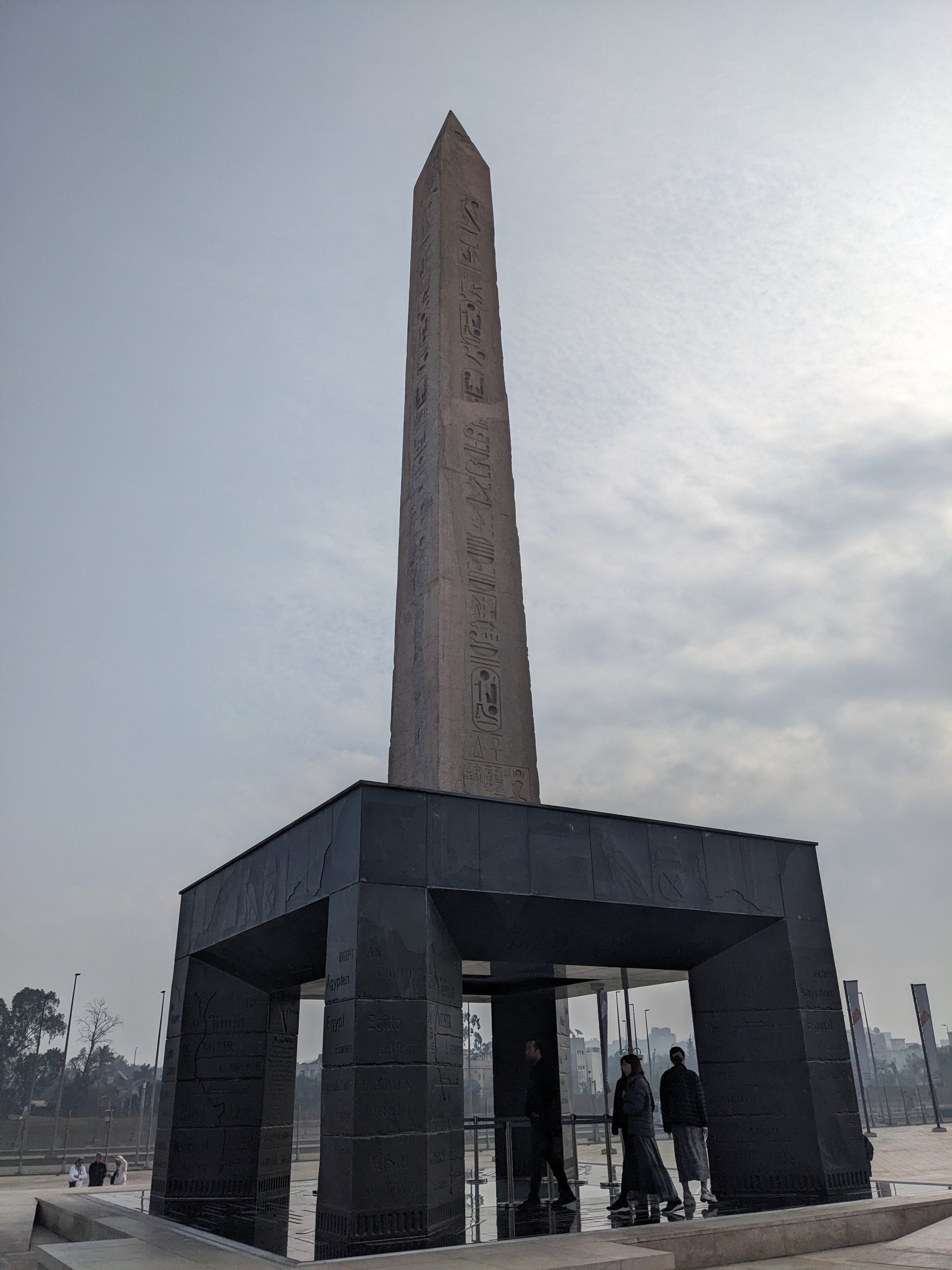
This includes the hanging obelisk just on the grounds up to the main building. It is the first thing that most visitors will see and it is a great introduction to the treasures that are held inside. It is a great introduction to the culture. There are many hieroglyphics carved into the stone, but the most interesting one is the one carved on the bottom. Here Ramses hid his name, so if any other kings came and tried to erase his name to take credit for his accomplishments, people would still be able to find the truth on the bottom of the obelisk.
There is also the grand staircase. Visitors have to travel up this staircase to get inside the main gallery. The staircase is covered with the largest collection of Egyptian tombs, statues and arches. They are the ones that are too big to bring into the main gallery, but are still impressive to see. Each one holds its own story, and I would highly recommend hiring a guide so they can take you to the more important ones, and tell you the stories that they hold.
The main gallery was just opened in October of 2024, and is where the main collection resides. There are so many pieces in this place that it would be impossible to see all of them in just one days. In fact, our guide told us that if we spent a minute looking at each one, then we would be in the museum for the next 80 days.
It is broken up into different rooms that follow the history of Egypt as it progresses down the hall. They then break up each era into the culture, history, and stories of that era. It is a lot to take in, so I would recommend taking a guide who can point out the more important pieces, and tell the stories behind them as well. I would not have gotten out as much from the experience if I did not have a knowledgable person to guide me.
I found out that there is a lot to see in Cairo, and that you need to make some decisions if you are planning a short trip out there. The pyramids and the sphinx are obvious musts, but there is another one that most people need to see as well, and that is the Grand Egyptian Museum. I was blown away by the sheer scale of it, and I could not imagine how it will grow even more when they open up the last twenty percent of it. It just gives me another reason to plan another trip some day to go out there to enjoy the museum again.
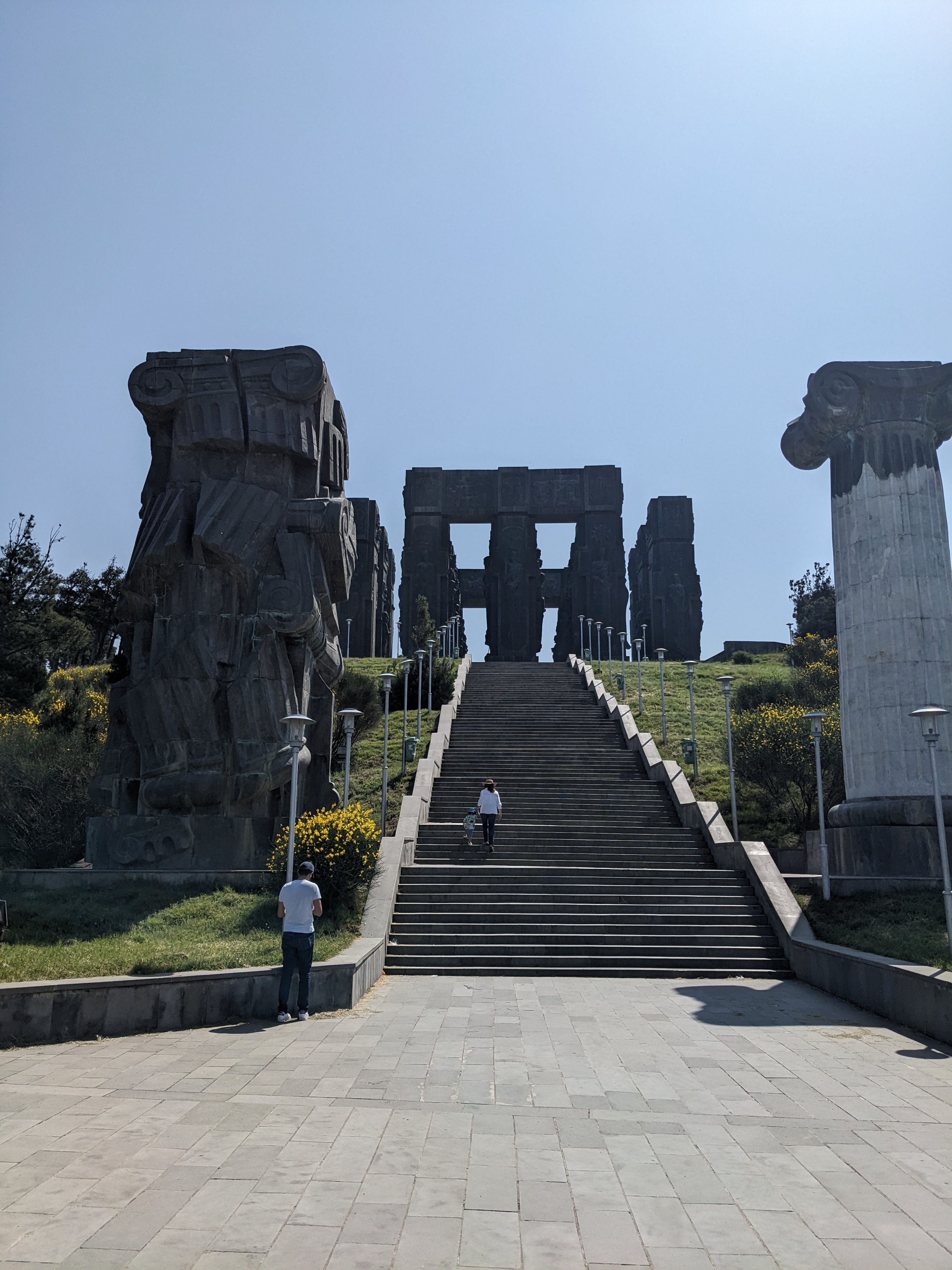
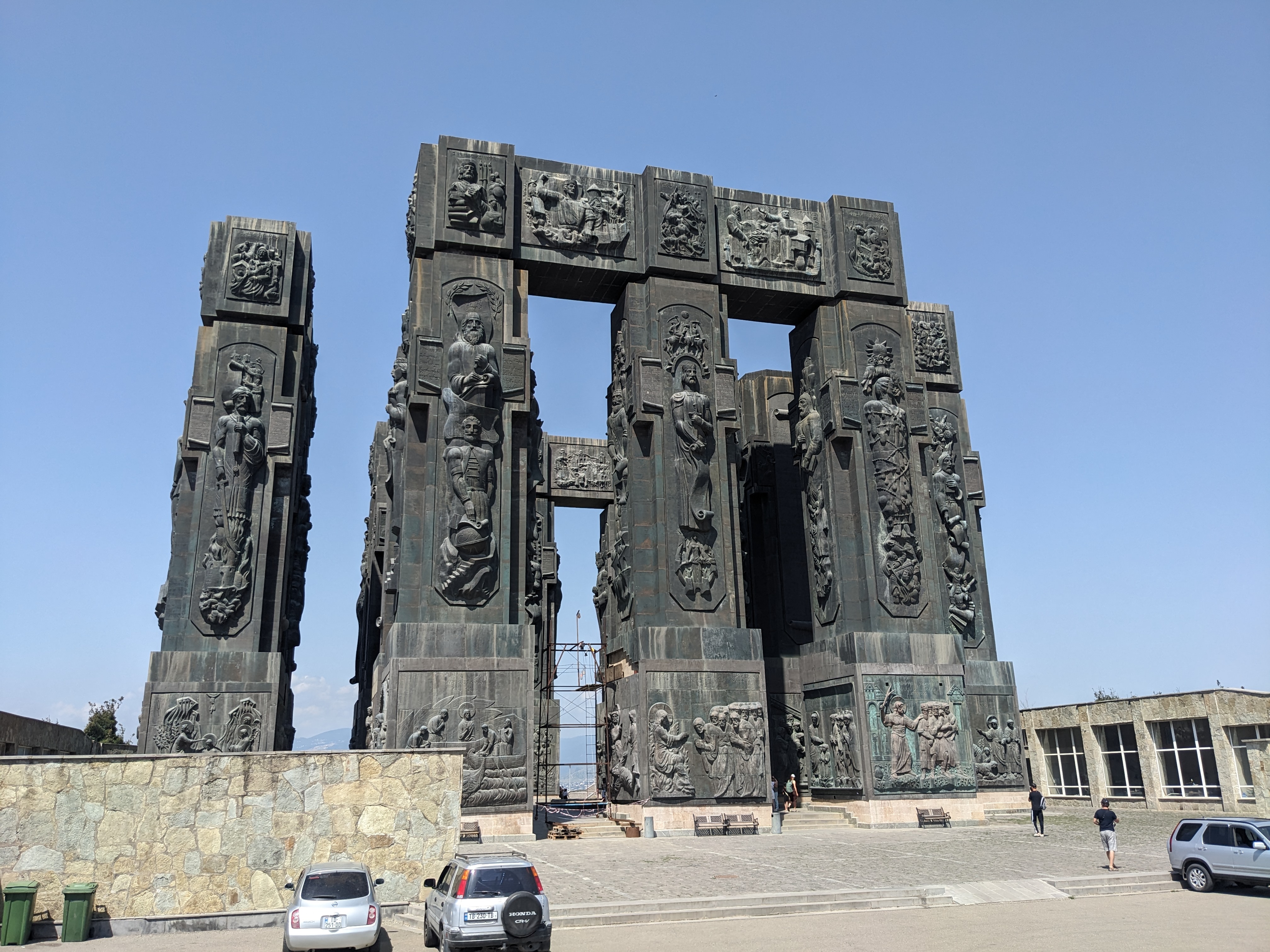
Sometimes when I am traveling, I spend so much time seeing what a town has to offer that I miss one of the bigger, more exciting features just outside of the city. Tbilisi has just one of these structures, the Chronicles of Georgia. Out on Keeni Hill just north of the city stands this massive structure of Stonehenge like pillars. It is hard to miss when you start traveling out that way, and it just begs to be visited.
The structure looks like it comes from a time before, but in reality, it is a relatively newer monument. Construction of the Chronicles started in 1985, and it was never completed, but enough of it was put up that it still is fascinating to come and look at. After climbing up the stairs to the structure, you are instantly immersed into the culture of Georgia as the pillars depict different aspects of it as well as some the country’s more famous participants.
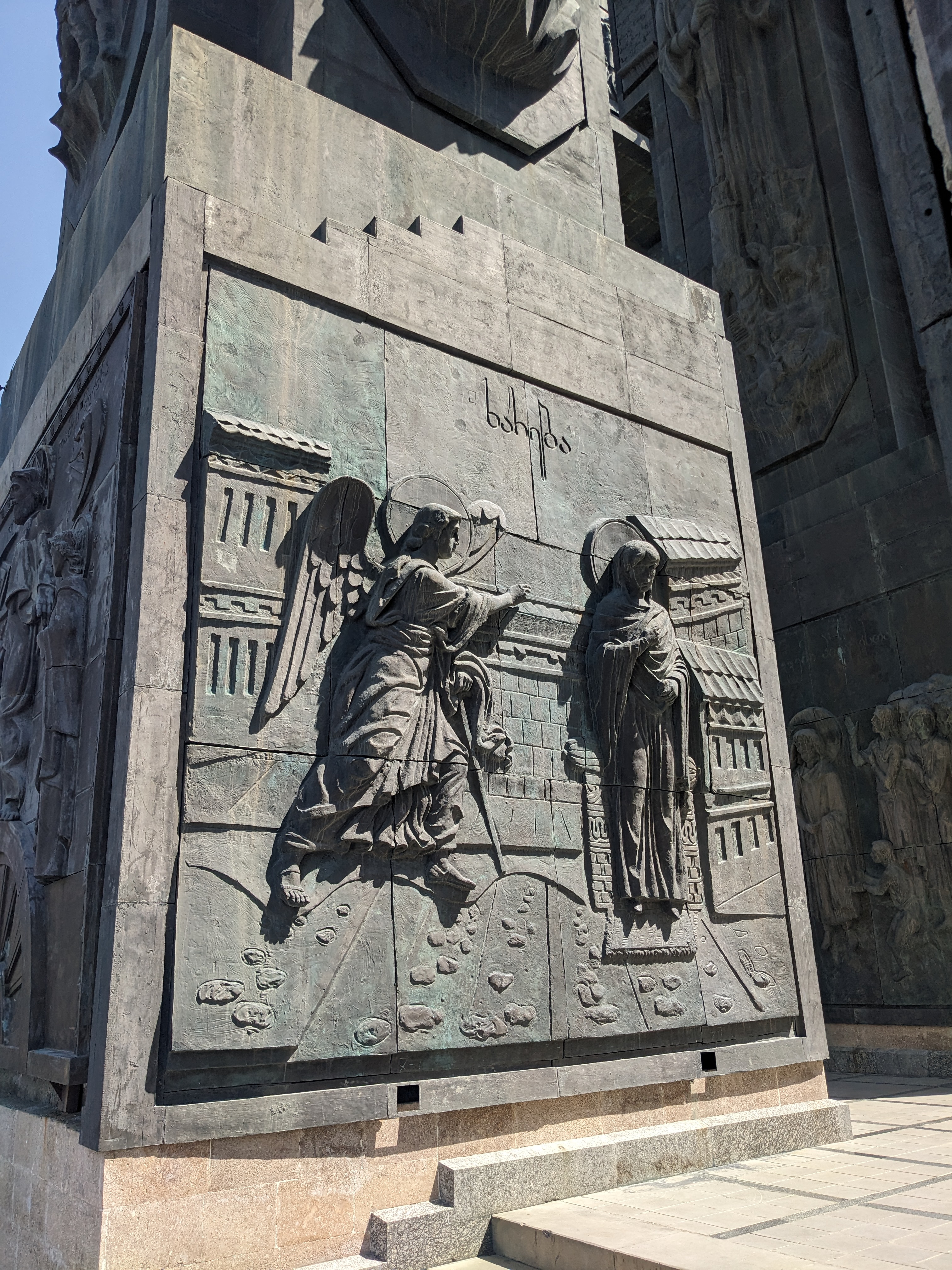
A closer look reveals that there are actually two different stories being told. The base of each pillar has up to four different reliefs depicting important stories from the Bible; whereas, the upper portion of the pillars has stories from the history of Georgia. The Bible stories were pretty easy for me to figure out because I am familiar with them, but the Georgian stories came with no context, and there was no information up there that helped to bring their stories to life. I have searched all over the place to see if I could find something that would give me more insight into the kings and queens I was looking at, but I still can’t find anything.
Despite this shortcoming, it is still an impressive spot to visit, especially if you are moving on to other parts of the country, such as the wine region or the mountains. It is a quick stop that you could easily spend thirty minutes to an hour at, and feel like you have really enjoyed it. Though you might not know the stories, the detail of the carving is still fun to explore, and talk about. The views up there are also spectacular, and there is an old church that is worth the time to explore as well.
From a distance, it may look like it is off the beaten path, but in reality, it is only a little detour from a regularly scheduled tour. It is so fascinating that it should eventually become a part of that regularly scheduled tour, so you might want to make it a part of yours if you come to Georgia.
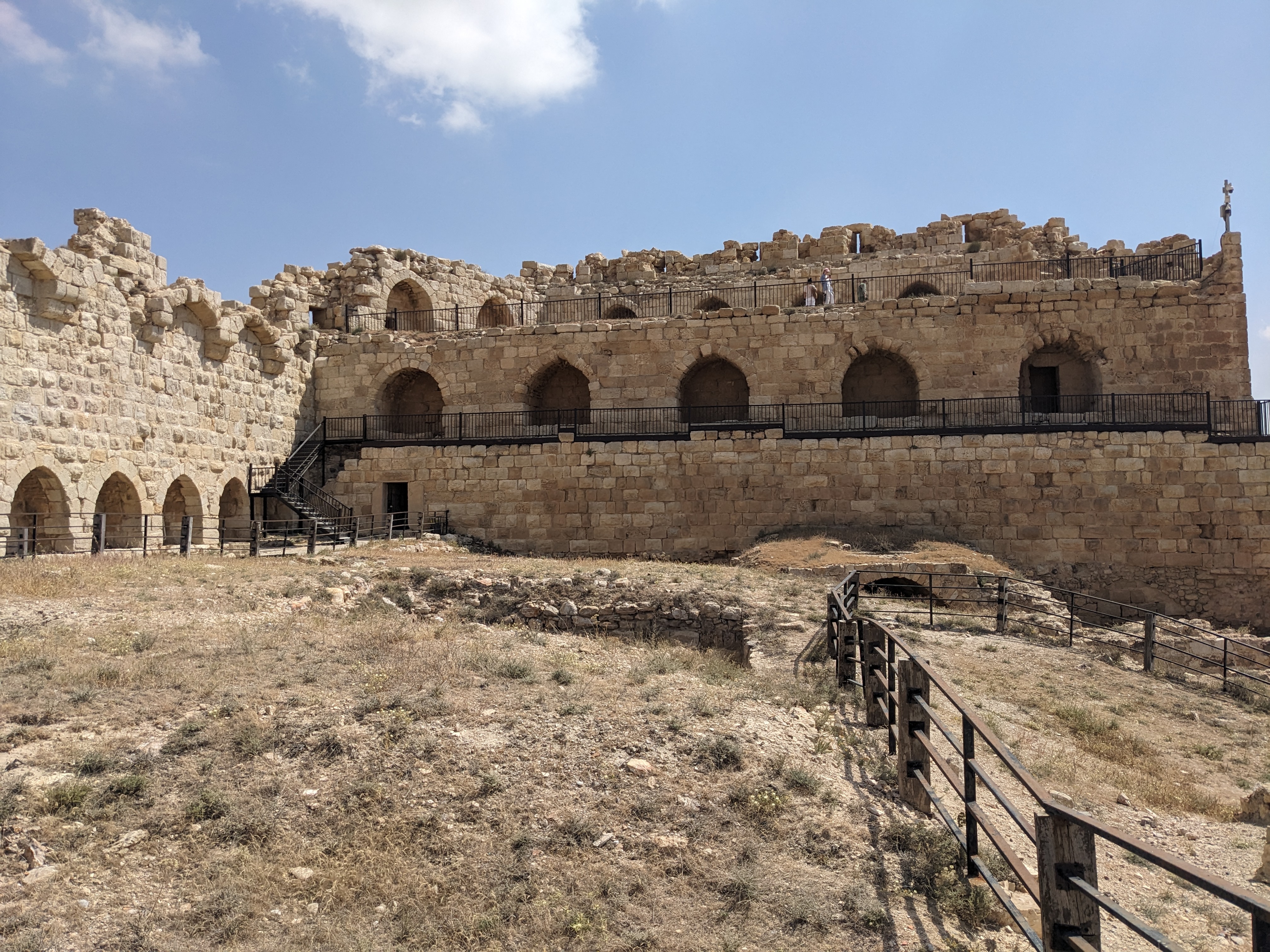
If you find yourself doing the Jordan Loop, and you have just left the Dead Sea to make your way over to Petra, there is a nice stop along the way that makes a nice break, and a beautiful place to enjoy a little piece of the areas history that does not have to do with either the Bible or Roman times. It is the Karak Castle, a large medieval castle situated on a hill in the city of Karak. The castle was built during the Crusades in 1142, and was used as a defensive position by many factions during that tumultuous time period in history.
The castle is a windy series of tunnels and rooms that sits on the hilltop that overlooks a large expanse of the valley below. For the most part, it is well preserved, and even though its dark passages might look foreboding at first glance, they light up as you walk along them so you can explore all the nooks and crannies that are there.
For how big and interesting it is, it is surprising how few visitors come to this location. I went during a down period of tourism for the country of Jordan, and I felt like I had the place to myself, but I am told that even when tourism was at its height, it was still not very packed. This makes it an essential place to visit, especially if you are traveling between the two bigger sights in Jordan.
The photo opportunities that it offers are limitless. I loved looking through the many embrasures, or arrow slits, in the castle and seeing how they could frame the valley below. Though the castle does not offer many explanations about what you are looking at, there is a museum on its grounds that will give you more insight about the area. I would tell you more about it, but I visited it on Jordan’s Labor Day, and it was closed on that day.
Even with missing out on the museum, there was still plenty to see on the grounds of this medieval castle. It is a great place to stop, and should be included as a quick adventure for all people making their way around the Jordan Loop. I would do it sooner rather than later because this place cannot remain a secret for too long.
It wasn’t until the end of my trip when I was asked if I had a little Scottish heritage in me. The question came from a driver who was taking us from where we dropped off our car rental to our hotel for the evening. The way he said it sounded as if he asked any tourist that he was in a car with the same question. I am sure he got an answer from many of those people that was the same as my answer, “Yes, I got a little bit of Scottish in me.”
Scotland is one of those countries that becomes a pilgrimage for many people because it tugs on something from within. They can hear the allure of hazy skies, whiskey tastings, history, kilts, highland games, and the occasional fish and chips. It promotes a lifestyle that they have only heard of in the books they have read as children or the stories told to them by an elder generation. They are curious about whether or not they can find a home in a land that was a home to their kin for so long.
Despite the rugged landscape, and the various castles, there is a sense of home that comes with traveling to Scotland. No matter where I went, I was greeted with a warm smile, and a friendly ear. Community was everywhere I looked. People would put down their phones to meet each other at the pub, or spend a day exploring the vast landscape that was offered. It is hard to come out to Scotland, and not fall in love with the land, the history and the people. For that reason, it feels like home.
The history of Scotland is one of rebellion, and national pride. It tells tales of victory, and defeat and how the land and the people were shaped by these moments. It boasts heroes whose exploits have been slightly altered to share national pride in other nations, so they can believe in the same fights that the Scots have fought for generations. It brings together nations under one banner while keeping its unique flavor for who they are and what they believe in. The history of Scotland is a fascinating one, and wherever I went in the country, I would run into a reminder of how rich and powerful that history was.
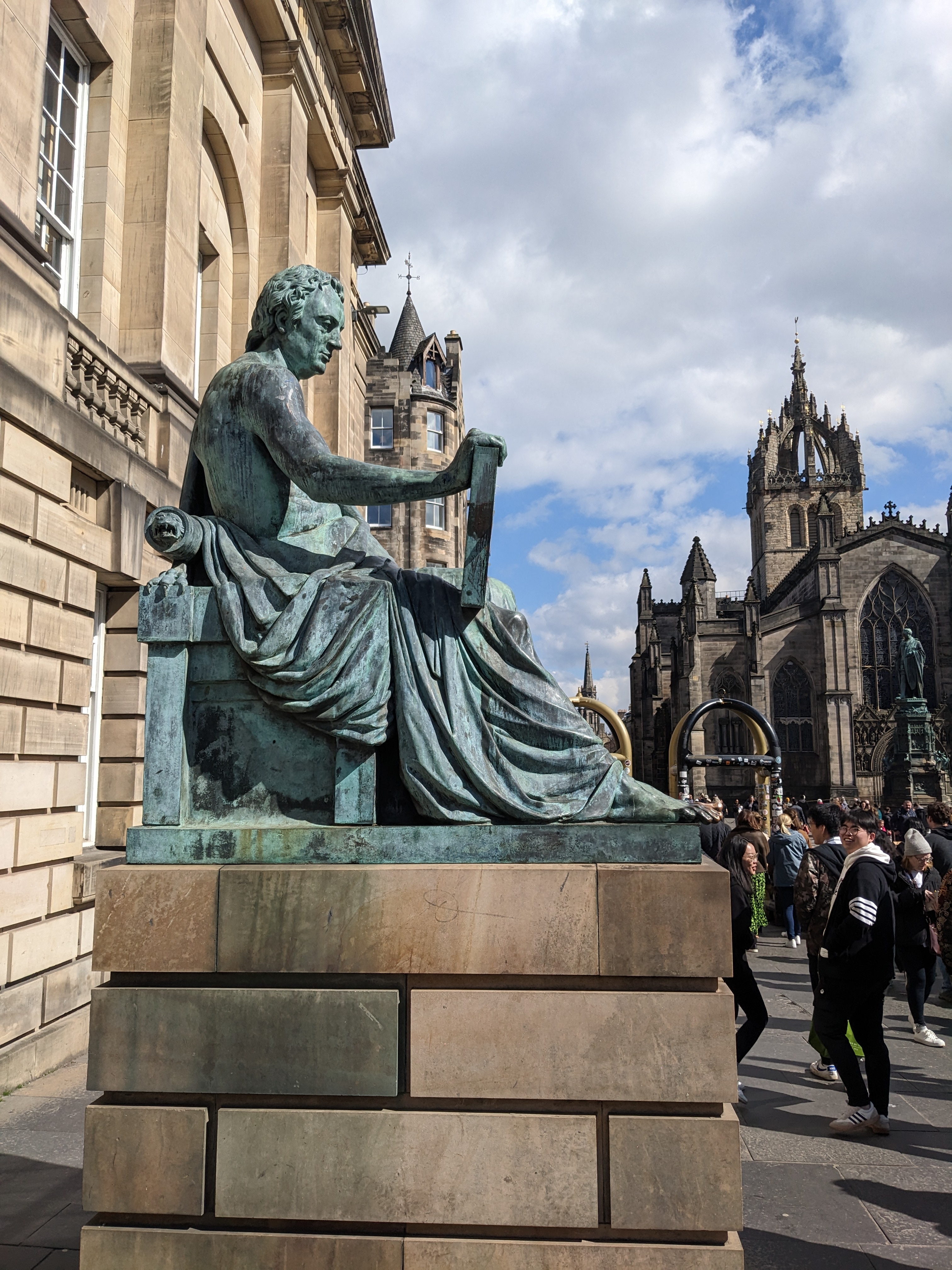
Scotland does not just offer the world a rich history and wonderful story to tell. It is also one of the hearts for intellectual thought in the world. Many great writers and philosophers have called Scotland, or more specifically Edinburgh, their home. Names such as David Hume, Robert Louis Stevenson, Sir Arthur Conan Doyle, Charles Dickens, Robert Burns, and J. K. Rowling all have connections to this great city, and many people from across the globe have been affected by their works in some capacity at some point in their lives.
Scotland’s impact on the world does not only stop at philosophy and literature, but extends into the sciences as well. There were great medical discoveries that came from Scotland including the discovery of the first anesthesia, chloroform. They were also the ones who cloned the first animal, Dolly the sheep. Their contributions to medicine has influenced the common practices so much that we would still be in the dark ages without them.
Scotland may be a small island off in the distance to so many people that they would never consider it a part of their lives, but if they look closer, there is a part of their lives that have been touched by the Scottish. In a way, when that man asked visiting guests whether I had any Scottish heritage, their answer should all be the same. Their is a little bit of the Scottish heritage in all of us. We may not be able to claim a clan as our own, but we can talk about how their history and culture has affected us in some capacity.
I am really glad that I was able to take the trip out to Scotland. It is a beautiful country, and I felt instantly at home in it. I suspect that this would be true for anybody that travels there. It should not be a must see destination for the ones who have a tartan hanging in their closets and they want to see the land where it comes from; rather, it should be for anyone who has ever been enthralled by its literature, learned a lesson from its history, or been saved by its contributions to science. It is everybody’s home.
I hope that someday, you can take the trip to Scotland and have the same kind of experience that I did. It is really worth the pilgramage.
You all look like ants, crawling down below When I am able to stand from the height. I can see how far that this city grew As it takes, from nature, another bite. Over the desert, the road stretches forth To the places where the Bedouins camped; You may look to the south, east, west, and north To witness how that culture has been stamped. It can now be found within the museums, Or the picture books given to children. Humankind is subjected to its whims To ignore the places where it has been. I stand atop its crowning achievement, A tower, to God’s grace, will not be bent.
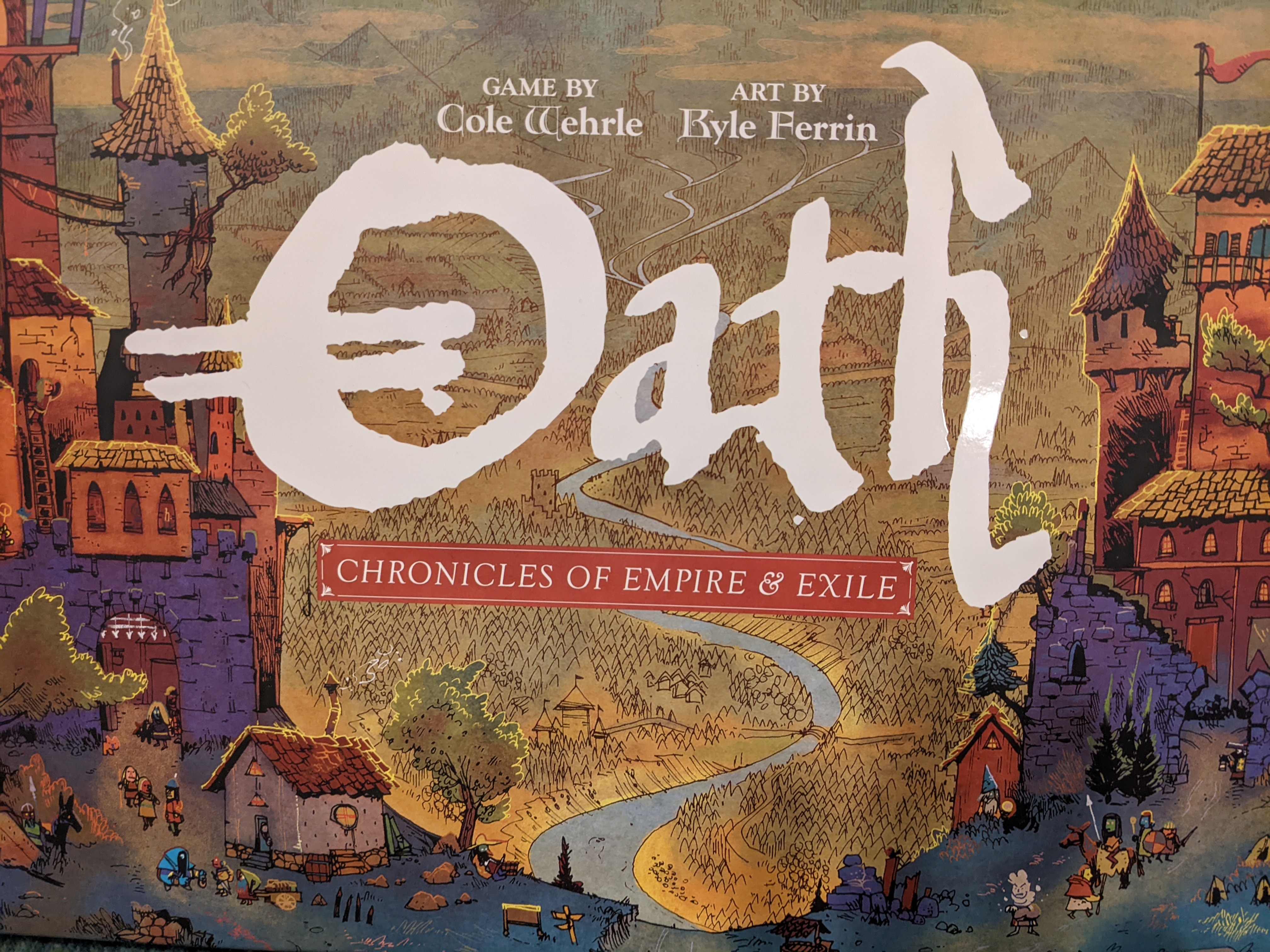
Hints of Oath: Chronicles of Empire & Exile started to surface at the beginning of the year, and there was something about it that instantly made me want to not just play it, but to own a copy of the game. All games have a central idea around it, and they usually focus on things such as dungeon crawl, cooperative, abstract, economic, area control, or role playing. Recently, some game have added a new aspect to it to add a campaign experience to the gameplay called legacy, and I have always been intrigued by these games because it would create a storytelling element to it that would make the experience of playing it unforgettable. The only problem I had with games like this is that after you have completed the cycle of the legacy, it could not be played again. This is a lot of money to spend on a game for only a limited amount of game time. Leder Games saw this problem and designed a game around legacy games’ central appeal, a sense of history.
Think about it. What if you had a game board that created its own history? Every game presented its own set of characters that played out their stories in various landscapes with their own objectives that created a new direction that the world would turn. Then take that world at the end of each game, let the winner write down this history of what happened, and then set up the game for a completely new experience the next time around with a new cast of characters playing their stories out in new landscapes with different directions.
And unlike all other legacy games, Leder Games have set up a system where, like history, the story never ends. This was too exciting of a concept for me to ignore this game, and now that I have played it, I am excited to share my thoughts on its unique and yet familiar style of play.
THEME
Three areas of the kingdom, the Cradle, the Provinces, and the Hinterlands, is tentatively held together by the rule of the Chancellor. This fledgling government has deployed war bands on some of the lands that it rules of over to keep control over other sights overrun with bandits, and even worse, the scheming exiles who are looking to take over the kingdom for themselves. In the first game, the Chancellor will try to keep control over his land by sheer force of his army, but this is not the only way that the exiles can overthrow this dictator. These other ways come in the form of Visions.
One of the exiles might find in the middle of the night that they have obtained a dream that they can interpret different ways. Maybe if they could collect the secrets of the court and use them to their advantage to make their way up through the ranks. Or they might become the most popular person in all of the land and get the favor of the people. Or they might search the lands for the hidden treasures that have been left behind for a time long forgotten. These powerful artifacts could help them in their rise to power.
The Chancellor still has another trick up his sleeve. He has collected a few of these powerful artifacts and has placed them in his treasury. At any time, he can offer one of these powerful artifacts to one of the exiles, and offer them citizenship into his kingdom. With citizenship comes certain privileges, and new paths to taking over the kingdom as a successor.
All of this takes place in a closed economy where favor is passed off to different factions within the kingdom who use that favor to unleash their special influence over the land. But one faction may gain too much favor which causes the economy fall into the control of the ones who may have advisors who are friends with those factions, making it harder for the other players.
Overall the story sounds like a complicated game of courts and politics that has enough variety to it to allow a different story to unfold every time the game is played. Add into the unique legacy aspect of the game that creates history for each individual game box and you are left with a fun and exciting story that will have you begging to play a new game as soon as you finish one.
Rating – 10
GAMEPLAY
A game with this complicated of a story line might scare away some people away because the gameplay must be as complicated to support it. It might scare others away because there is no way that a designer could take on such an ambitious endeavor without it all falling apart. It would take quite the balancing act to make this work out properly.
But this is where the genius of Cole Wehrle comes into play. He has already made his mark with other four-lettered games such as Root and Fort, and each of those games has its own unique twist on gameplay that makes it unique, but Oath is by far his most ambitious. There is enough asynchronous game play going on this game that you have to pay attention to what other people are doing, or before you know it, they will have taken over control of the kingdom. The nice thing about this gameplay is that, except for the Chancellor whose role is to react to what is going on, the rest of the players have the opportunity to choose their own paths to victory. All of this come in a set of choices that when stripped down are not as complicated as it would seem to be in a game like this. There are elements of randomness, but it is adds more to the story rather than being frustrating when a person looses due to some unlucky role of the dice.
Despite all of these different ways of going about pushing your influence out on to the game board, the gameplay is rather easy to pick up and figure out. There are only six different actions you can take per turn, and some minor actions that you can participate in as well, so it does not take long to figure out what you can and cannot do. Strategy takes a little longer to figure out because you are not always aware of all the new cards you will see during a game and how they will be able to help or hinder your gameplay. It is what makes the game exciting and fun each time you play this.
It is a little more crunchy than a typical game, and takes some time to figure out, but Leder Games added a walkthrough of the first round of the first game that you play. It talks you through what would be the best move for four players based on what they have in their hands and what cards they draw. It also talks about why this is an important move for each person to help wrap your mind around the strategy of the game. So even though, it may appear complicated and intimidating, they help ease you into the game.
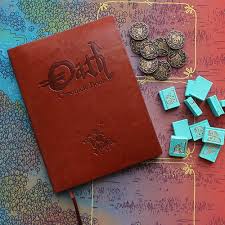
The best part of all of this is that the gameplay and the different cards that you get to see for advisors, artifacts, and locations with different win conditions not only playing out during each game, but for each player that each game is a unique experience. It also feeds directly into the theme and creates a unique story each time that you play. People who love this storytelling element in their games will obviously make the story come alive more as the game plays out, but do not think of the stories that this game tells is like one that plays out in role playing games. The strokes are more broad with the narrative and important moments in the history of your board are the ones that you will be talking about long after the game is finished. People who bought the Kickstarter version of the game even received a journal where they could write down the story after each play of the game and how that has expanded their overall history. It was one of the things I was really excited about, and was really disappointed that I did not get it with the version I bought through retail, but a quick trip to a local bookstore, and a purchase of a cheaper journal fixed this problem rather quickly. The one I got even looks like it might have originally been part of the game to begin with.
Rating – 10
ARTWORK
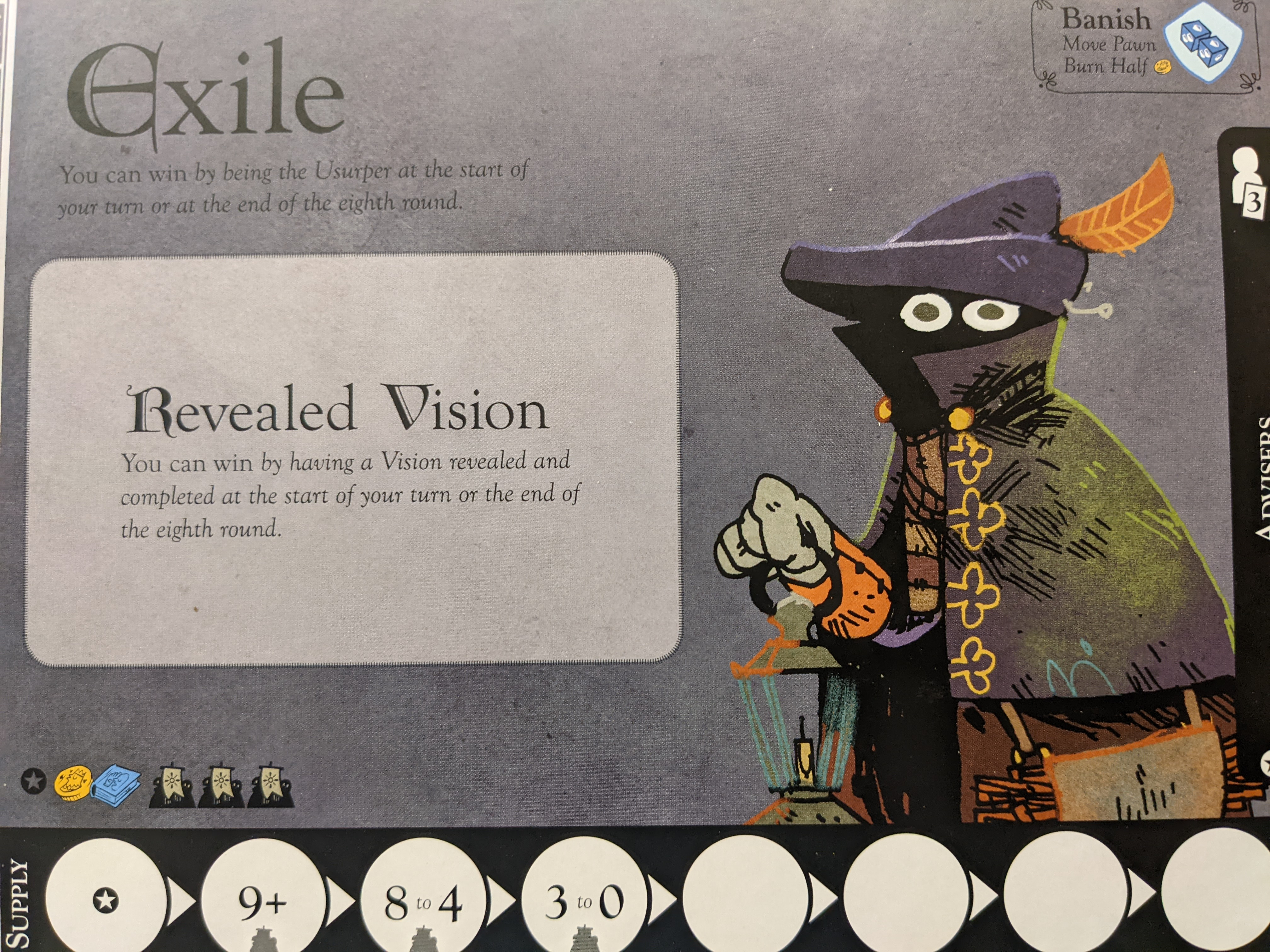
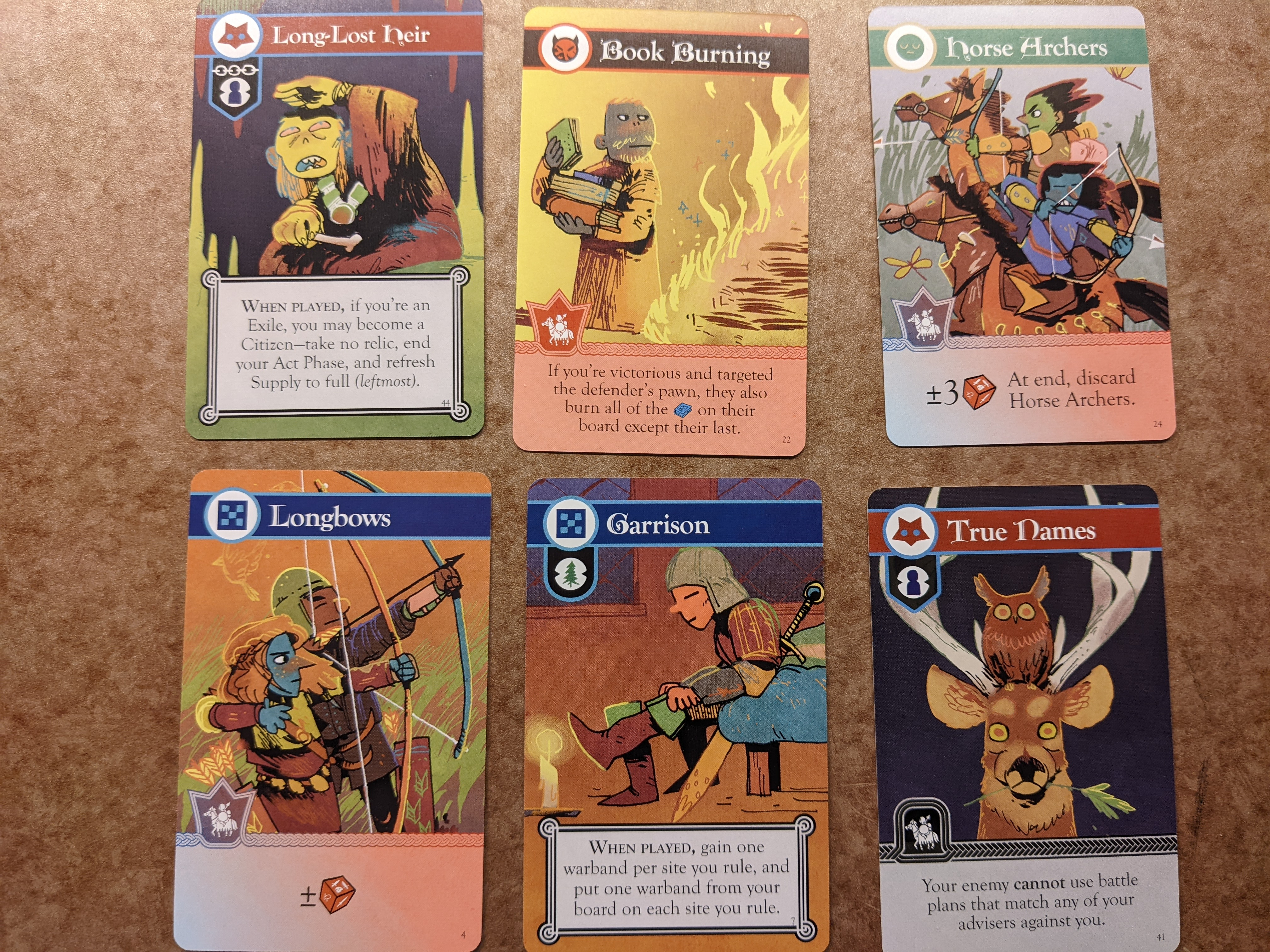
If you know anything about Leder Games, then you know that each one of their games has a certain look to it that adds to the overall enjoyment of the game. Kyle Ferrin has a certain art style that quickly recognizable and can be seen in their other two games, Root and Fort. He has taken great care with each of the cards, whether, it is one of the advisors, lands or artifacts. It is not only a great card to look at, but each cartoon character begs for its own story to tell that will add to the narrative that your group tells. It also adds a different kind of levity to the game. This is easily a game that could come across as being extremely dark as war, and court intrigue play out in every session, and if the artwork was designed to to reflect this darkness, then I feel like it would be a completely different game.
The game board also has a unique design. It is not a big piece of cardboard that you unfold and place on the table, or a collection of tiles that you have to piece together. It is a nice mat that you role out and place your pieces on. It does provide the basic knowledge that you need to have in order to play the game, but for the most part, until you add the other pieces, it does not add a lot to the overall gameplay.
Great care also went into creating the game pieces. Though the only difference between the war-bands that you use during battle is the color, the pieces that represent the various exiles and Chancellor reflect the personality of each of them. Of course, the Chancellor’s piece is taller that any of the other ones that just adds to the fragile nature of his character, as if he is taller somehow makes him better. The pieces also have the same feel as the cards that are played and once again help you to become a part of the world that you are playing in.
The game not only is a lot of fun to play, but it also has a great look to it that adds to the game play. The Kickstarter version of the game even went so far as to make the favor and secrets plastic which adds more to the overall experience, but they are nothing more than cardboard punch-outs if you buy the retail version of the game. It was a little disappointing when I opened the box, but it was quickly forgotten when I looked at all of the other artwork that game had to offer.
Rating – 9
INTERACTIVITY
As always, the main reason I enjoy to play games is because it allows me the opportunity to hang out with friends and enjoy an experience unlike any other. Some games have low levels of interactivity where the players are over in the corner doing their own thing, and it isn’t until the end of the game and everybody counts up their points that the interactive aspect of the game begins. Oath is not this kind of game. The game forces you to interact with other people and either work together to stop the bigger threat, or fight against your greatest enemy. Some people are trying to be sneaky, while others are using all of their force to win the game. You will be spend a lot of the time playing this game interacting with each other. When I played, as soon as the game got going, there was not one of us that were sitting down. We were so excited about what was going on that we were walking around the table, looking at different points of attack and strategizing about how we could pull off a win. Nobody was ever completely out of the game, and at any moment, a simple turn could change the tide of the game. I absolutely loved the aspect of this game.
The battles also added a lot of dramatic tension that I had not seen since playing the old area control games, and it was not a long drawn-out tension like you might see in other area control games, such as Risk or Axis and Allies. Basically, it is one role of the dice for both the attacker and the defender. At first look, the attacker has the advantage because they have a handful of dice compared to the defenders couple of dice. But the dice that the defender uses are more powerful, and even though, the attacker won most of the time, the battle would leave both sides devastated. I believe this to be the most accurate depiction of war I have ever seen. Very rarely, does someone just come in and destroy the other side without taking any casualties. It just means that there has to be a good reason to attack, and you had better have a lot of war-bands mustered before you attempt it.
There is also a lot going on in the game, so you need to keep a close eye on everything happening, or someone might sneak in a win when you least expected it. The bottom line is I spent a lot of time interacting with the people I was playing with, and because of the legacy nature of the game, it would be best to try and find the same people to play with on a consistent basis, or they might lose what is going on with the history of the board. The set up for the next game took a long time to figure out, and people got bored while this was going on, but if the winner spends that time writing their history down and sharing it afterwards, it will add to the overall experience.
Rating – 10
EXPANSIONS
At the time of the writing of this review, there are no expansions to Oath. I have not even heard of hints or rumors about expansions coming later, but considering the game is less than a year old, it does not surprise me. If it is anything like Leder Games other big hit, Root, there will be extra packs of cards added to the game, and new complications to keep people interested in playing the game for years to come. Right now, the only thing that you can buy to add to the experience is the leather bound journal to keep track of your board’s history, but I am still a little annoyed that this does not come with the game. I do believe it is the main draw of the game and it is the one thing that really make this game more unique than any other I have ever played. As of right now, this is not one of the strong points of the game, but there is enough going on in the game to keep you engaged, and you will not replay a game any time soon.
Rating – 5
OVERALL
I have loved my experience with the game so far, and I am constantly thinking about the next time I will get to enjoy it again. I love the history aspect of the game, and how each play is completely different, but somehow still familiar. Its gameplay is simple enough that I feel confident in what I am doing, but complex enough that I still feel like there is a lot I have to learn about the game to get really good at it. I do hope that they have plans to make expansions for this game, so that it stays fresh and exciting for each game play and allows me to continue to add on to the history of my board. With this in mind, this is not a game for everyone. Though the rule book is short, there are enough of them to keep certain people away from this game. It is also rather expensive, so before buying, you might want to make sure that you have a group of friends that will be excited about playing it over and over again. If you do have that group of friends, it could easily become that group’s favorite game, and I could see it being pulled out time and time again.





















 John Collings