Where I live in Peru, I am close to some ancient ruins that predate the Inca empire. It is a strange feeling to wander around town, and to stumble across these from time to time, and to think about all of the riches that they hold. These ruins are all over the place in Peru, and over my many travels throughout the country, I cannot marvel of what the civilizations in this part of the world might have been. I also think about the explorer that came out here, and explored these various sites, and took back to their countries the treasures they discovered there. It doesn’t help that my newest game that I have been recently playing, I believe was partly inspired by this dynamic in Peru.
In The Lost Ruins of Arnak, you play an explorer that has recently landed on the island of Arnak. As that explorer, you are tasked with finding the rumored ruins that lay somewhere on the island. You need to collect the appropriate resources required to exchange them for the knowledge and the bribes that the ancient monsters crave to be the one to discover this mythic location. You travel on foot, or take cars, boats and planes to different locations until you can make it to the lost ruins.
The landscape of Peru, and the history that I learn while living here reminds me of the game, and the game reminds me that I am living in Peru. Not only has it been a great game to play in South America, but its design and game play have also made it a fun game to play even if I was not living in this part of the world right now. So do not be scared if you live in a different part of the world that does not include ancient ruins, Amazonian rain forest, and exotic beasts, I am here to give you my thoughts and feeling as whether this is the game for you.
THEME
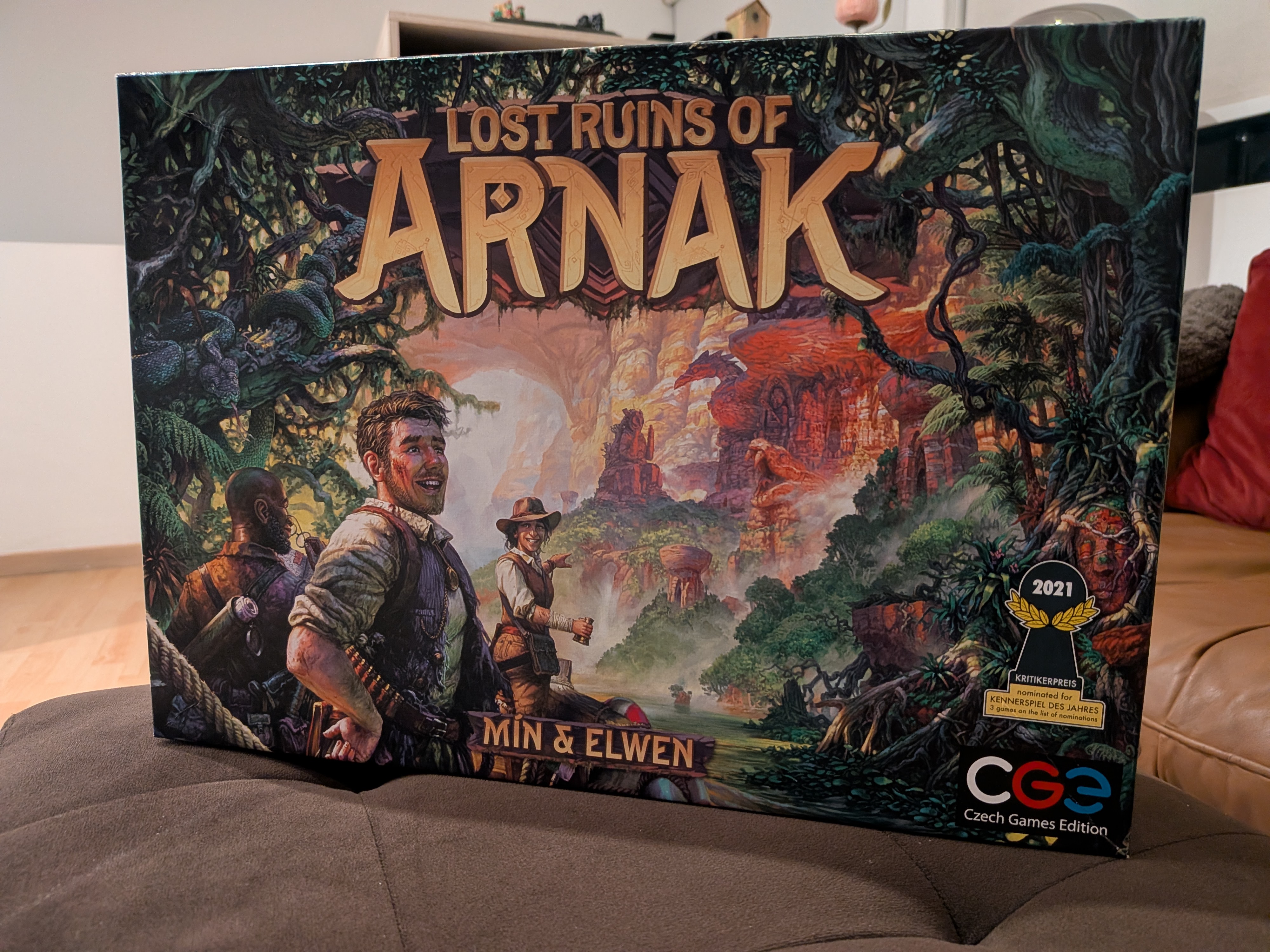
Even though the game is set in a mythical location, it is easy to imagine to believe that this place is somewhere in South America. From the jungle on the box, to the mythical creatures that you can meet along the way, it makes me feel like I am a part of an Indiana Jones adventure where you are competing against other ambitious archeologists. The big difference is that they are Nazis, but your best friends gathered around a game table. You are not only required to send people out to various dig sites to see if you can find the resources that you need in order to make your way to the final goal, but you also need to complete research on a track that rewards those who do the work.
There are a lot of fun details that add to the storyline that is created during the play of the game. There are items, and artifacts that you can pick up along the way that can be used to improve your ability to outwit your opponents. There are also allies that give you certain privileges on the island that can improve your chances to be the most successful archeologist. Their smiling faces join you in your quest, and as you gain more knowledge about what you are looking for, they also gain in their abilities.
Michal “Elwen” Stach and Michaela “Min” Stachova designed the game with the theme in mind. Everything that happens in this game lends itself to the story being told. It really immerses you in the world they created. It does help that I get to play the game in a place that reminds me of this world, so I feel very immersed in that world already. Still, it is so well imagined that I do not think you have to be in South America to feel a part of the game.
Rating – 9
GAME PLAY
The Lost Ruins of Arnak has won a lot of awards after it was released, and that is mainly due to the unique way that it blended a couple of mechanics into a new game system that has never really been seen before. It feels both familiar and fresh at the same time. It will instantly become a favorite of anybody who loves worker placement games as well as the ones who love to deck-building. It all works together to create a Euro-game with many paths to victory that will keep players trying new ways to gather the most points possible.
The game plays out over a series of five rounds. During that time you have two workers that you can send out to various sites to gather resources. You do this by playing certain cards that you have in your hand that allow you to reach different sites. The easier sites are ones that you can walk to; whereas, you need a car, boat or plane to get to the sites that are further on the island. You also need to collect some compasses to make to the deeper sites. The resources that you can gather there are better, but they are also protected by creatures that protect the riches of the ancient civilization. You can befriend these creatures with resources or you can just sneak in, steal those resources, and retreat with a little more fear that gathers up in your hand making it less powerful.
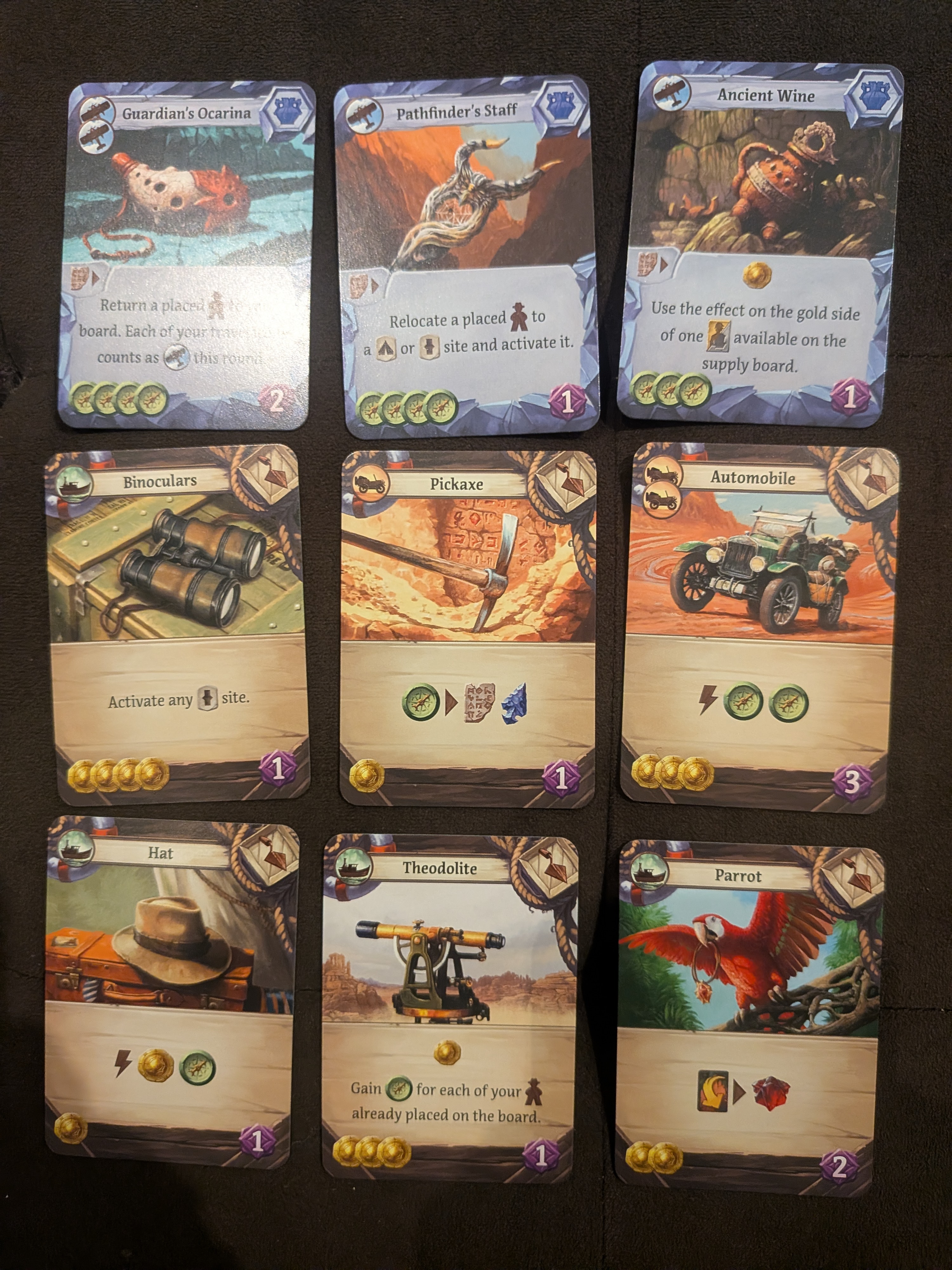
Still, there are ways to get a more powerful hand. While going out to find artifacts, you gather up some gold that you can use to buy certain items that help you in your exploration of the island. These items give you special powers over the other players, and adds depth to your deck. There are also artifacts that have to be found from searching the surroundings, but the power they give is slightly better than the items. There are fewer artifacts than items at the beginning of the game, but by the end of they switch though you will have less time to play what you have picked up.
There is one more thing that you have to think about while playing the game, and that is the research track. Just like any intellectual doing research, there is a race to see who can get to the top first. It requires for the person doing the research to lose some of the resources they have collected along the way, but there are also rewards as you move up the track, more for those who move up it quicker. There are also a lot of points available if you make it all the way to the top of the track, so this becomes one of the central focuses of the game.
For the most part, there are a lot of twists and turns in how this game is played with many paths that can lead to victory, and a balance to try and control your options along the way. It makes for unique gameplay that you will not quickly forget about.
Rating – 10
ARTWORK
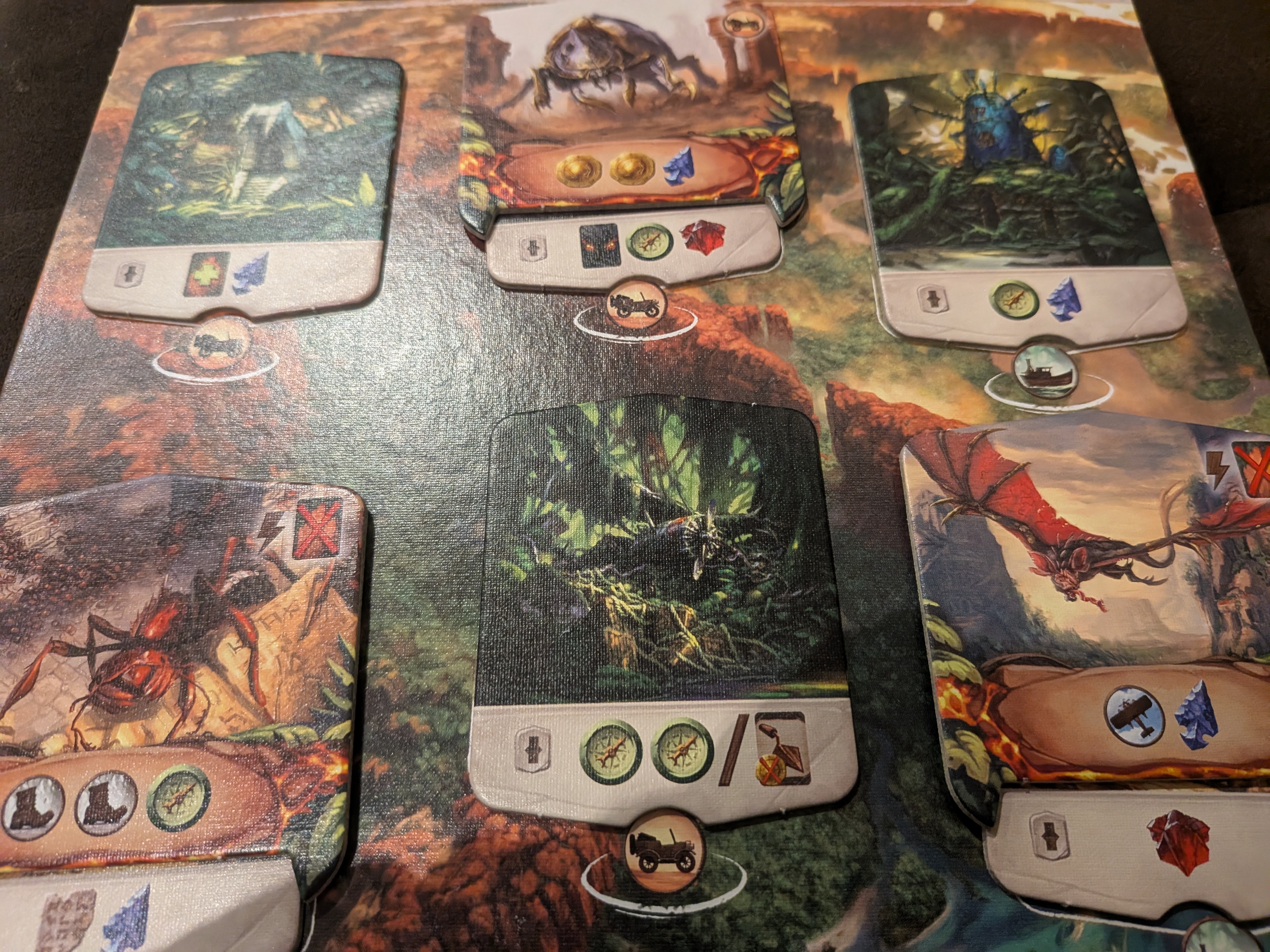
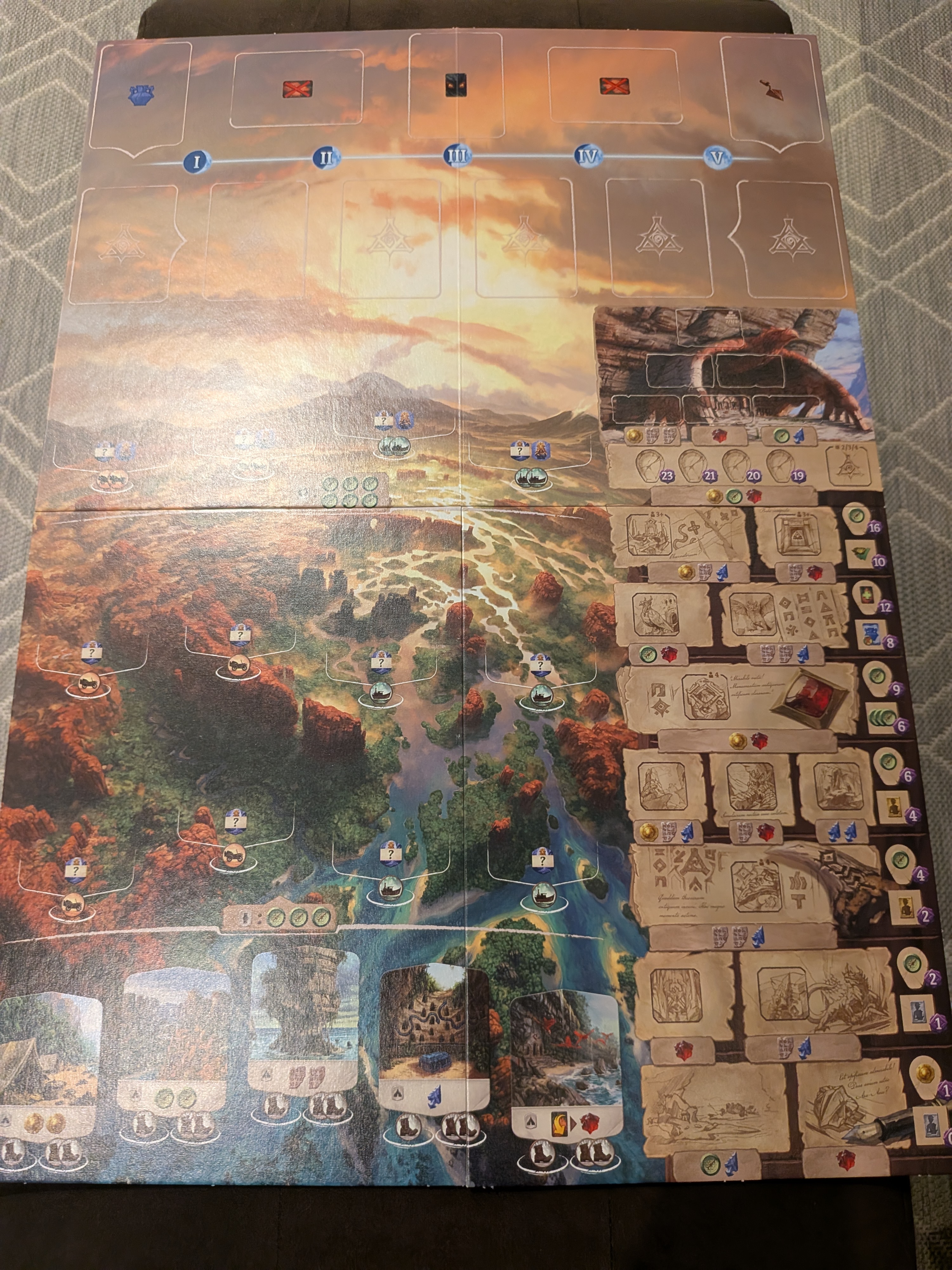
A crew of artists were employed to create the artwork for the Lost Ruins of Arnak though when playing the game, it does not feel that way. Ondrej Hrdina, Jin Kus, Filip Murmak, and Jakub Politzer had a single vision when creating the feel of this game. First off, the board is big, and you will want a good table that will be able to house all of the people on it comfortably. Still the spread of the board gives you the feel of a large island just waiting to be explored. It looks a little bare at the beginning of the game, but as more sites are uncovered, the board really starts to come to life with the hidden temples that can be found in the jungles, and the creatures that protect them. In games with higher player count, the board really comes to life by the end of the game, but this is not the same if you are only playing a two player game. In those cases, the board still looks empty by the end of the game.
As for the temples that you discover along the way, they are a lot of fun to look at. Each one has its own distinct feel, and when you discover it out in the middle of the wilderness, it make you feel like a true adventurer exploring some unknown island. The creatures that are protecting them add another depth to the immersion that this game holds. They look like something you would see crawling out of the Latin American jungle, complete with the mythology that would be found by the people who live there. The creatures do not come with names, but they have sso much personality that you feel like you should name them every time they pop up on the game.
A lot of the game involves iconography to dictate what certain cards or spots can allow you to do. There are a lot of them, and each player is given a cheat sheet to help them decipher all of the different icons. It does make the game easier to figure out, but the icons do not always clearly portray what they mean, so the first few games, you will spend a lot of time referring to this cheat sheet. It works well, but it is not always intuitive.
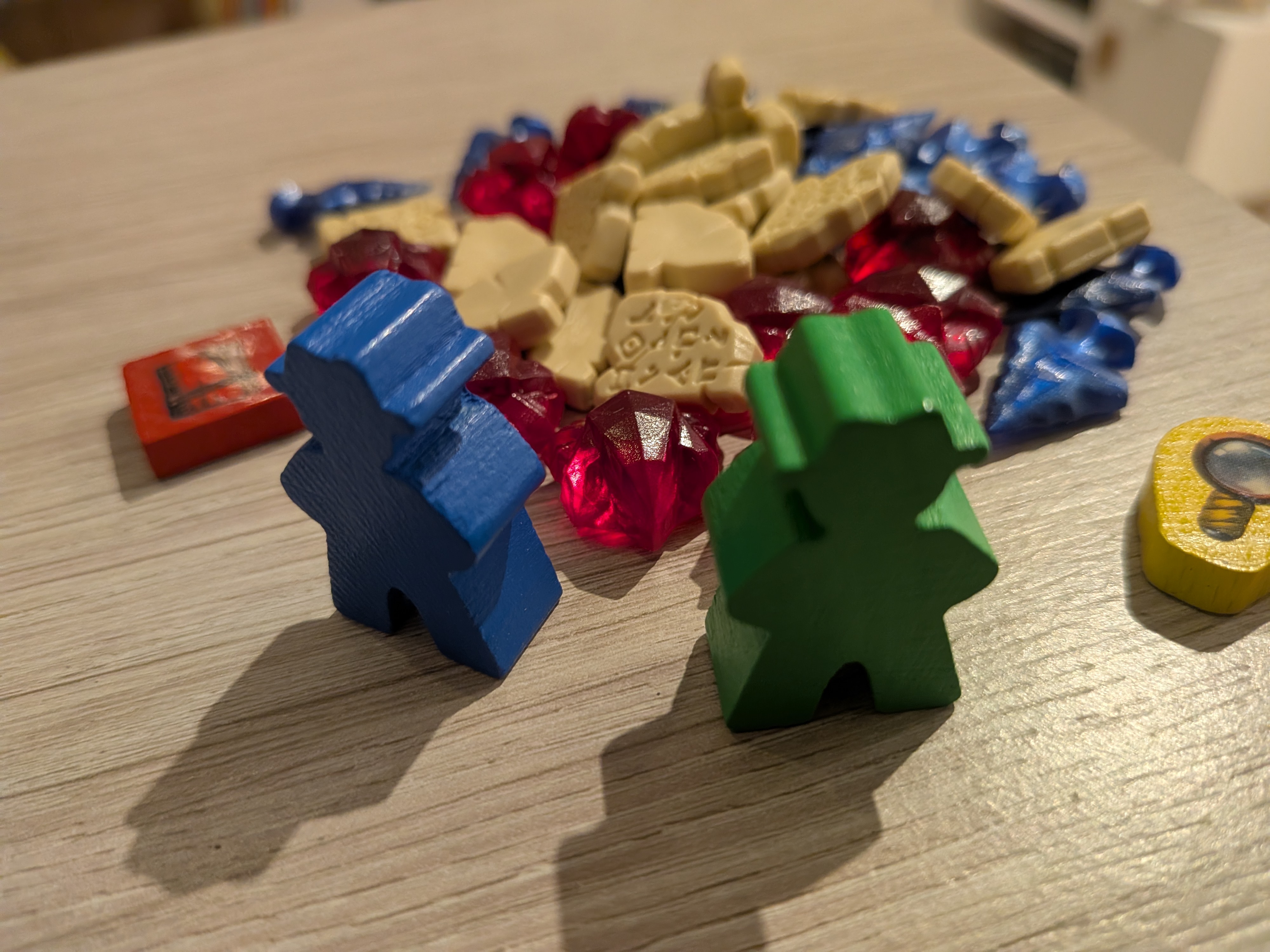
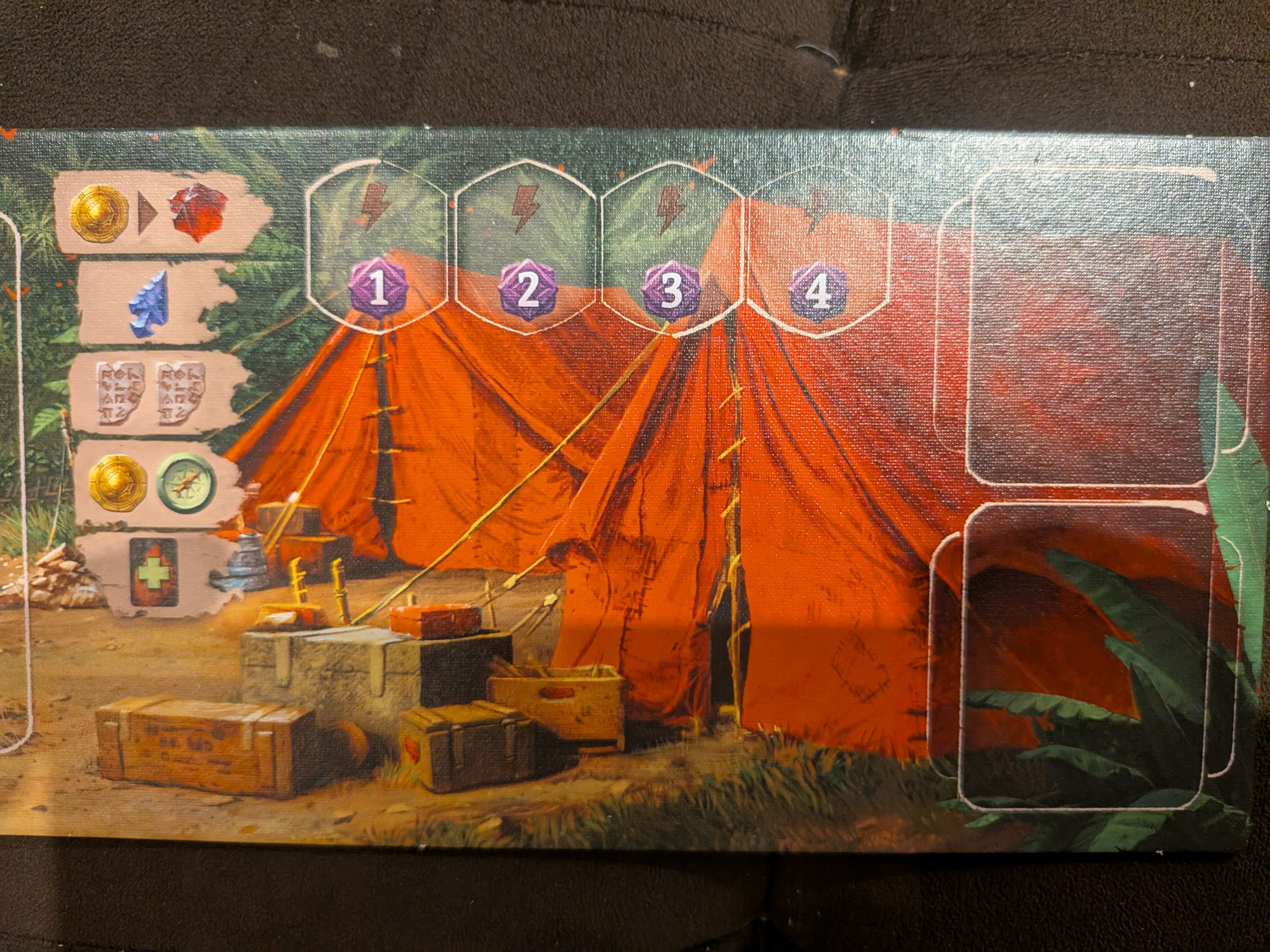
The playing pieces though are an absolute joy. The meeples are big and chunky. They look like mini explorers and make the perfect worker for this game. I enjoy the fact that they are made of wood, so they feel great when you get to hold them in your hands. The resources you collect are also a treat to handle. The arrowheads, gems, and tablets are made out of plastic, but it is fun to collect them, and place them in a pile of your game-board which, by the way, is painted like a base camp.
Rating – 10
INTERACTIVITY
Like most worker-placement or deck-building games, the interactivity level is pretty low. You are mostly concerned about what you are doing in your play area, and you don’t really think about what other people are doing. The biggest interaction comes when thinking about the places where you are putting your workers, the cards you are collecting for you deck, and the path you are traveling on to get the most points possible. If you take the spot that another person wanted, it could make things a little difficult for them, and it requires them to rethink how they are going to accomplish what they want to accomplish. There is also a little bit of a race element associated with the research track. If you are the first person to move up the track in certain places, you get a bonus. This causes players to put a lot of focus on the research track. There is also the bonus of the person that reaches the top of the track first, as they get a bigger bonus then all of the other who come in behind them.
Basically, this game falls into the range of your basic Euro-style game, where players have their own thing going on in front of themselves which does not have a lot to do with the other people playing the game. Yes, it is a little bit of a bother if someone takes a space before you can, but there are so many paths to victory that you can find another way to set you on the path to victory. I still have fun hanging out with my friends while playing this game, but it is not high on the interactivity scale.
Rating – 6
REPLAYABILITY
As there are many games to choose from on the market, it is important to know which games are not going to get stale, and you will want to bring to the table again and again. Some games come with more difficult challenges within the box to make the game exciting again for those who have played the base game too many times, and then there are other games who offer expansion sets that add new twists or make the game asymmetrical. The Lost Ruins of Arnak do both of these things. The kind publishers at CGE games understand that for a game to become iconic, they must offer this to their fans in order to keep their game in their minds for and on their tables.
The game itself comes with a two-sided board, the Bird Temple side, and the Snake Temple side. The Bird Temple side is what is recommended for anybody who is playing the game for the first time; whereas, the Snake Temple side is for the more serious Euro-gamer who wants to try out something a little more challenging. It also breathes new life into the game after playing the Bird Temple side for so long.
If you still want more to the game, there are four expansions available for the game. The most difficult to find, Surprise Shipment, is a mini expansion that only adds new artifacts and items to the game. It switches up the gameplay a bit, but not enough to make it a must buy. The other expansions add more depth to the game, and extend the table presence that it will have. The first is Expedition Leaders which adds asymmetrical gameplay with the starter decks for each player. It also includes new artifacts, items, guardians, and research tracks to spice up the game a bit. The Mission Expedition adds a campaign mode, and two other players that expands upon the asymmetrical gameplay introduced in the Expedition Leaders expansion. It also introduces a cooperative mode to play and new research tracks, and resources that can be used in any version of the game. The Twisted Paths expansion also adds new mechanisms as well as two new maps, and new temples. Each expansions adds new life to the game, and adds multiple ways to play this game so that it may never get old.
Rating – 10
OVERALL RATING
The Lost Ruins of Arnak is a great Euro-game that adds some new mechanics that changes things up to make it one of the most unique games on the market. It is fun to build your deck with unique items and artifacts while also gathering your resources and using those resources to bribe guardians, move up a research track and eventually find those ruins that have been lost in the depths of the Amazonian-like jungle. It is one of those games where the mechanics work well with the theme to create an immersive experience for everyone playing the game. It has the same complaint that most Euro-games have that you spend most of your time creating something on your own, and not interacting much with the others around you. At the same time, everyone leaves the game feeling like they are still friends, and in the end that is the thing that matters most.
I have a fond connections to the game, but at the same time, a lot of that might have to do with living in an environment much like the one that I am playing in. Still, I do not think that this matters much. The game has a great engine designed into that allows for fun turns where it feels like you can do so much, and it is dripping with so much theme that you do not need to live in South America to feel like you are there. It is easy to see why it has won so many awards, and I can see it lasting around for many years to come. It should easily find a way on to your shelf because while it is there it will make that voyage to your table on numerous occassions.
Overall Rating – 4.5 out of 5

