
The year 2023 was the first year that I kept track of the games I played throughout the year. I took on this challenge because I have always loved to see what other people who enjoy the hobby have considered their favorite games at the end of the year. I had played a total of 55 different games that ranged from simple card games like Mississippi and Hearts, to digital games I have found as apps that I can play while I travel around the world, to table top games that I have enjoyed with my friends and family. I used the ranking system on the website Meeple Pub to come up with this list and made minor adjustments after I saw the results. It is a subjective list of games that I have enjoyed, and I understand that my tastes in games might not be the same as other people. I would still love to hear what you think about the list, and if you have any recommendations for me to hunt down and try next year as I start the list all over again please tell me those games in the comments below.
In the meantime, please enjoy the list of my top twenty games I played in 2023:
20. Lords of Waterdeep

This is one of the older games that appears on this list. It first came out in 2013, and is a simple worker placement game that takes place on the Sword Coast in the Dungeons and Dragons universe. Though there have been many other worker placement games that have come out since its arrival, this game’s simple design is still fun to play today. The stories it tells are definitely in the Dungeons and Dragons universe, but they do not tell the stories like other games will. The challenges are more there for fan service than anything else, but it is still does not take away from the overall game play.
19. Sushi Go Party

This is the perfect filler game. It only takes a couple of minutes to explain how to play, and once you get started playing, the fun is endless. I prefer the party version of this game to the regular card game because there is enough variety in the box to allow the game to change to make it more challenging for people who have played it a few times, or just basic for beginners. The artwork is a lot of fun, and I love the pass mechanic. It helps to feed into the theme, and it makes me feel like I am at a sushi restaurant in Japan where you sit there and watch the sushi go by, taking only what you want to eat. Its quick game play makes it a must own for anyone who likes to play board games.
18. Scythe

Most of the time when I get to play this game, I play it through the app on my tablet. It is fun, but it is a lot more fun when I get to play it with a physical copy of the game and a group of people. This game actually plays better at a higher player count which makes it hard to get to the table. The complication of the game also does not fare well for those that do not like more difficult games. A lot of these thing play against me ever getting to play the actual game, hence the app. Still, it is a great game that combines area control, and resource management wrapped up in a theme that you will never find anywhere else. The artwork for this game is also outstanding, and it makes me want to try out the new game from Stonemaier Games that is set in the same universe, Expiditions. It will definitely be one that I will be on look out for in the new year because of the way I enjoy playing Scythe.
17. Sagrada

Who would have known that dice could be this fun? This puzzle is a great one to play and it looks absolutely beautiful when it is all finished. This is another one that I play as an app more than with live people, but it works really well on the app. Either way it is a challenge to make a stain glass window for the famous Sagrada Familia cathedral in Barcelona. The drafting process works really well, and it is fun to try and complete the puzzle while collecting points. I never tire of its mechanics and it will probably stay this high on my list for years to come.
16. Wingspan

For many of the people I play games with, this would be in their top three. This is a beautiful tableau builder whose collection of cards can create an amazing engine that is fun to watch in action when everything gets triggered. It is also fun to read about all the birds and learn more about the ones who can be found in the Western hemisphere of the world. The problem comes for me, when people come over to play games at my house, they always want to play Wingspan, and that does not allow me to play other game I have as much. They play it once in a while; whereas, I play it all the time. It seems to be the only game I get to play. It would probably rank higher on my list if I didn’t play it as much.
15. Arkham Horror: The Card Game

I bought this game because a lot of reviewers claim that it is one of the best solo board games out there. I knew that there was going to be a period this year where I would be on my own for awhile, and this would scratch that board game itch when I couldn’t get people over to my house to play a game. The rules are a little bit fiddly, and take a couple play throughs to figure out. Because of this, I have not played it much, but the last time I played, I figured out those rules, and I started to see why people love it so much. I expect this to land much higher next year. It is atmospheric, and probably one of the best story telling games I have experienced.
14. Pandemic

This is the first game I will open up as an app when I am traveling, and I have wasted a lot of time trying to save the world from the deadly diseases out there. Not only will I play the app, but I also have a physical copy of the game that I will pull out from time to time to try my hand at saving the world. Even though this is a cooperative game designed to play up to four people, I find playing it by myself more fun. I do enjoy playing when I have somebody to play with that knows how to play, but that is hard to do. Most of the time when I play with other people, I find myself quarterbacking, and taking over the game. I love the game, and it’s an amazing cooperative game, but the quarterbacking aspect of the game is its biggest flaw, and the reason that it falls down here on the list.
13. Raiders of the North Sea

I have only played the base version of this game. I know that there are some expansions to this game that makes it more complicated to play, but I have not taken the leap yet to try these out. That aside, it is still one of my favorite worker placement games out there. I love the way that you take a worker and place a worker in the village. It means that some times certain actions are not available to you. I also love the dual aspect of the cards, and though you might have a lame fighter, they can be used in other ways to achieve victory. It creates one of the most thematic worker placement games out there, and the tension in this game works well to tell a great story.
12. Carcassonne
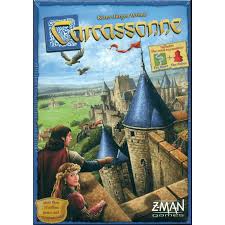
This is easily one of the oldest games to appear on this list. It has become a modern classic in the board game hobby. Its premise is pretty simple as players work together to create the landscape of the French region of Carcassonne during the medieval period complete with roads, towns, plains, and abbeys. It creates the perfect puzzle on your table top, and there is something satisfying placing that perfect piece that completes one of the features that you are working on. It is pretty easy to teach as well, and is one of the perfect gateway games to get more people into the hobby.
11. Fort

This is the first game to appear from one of my favorite publishers, Leder Games, and easily the least complicated. I first got this game to take with me on my travels so I could play more complicated games with my wife, and the first couple of plays were not as satisfying as I had hoped it would be. I enjoy the mechanics of building a deck by pulling kids from other people’s yards, and how this makes the cards move around the table, but in the end, it is a race to see who can build their fort the fastest. This was until I added the Cats and Dogs expansion. Now, I will not play the game without either cats or dogs or both of them. It changes the game quite a bit, and allows winning conditions to happen that don’t necessarily have to do with building the fort the fastest. If you are ever considering getting this game, make sure you have that expansion because it turns the game into one of my favorites out there.
10. The Crew: Deep Sea Mission

Just everybody who adds the Crew to their list, there is a little bit of cheating going on. When I created this list using Pub Meeple, I had put both versions of this game on this list because their game play is a little different. Both of them appeared on the top twenty games of the year, so I did not think that it was fair to include both. I combined them under one entry, and included the Mission Deep Sea as my favorite between the two. This could be the best cooperative game ever created. It combines the trick taking mechanic with limited communication to get rid of the quarterbacking problem that occurs with other cooperative games. I love playing both versions of this game, and you cannot go wrong with either one. When I do start playing, the group I play with is always saying one more round, and we keep on saying that until late in the evening. It is completely addictive, and I have not met a person who does not enjoy playing this game.
9. Root

This is the second game from Leder Games to appear on this list, and the first one that is designed by my favorite designer, Cole Wehrle. He is doing things with board games that no other designer is doing, and he creates new experiences with each game that makes the rumor of a new game from him an exciting prospect. The only problem is that his games are complicated, and there is a high learning curve needed in order to understand how to play his games. Root probably has the highest learning curve. The asymmetric design of this area control game creates amazing game play (I enjoy playing the Eyrie the most), but makes it really hard to teach others how to play the game. Still, if you can find a group to play this games with, it will easily become one of your all-time favorite games. I just wish I could get it to the table more often because I really like to play it.
8. Eldritch Horror
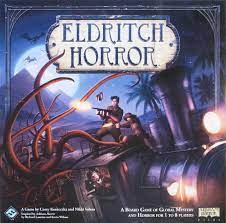
This is the last of the cooperative games that made the list, and though I do not believe it is the best cooperative game ever made, it is the one I enjoy playing the most. It is a little complicated, and the rules are a little fiddly. However, the engine that is used to run this game is amazing, and it creates a great storytelling adventure every time I have played it. Because of the complication of the game, there is no one who can run the whole game, so it takes away the quarterbacking problem encountered in other cooperative board games. The rolling of the dice that the players have to do for each encounter makes it feel like you are a part of the game every time. I think it plays best at three or four people, but I did enjoy the time I played it with eight people this year. It is a long game though, and because of this extensive game play, it does not get to the table as much as I would like it to. Still, it is an unforgettable experience every time that it does.
7. Everdell

Everdell will always hold a special place in my heart. It was the first modern board game that I got during the Covid pandemic that got me back into the hobby. It is also the first worker placer game I ever played even though I was familiar with the resource management aspect due to other games such as Catan and Warcraft 2. Still, this was the perfect game to take me through the pandemic. The artwork is beautiful. The game play is challenging enough, but also relaxing enough so it does not cause stress while playing it. My favorite aspect of the game has been its expansions. At this time, there are a total of five expansions, and I own two of them, Spirecrest, and New Leaf. Both of them have added new mechanics to the game, and have given a breath a fresh air to Everdell any time I feel like the game is getting stale. It is not just nostalgia that keeps this game this high on my list, but also the fact that it knows how to reinvent itself.
6. Imperial Assault

I love this game, but at this time, I have not found that group to play it on a regular basis. It is a great dungeon crawler with a fun campaign mode that tells a great story in the Star Wars universe. The rules are really simple, and it comes with a tutorial scenario that makes learning the game easy. I wish I could get it on the table more often because when I have played through the campaign I have had a lot of fun. Just like other games on this list, I will continue to push it on my friends in the hopes that one day I will be able to play through it again, and maybe even experience some of the other campaigns that are available for it. There is also a solo mode that can be played through an app that I might try this year if I cannot get others to join me in its experience.
5. Dungeons and Dragons
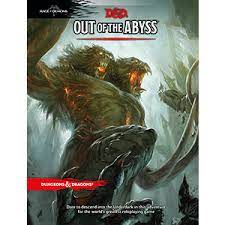
Some people might call this game to be a cheat because it is a role playing game and not a board game. I would argue that at any time you get around a table with a group of friends and follow a set of rules that allow you to enjoy each others’ company that you are experiencing exactly what makes this hobby great. This is easily the game I have played the most this year, and always with the same group of people. It is a weekly session that I always look forward to, and as of right now we are half way through the Out of the Abyss campaign. It also adds one of my favorite aspects of table top gaming, storytelling. I could not recommend this game enough for anybody that loves the act of storytelling. It is a great form of escapism, and there have been so many times over the course of this campaign I have laughed so hard. The character I am currently playing might be one of my favorites of all time, and it is for this reason that this game ranks so highly on this year’s list.
4. Unmatched

I had always been interested in playing this game just because of its premise, bring together great characters from many different IPs, and have them fight each other in one on one combat. There are so many different versions of this game, and each character has it own unique system that makes the possibilities endless. I have only played the Legends, and Cobble and Fog versions of this game, and I have already thought of great ways to bring them together to create a competitive season where they fight each other to create a final outcome between the best two that would determine who is the most powerful of the collection. It states that you can play up to four people with this game, but it really shines when playing two player. They also have released an app that allows you to connect with people from around the world so you can scratch that itch at any time and get in a game. I can’t wait to explore this game more this year, and see what the other available characters have to offer.
3. Oath: Chronicles of Empire and Exile
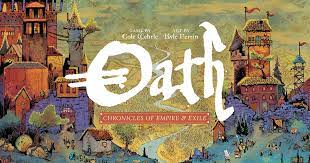
Leder Games and Cole Wehrle pop up on this list again. This is easily the most complicated game of theirs that I have played, and also the one that is the best at telling stories. It combines a unique game play with a way to tell the history of the board contained in the box. I got this game two years ago, and I have had a few games here and there along the way. It has created a fun history of the board so far, but I had been struggling to get it on the table to continue to create that history. But I persisted in trying to get a group of people together to play this game more often and at the end of the year, I was rewarded for my efforts. I finally found the group, and we have played on a more consistent basis. The complication of the rules do not seem a bother me anymore because we are playing it more regularly, and the history we are telling is becoming richer because we are able to remember what has happened in-between each session. The games can be as short as an hour, or as long as three, but we get faster each time we play. I am glad that I have stuck with it, and it has become a favorite of mine to play that I hope to continue to play for many years to come. I would love to see where that history takes me.
2. Isle of Skye
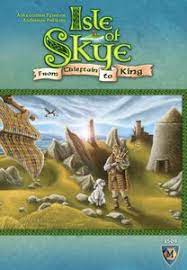
I recently took a trip to Scotland and I wanted to bring with me a game that I would enjoy that would highlight the place I was traveling to. I found the app for the island I would spending a lot of my time at, and I tried it out. It quickly became a game I returned to again and again. I played it so much that I ended up buying a physical copy of the game with all of the various expansions. I have not played any of the expansions yet because I continuously teach people how to play the base game. Everybody who has played has thoroughly enjoyed the game, and it is one of those games that works better with a higher player count. At the same time it has simultaneous game play that you never feel like it drags when it is not your turn. I can’t wait to introduce enough people to this game so I can start introducing the expansions and see how much they change the game. It might be the newness of this game to me, but I love playing this game, and will always jump on the chance to bring it to the table.
2023’s Best Game: Chinatown

I love this game. The teach only takes five minutes, and the rules are really simple. However the gameplay is deep, and the pure negotiation aspect of this game cannot be rivaled. I have introduced it to many people, and I will say that this game is not for everybody. It is competitive, and at times, it can get loud as people negotiate for spots on the map, but every time I have played it, people have laughed, pushed to be the best business person on the board, and have generally had fun. It does have some concerns about its design, and it makes me wonder what they were thinking with some of the artwork. With that in mind, there is a re-skinning of the game that is supposed to happen this year which should solve some of these concerns. Despite that, the gameplay of this game is a blast, and it is easily the one I have had the most fun with when it is brought to the table. It is for this reason that Chinatown is my favorite game of 2023.





 John Collings