
I cannot claim to have come from the Pacific Northwest, but I have visited enough times to believe that it has now become a part of me. The natural beauty that this part of the world has to offer is unlike any other place in the world that I have seen. There are majestic rivers filled with salmon, elk wandering through the woods, foxes hiding in the plains, hawks flying over the wetlands, and even bear hiding up in the mountains. The place is a paradise for anyone who loves the outdoors. If only there was a way that I could bring that beauty to my table in the form of a board game. Luckily, there is the 2022 Spiel de Jahres award winning game, Cascadia, the perfect way to be transported back to the Pacific Northwest
THEME

Building a wilderness in the Pacific Northwest and populating it with animals does not sound like it would sing very well as a board game. It would feel like just something that was plastered on a game with good mechanics, but I think it was the other way around. The five environments in this game as places that are easily spotted all over Oregon and Washington, and the care given to the animals and their placement also lends itself to the care of understanding these balanced ecosystems. The ways the bears, foxes, elk, and hawks interact with their environments work very similar to how they would in real life. The animal, salmon, is the one that does not always seem to work the way that they should. Granted they do create salmon runs, but this does not always make sense when they appear in plains or mountains. Every time I have played with new people, they have questioned this choice. It is the one small hiccup in an otherwise beautifully planned theme to this game, and it is quickly forgotten once game play begins.
Rating – 9
GAMEPLAY
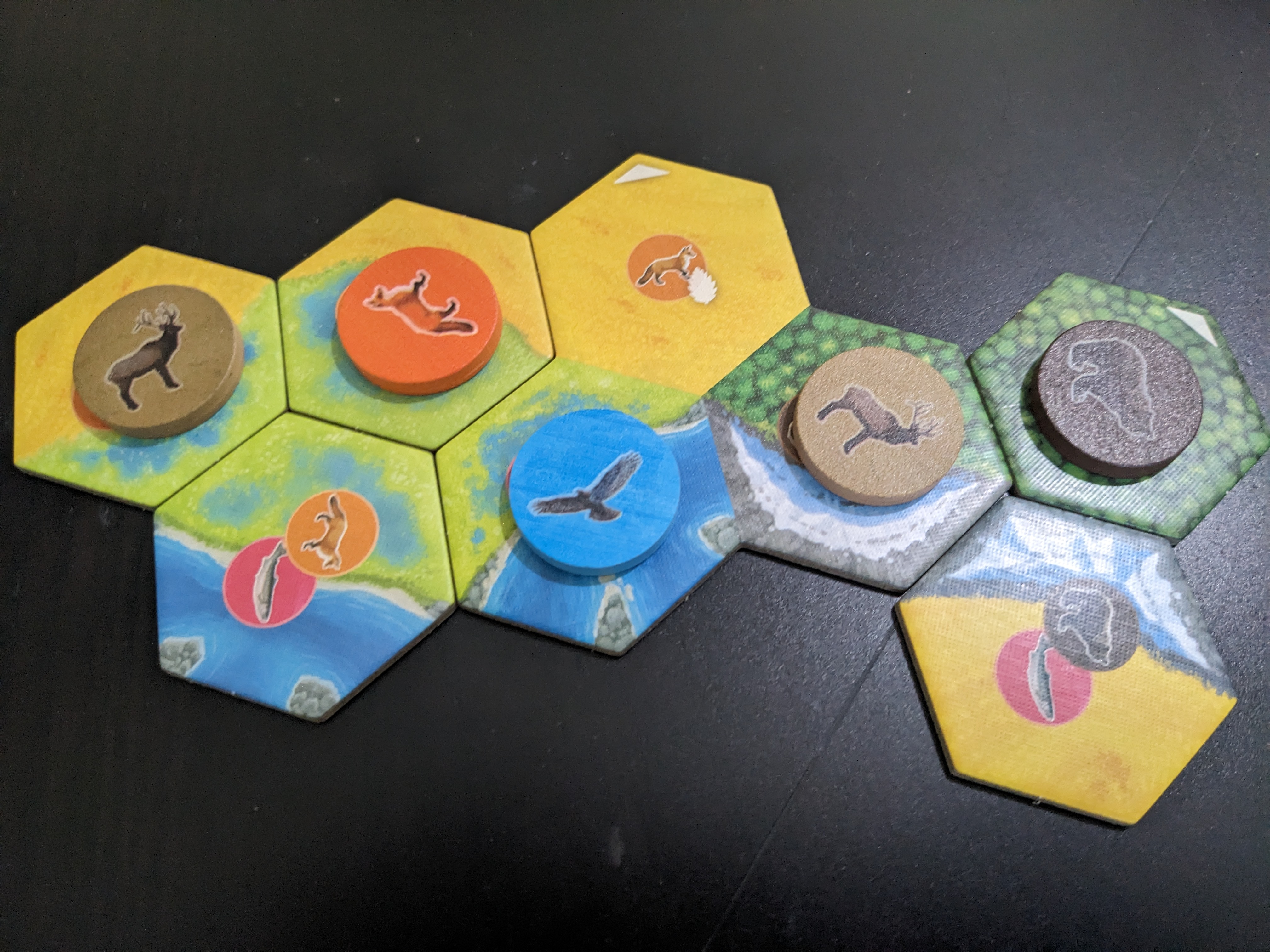
I love the teach of this game. It is really simple, giving people only four choices per turn. In front of them there are four environments paired up with a type of animal. They pick one of the pairs, and add it to their environment. In the course of the game, they are trying to create bigger environments because they will get points for each of the five types of environments based on how many hexagons they have connected. They will also try to place animals on those overall landscape in certain ways that will also collect a certain amount of points. If they place an animal on a single environment place, they earn a pinecone that also collects points, or the pinecones can be used for special powers during the pick phase that allows a player more options of what they can grab. That is basically all you need to know in order to play the game.
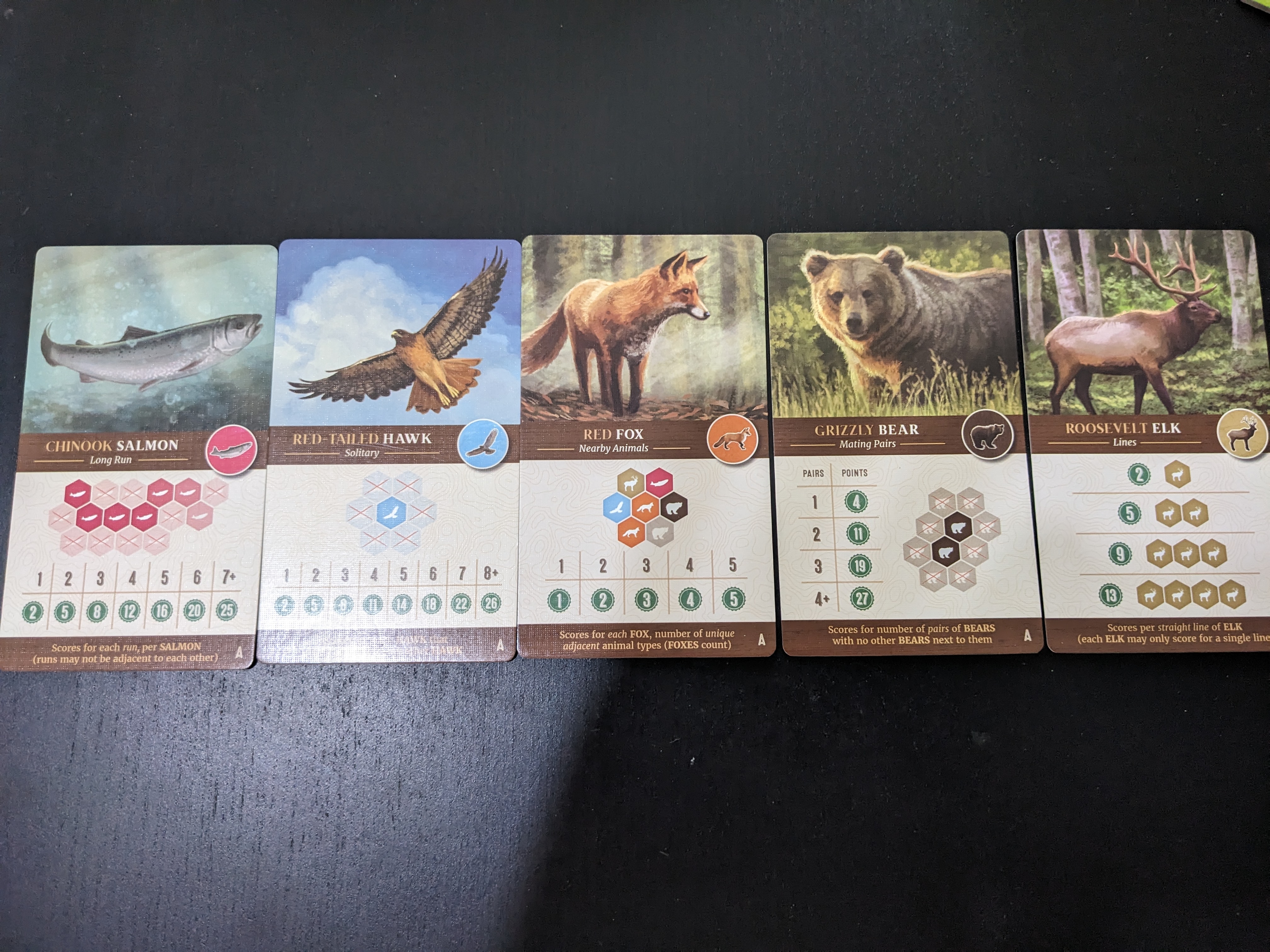
I know it sounds simple, but the choices become tough to make while playing the game. The strategy of what you want to do and when is more complicated then you think. The game also comes with four sets of cards that change how the animal placements score, allowing a fresh perspective on the game if you get tired of the base set. The game gets more complicated with each level, and I would even suspect that you could pick out cards at random to play the various animals if you wanted to mix it up even further. It just makes the replay-ability of the game nearly limitless, and it would take a lot to ever get tired of all this box has to offer.
Rating – 10
ARTWORK
It did not take long to find an artist to add a little flavor to this game. Randy Flynn, the game’s designer, did not even have to look outside of the Pacific Northwest. He was able to find the renowned artist who had created the artwork for games such as Viticulture, Calico, and Wingspan. Her ability to capture the true essence of nature shines in this game. The depictions of all of the animals is absolutely gorgeous, and adds to the gameplay. Also when you eventually build your landscape in front of you, it looks like you looking down at Central Oregon from a plane. There is a nice balance between the five landscapes so one of them does not dominate over another, and when you add the animals, the colors really pop. It does take a game or two to be able to distinguish between the mountains, and the water environments, but besides that, the game is beautiful.
Rating – 9
INTERACTIVITY
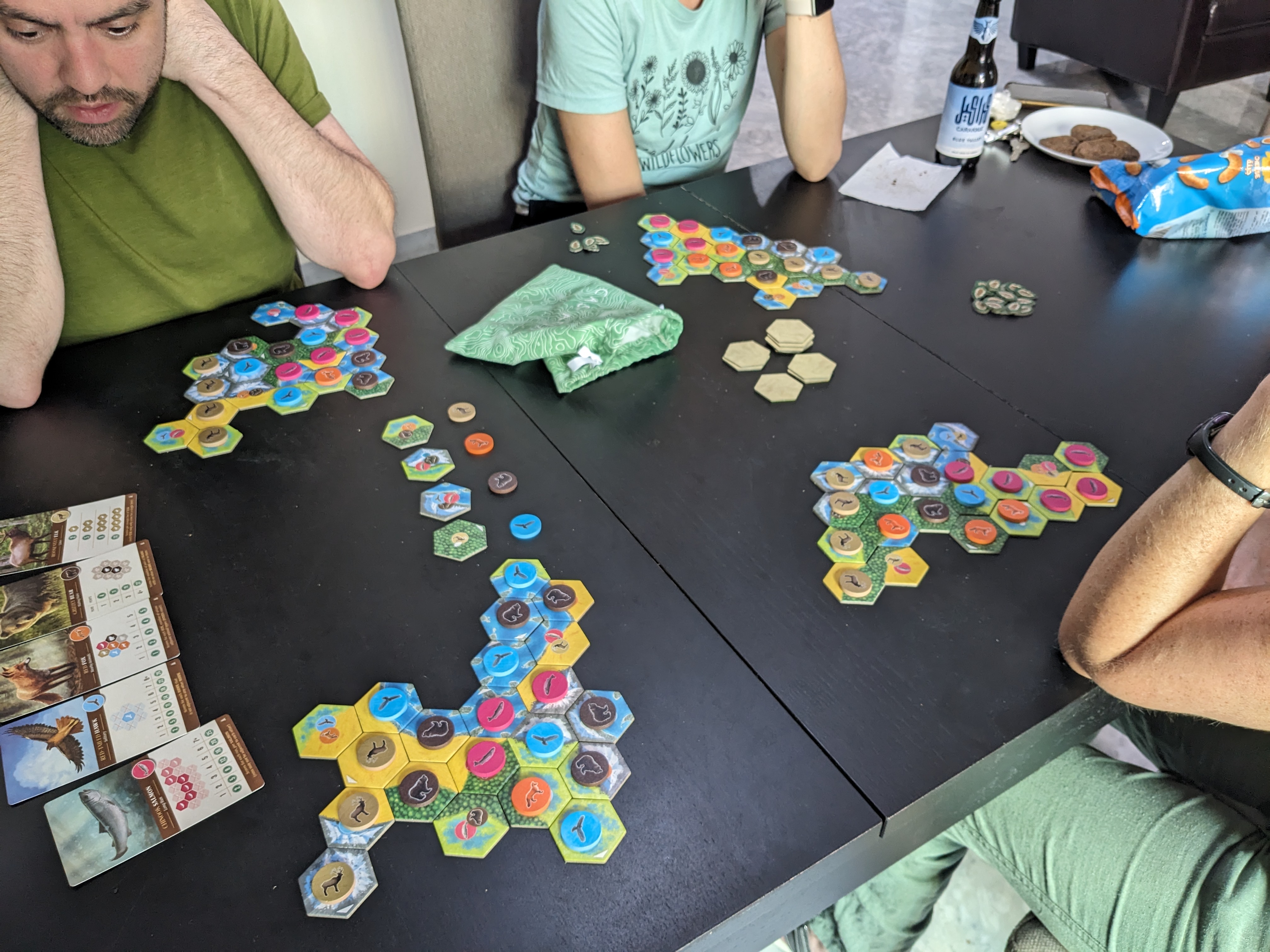
This game is what I refer to as a zen game. There is a central portion of the game play area where people make their selection, and whatever you chose is added to a grid that is set up in front of you. When playing the game, you spend more time making decisions that effect nobody more than you, and the pretty design that you create in front of you is created for your own benefit. There is not much interaction with the other players except when you pick your tile and animal. Sometimes people will pick the combination that you wanted because they also wanted the same thing, and sometimes you will pick something because it will prevent somebody else from doing something really spectacular. Otherwise, most of the game is spent designing your own little part of the Pacific Northwest, and rarely do you pay attention to what somebody else is doing. There is a little bit of interaction when you tally up all of the points at the end of the game, especially when looking at the different environments. Some people will gain bonuses for having the biggest of each of the environments, but that still does not have a huge impact on how you play the game. Overall, it is the perfect game for those that do not like to be mean to other people, and most of the interaction of the game is spent enjoying each others’ company.
Rating – 7
EXPANSIONS

The reason that many expansions exist is because people want to breathe life back into a game that have loved but have grown tired of. A good expansion won’t just add new cards or extra places at the table; instead, it will add new mechanics that reminds people why they fell in love with the game in the first place. Landmarks is this kind of expansion. There are now chunky landmark tokens that can add to your board that will allow you to collect a bonus card that gives you another challenge to go after. It complicates the game a little bit, but not enough to make it confusing to anyone who has become familiar with the gameplay already.
Even with this new mechanic, it also adds new animal cards, new tiles, and allows for up to six players to enjoy the game at one time. So it not only adds new mechanics, but it gives you that little bit of extra that you want in an expansion, and it is easily one of the best expansions ever introduced to a game.
Rating – 10
OVERALL
Cascadia has become a regular at my game table, and it is easy to bring new people in to enjoy it because the rules are easy to understand but the strategy is deeper than expected. It has a beautiful table presence, and the initial box has enough of differences in it to make it replay-able without it ever getting boring. Even if it does start to get a little boring, the Landmarks expansion is the perfect addition to bring back the joy that you had when you started playing it in the first place. It is easy to see why it won the Spiel de Jahres award, and it should be a part of everybody’s board game collection because it is a very fun game.
Rating – 4.5 out 5 stars









 John Collings